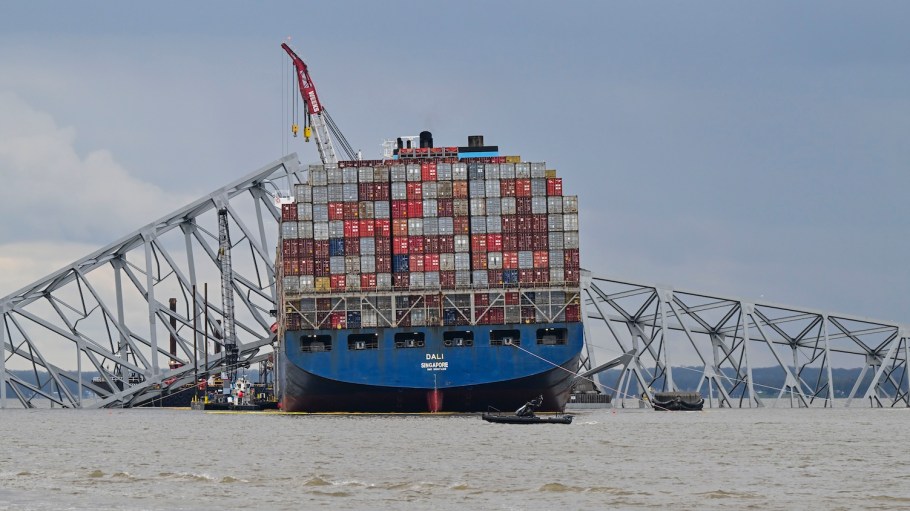
The Federal Maritime Commission (FMC) warned ocean carriers not to capitalize on the diversions of cargo away from the Port of Baltimore after the collapse of the Francis Scott Key Bridge.
In a Friday statement, the commission said demurrage and detention fees administered by carriers and port terminals must be “reasonable.” These charges both serve as late fees, with demurrage fees assessed on a shipper that takes longer than the time allowed to load or unload a cargo container at the port. Detention fees, on the other hand, occur when a shipper takes too long to return the empty container back to the port.
Related Stories
“Regulated entities are reminded that all statutes administered by the Federal Maritime Commission remain in effect,” the statement read. “Common carriers and marine terminal operators (MTOs) must continue to comply with all statutory and regulatory requirements governing their operations.”
These fees are designed to incentivize the quick movement of cargo, but have been a point of contention for shippers, their carriers and the port terminals where the cargo is stored since the height of the Covid-19 pandemic.
At the time, in which port congestion became more of a global concern amid surging cargo volumes, many shippers had criticized the carriers and terminals for taking advantage of the conditions at the gateways to charge excess fees.
Bed Bath & Beyond is one shipper that had filed suit against multiple carriers for charging excessive detention and demurrage fees, taking complaints to Mediterranean Shipping Company (MSC), Evergreen, Orient Overseas Container Line Limited (OOCL) and Yang Ming over the charges. And earlier this month, Samsung filed complaints against Cosco Shipping and OOCL on similar grounds.
For Bed Bath & Beyond, the fees are just one of multiple allegations levied against the liners, with the bankrupt home goods retailer also coming at the carriers for failing to meet minimum service requirements and coercing them into paying more for peak season surcharges.
Lawmakers in Washington had kept an eye on the relationships between shippers and carriers, leading to the expansion of the FMC’s power. Two years ago, President Joe Biden signed the Ocean Shipping Reform Act of 2022 (OSRA) into law, enabling the FMC to oversee and enforce these kinds of charges, while also shifting the burden of proof for the reasonableness of fees to ocean carriers instead of shippers.
Under OSRA, demurrage and detention bills must be transparent on how the fees were calculated and include contact information on how shippers can request to waive the fees.
The agency’s updated demurrage and detention rule goes into effect May 28, and is designed to deliver more clarity on who can be billed, the allowed timeframe for billing and the process for disputing the fees.
With the updated rule, invoices can only be issued to one of two parties: either the person who contracted for the ocean transportation or storage of cargo; or the consignee, defined as “the person to whom final delivery of the cargo is to be made.” Shippers will not be obligated to pay the demurrage and detention fees if carriers fail to properly bill under the new system.
The FMC’s Bureau of Enforcement, Investigations and Compliance (BEIC) has been targeting ocean carriers more often since 2022, most recently calling on MSC this month to pay a civil penalty of $63.3 million on allegations of “knowingly and willfully” violating the U.S. Shipping Act.
After a six-month investigation, MSC is being accused of charging excessive late fees on non-operating reefers, as well as billing third parties that were not originally part of the contractual agreement using a broad definition of “merchant” in its bills of lading.
In the wake of the Baltimore bridge collapse, the FMC notably sent out its warning to all carriers after the major container shipping firms invoked “force majeure” for their shippers. This is a legal clause that frees carriers like MSC, Maersk, CMA CGM, Hapag-Lloyd and Cosco Shipping from fulfilling certain prior contract obligations due to “acts of God” or unforeseen events out of their control.
With force majeure in place, carriers no longer must assist with the movement of cargo once it is diverted to an alternate port, thus leaving shippers with transportation and storage costs on land. This means importers become fully responsible for finding their own transportation to move the cargo to its end point before container late fees are charged.
However, unlike the demurrage and detention fees put in place, these charges are not expected to be waived by the carrier, and likely would not get the same treatment from the FMC.