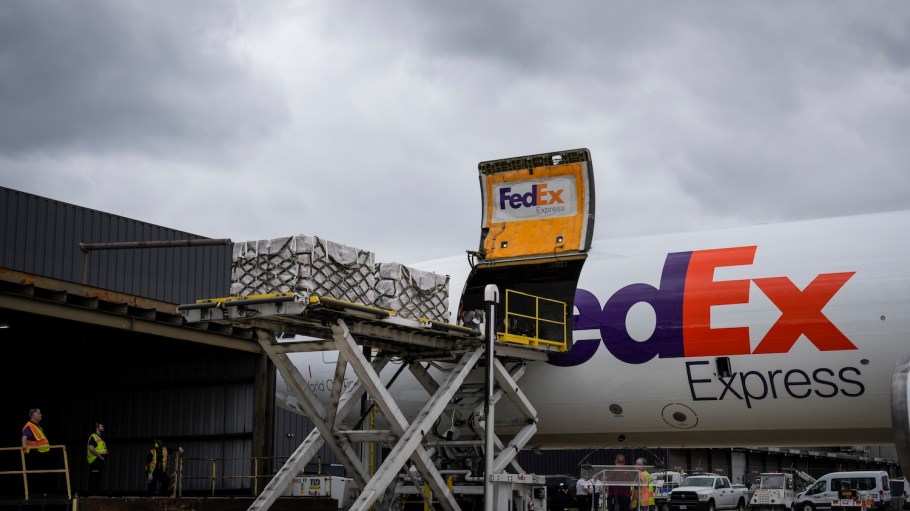
As FedEx maneuvers through a poor first quarter amid lingering weak volume demand worldwide and a consumer-driven shift to less profitable delivery services, demand for freight out of Asia remains one of the company’s top current strengths.
FedEx’s international economy service for packages saw a 22 percent revenue increase to $1.4 billion in the first quarter on a 35 percent volume jump—another indicator that FedEx is one of many air freight shipping companies contending with a flurry of low-value packages from overseas.
Related Stories
According to chief customer officer Brie Carere, FedEx assumes there will be “continued strength” in export volume demand out of Asia for the remainder of the fiscal year. Carere said the company has “very productive relationships” with Shein and Temu, without referring to either e-commerce giant by name but calling them the “big two.”
“We’ve also been very strategic in making sure that the relationship is mutually beneficial,” Carere said during a Thursday earnings call. “What do I mean by that? Obviously, these are two massive shippers coming out of the Asia market, and we have found small opportunities to work together relative to our overall Asia business. So, we’re really happy with the relationship.”
But Carere suggested that FedEx is not looking to be reliant on the business of either Temu or Shein.
“They are accretive, but we have really focused on the parts of their business where they do need speed and/or where we have available capacity coming into the United States,” Carere said. “They will not be a significant growth driver for us and we’re not planning on that.”
As FedEx’s contract with the U.S. Postal Service (USPS) ends on Sept. 29, the company continues to overhaul its global air network to increase network flexibility, cut costs and grow in more profitable markets.
As part of this “Tricolor” redesign, FedEx is expecting to reduce its daytime flight hours by approximately 60 percent, with most of that reduction taking place in October.
Despite the fewer flights, FedEx could benefit from more air freight volumes if an East and Gulf Coast port strike takes place starting Oct. 1.
“My experience is anytime you have some port disruption, it generally favors air freight so we’ll be watching that closely,” said chief financial officer John Dietrich.
The parcel delivery firm is still making every effort to cut spending in efforts to reach its $4 billion consolidation goal by the end of fiscal 2025.
During the earnings call, Raj Subramaniam, president and CEO of FedEx, said the logistics company has reduced pickup and delivery costs roughly 10 percent in markets where it has fully rolled out its Network 2.0 delivery network consolidation strategy. Subramaniam said the service levels in these markets are meeting or exceeding FedEx’s network average.
Aiding the consolidation effort, FedEx is leveraging machine learning to dynamically route packages in real time with the recently launched Shipment Eligibility Orchestrator, Subramaniam said. This tool can direct time-sensitive shipments or high-priority health care products to designated couriers trained to handle them.
Alongside the orchestrator, FedEx piloted a new “Hold-to-Match” solution aimed at cutting last-mile delivery costs. The carrier holds ground packages slated for early delivery if another package is going to the same destination the following day, according to Subramaniam. With the solution, FedEx says it is helping lower the company’s cost per package.
The Memphis, Tenn.-based logistics giant is also cutting down on the total facilities in its freight network as it looks elsewhere keep down costs.
FedEx Freight, the less-than-truckload (LTL) unit that saw revenue decline 2 percent to $2.3 billion, closed seven of its roughly 360 terminals during the first quarter. The cuts are on top of the closure of 29 service centers in the year prior, and come as the unit remains under review for the remainder of the 2024 calendar year.
Dietrich said during the call that FedEx is “on track” to complete the assessment of the freight unit and its role in the wider business.
While there is uncertainty of whether FedEx will try to retain FedEx Freight as part of the offering beyond the strategic review, Dietrich noted that the company is still reinvesting in its growth.
“With regard to freight, it’s absolutely part of our capital investment program and our plans,” said Dietrich. “We’re looking to invest in those areas of the business that’s going to provide the best return on invested capital and freight is certainly one of them. Stay tuned in terms of the details on that.”
Already the largest LTL business by revenue in the U.S., FedEx Freight has been under more of a microscope since the debut of the strategic revenue. FedEx officially changed its financial reporting earlier this month, making the FedEx Freight division one of two reportable business segments at the company.