Money is flowing into more electric trucking companies as the industry still grapples with a years-long slump in freight demand and slow electric vehicle (EV) adoption.
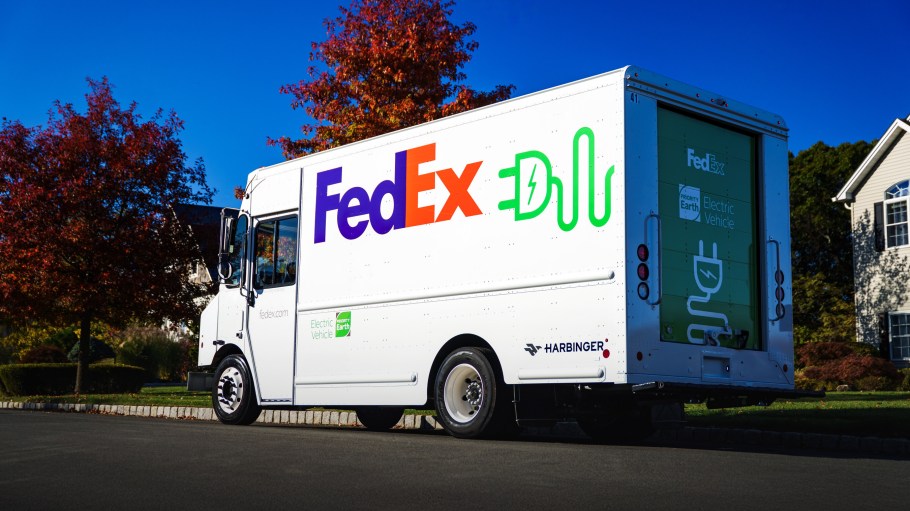
FedEx is co-leading a $160 million funding round into medium-duty electric and hybrid vehicle manufacturer Harbinger, placing an initial order for 53 of its EVs.
At the same time, Swedish-based autonomous trucking technology company Einride is preparing to go public via a SPAC at a valuation of $1.8 billion, following in the footsteps of autonomous trucking company Kodiak AI just two months ago.
Related Stories
For FedEx, the investment reflects the shipping giant’s ongoing network transformation and resulting need for larger-capacity pickup and delivery vehicles as it continues to optimize its network and routes.
“Any vehicle that holds up to our rigorous on-road testing and offers state-of-the-art safety features with lower total cost of ownership is win-win for drivers and for our business,” said Paul Melander, senior vice president of safety and transportation at FedEx in a statement. “As we work toward a goal to electrify the entire FedEx pickup and delivery fleet by 2040, this trifecta of performance, price and operational resilience is what we need to be able to continue to scale.”
Harbinger designs and manufactures stripped chassis, which consist of a vehicle’s foundation and major systems without the outer shell, at its headquarters and production plant in Garden Grove in Orange County, Calif. These chassis are then sent to other delivery truck manufacturers to complete the build of the truck.
Since it started manufacturing in January, Harbinger has made about 400 vehicles. The company expects to produce about 3,000 vehicles next year.
The production is escalating even as the freight market has been contracting, with more trucking capacity exiting the industry in 2025. Sales of medium-duty trucks were down roughly 10 percent through September of this year compared with the same period last year, according to data from research firms FTR Transportation Intelligence and Omdia.
In particular, the commercial electric truck space hasn’t been fruitful. Just last month, General Motors ended production of its BrightDrop electric vans after four years. FedEx was a customer. And while Rivian has supplied roughly 25,000 electric vans to Amazon, the company has yet to find another major customer.
Nevertheless, those involved with the financing see room for growth. The Technology Impact Fund of asset management firm Capricorn Investment Group and recreational vehicle (RV) manufacturer Thor Industries co-led the financing round.
Dipender Saluja, managing partner of Capricorn’s tech fund, said FedEx’s participation signals a demand for innovation in the medium-duty truck sector and for an electric model that helps advance business and sustainability goals at the same time.
“Over the last two decades, medium-duty truck fleets have generally deployed small volumes of demonstration electric trucks. The industry is now ready to move to mass adoption, with Harbinger leading that scale up.”
The funding for Harbinger comes as those looking to power self-driving technology for electric trucks see more market opportunity.
To join the public markets, Einride is expected to raise $219 million through its SPAC merger with Legato Merger Corp. III. That merger is expected to be completed in the first half of 2026, where the company would then trade on the New York Stock Exchange.
The autonomous tech company, which has a U.S. headquarters in Austin, Texas, is seeking up to $100 million in additional capital from institutional investors. The firm operates a current fleet of roughly 200 electric vehicles, and more than 25 enterprise customers, with one being U.A.E.-based port operator giant DP World.
Einride provides freight services for both driver-operated electric trucks, like those manufactured by Harbinger, as well as heavy-duty autonomous EV trucks. Its technology can be licensed to third parties, including both its operational planning AI software and its proprietary autonomous driving system.
According to Einride, it has completed more than 1,700 driverless hours in contracted customer operations, driven over 11 million electric miles and completed more than 350,000 shipments.
On the same day Einride unveiled its merger, Kodiak AI (formerly Kodiak Robotics) gave an update on its own technology, indicating that has deployed the Kodiak Driver platform in 10 fully driverless trucks. The company said it was on track to reach its initial commitment of providing 100 driverless trucks to Atlas Energy Solutions.
Kodiak Driver uses proprietary hardware called SensorPods to leverage light detection and ranging (LiDAR) and cameras, providing the AI-powered “driver” a full understanding of the road and environment surrounding the vehicle.