While driverless trucks might not be a commonplace sight on America’s highways in 2020, the industry continues to test and evolve automated trucking tech, and it seems it’s just a matter of time before unmanned semis are coming down the road.
“Despite numerous headlines declaring the arrival of driverless, self-driving, or robot vehicles, very little, if any, driver-free commercial usage is under way beyond closed-course operations in the United States,” Susan Beardslee, freight transportation and logistics principal analyst at ABI Research, said in a new whitepaper.
ABI’s research noted that Alphabet’s Waymo has been in testing mode since 2016 and its latest vehicles are still manually operated by trained drivers. Daimler Trucks’ 2020 Cascadia with Detroit Connect 5.0 will offer Society of Automotive Engineers Level 2 partial automation features, initially with automated braking, steering and forward lateral control, ABI said, adding that Daimler just delivered two eCascadias for customer testing.
Related Stories
Walmart, in partnership with Gatik AI, has been testing “self-driving” Ford Transit vans that are planned for middle-mile deliveries. The vans will also be operated by drivers in the pilot.
“Despite the successful primarily manned testing and early revenue operations, there are no known regulatory approvals or fully autonomous methods to address the first and last mile for heavy-duty big rigs through challenging urban and suburban locations,” Beardslee said.
Successful revenue-generating routes will remain highway-only for the foreseeable future, with ABI Research not forecasting a material level of SAE Level 4 shipments prior to 2023 in North America.
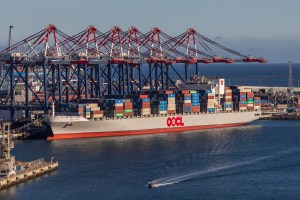
Many other opportunities, including closed-course uses such as airports, ports, mines, oil and gas operations, universities and corporate campuses, are early movers, with growing opportunities to evolve the role of “drivers” in vehicles equipped with significant AI.
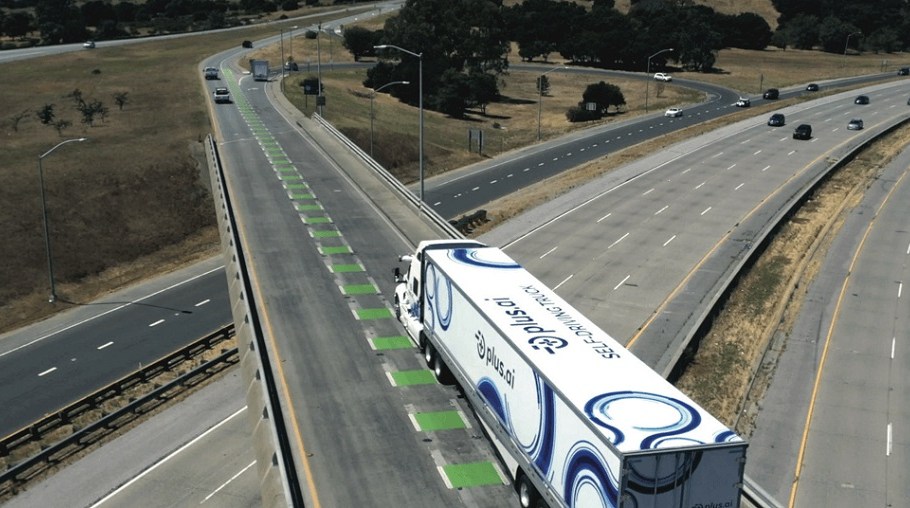
Separately, Plus.ai, an artificial intelligence startup in Cupertino, Calif., has engineered an autonomous driving system for commercial freight trucks. This month, it made the world’s first cross-country trip of its kind to deliver butter to a small town in Pennsylvania, according to an article in Popular Mechanics.
It took the Plus.ai truck three days to complete the journey, during which it made a few stops, but never because it couldn’t handle the driving, the company said. A safety driver aboard the vehicle monitored the journey but did not take over and intervene for the truck other than during fuel stops and federally mandated breaks. The trip yielded zero “disengagements,” where the truck lost control, the company said.
The company’s data fusion system creates a field of front detection that’s 1,600 meters deep, allowing the truck to see far ahead. At the same time, Plus.ai achieves a wide field of view to help the vehicle adapt to new road shapes and slopes.
UPS Ventures, the venture capital arm of the delivery company, in August announced a minority stake in self-driving trucking startup TuSimple, a unicorn that’s raised more than $1 billion in funding. The venture capital organization said its goal with the investments is to test the capabilities and limitations offered by a fully autonomous delivery fleet.
The investment is evidence of the company’s desire to own a controlling interest in the future of driverless trucking, UPS chief strategy and transformation officer Scott Price said.
“UPS is committed to developing and deploying technologies that enable us to operate our global logistics network more efficiently,” Price said. “While fully autonomous, driverless vehicles still have development and regulatory work ahead, we are excited by the advances in braking and other technologies that companies like TuSimple are mastering.”