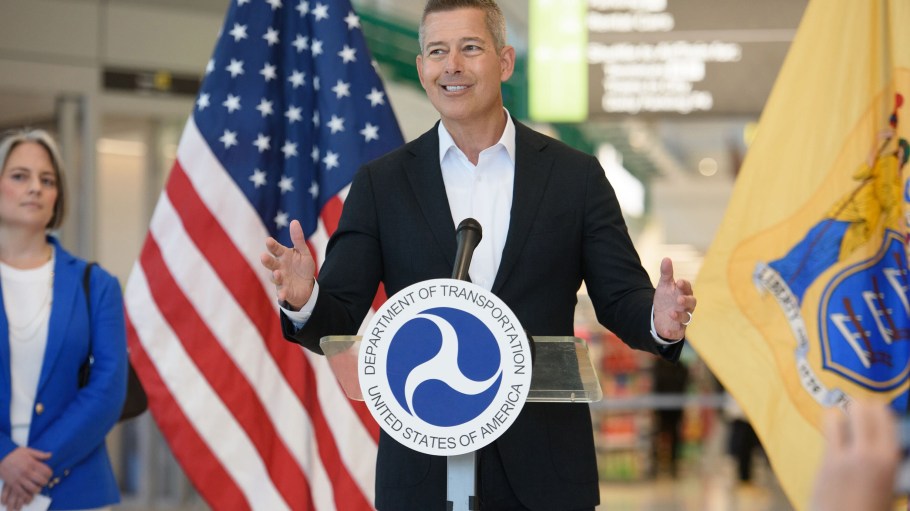
Transportation Secretary Sean Duffy announced trucking reform that aims to expand parking for trucks across the U.S., remove “one-size-fits-all” regulatory measures and crack down on cargo theft.
The reforms are actions taken in response to an executive order signed by President Donald Trump in late April, in which he called for more “common sense” rules in trucking, including the enforcement of English language proficiency among drivers and a rollback in regulations that the administration argues are currently undermining trucker safety.
Related Stories
“Truckers keep America running. While the country sleeps, truckers grind through the night to help keep shelves stocked, families fed, and businesses humming,” said Duffy in a statement. “It’s a job that requires grit and dedication. But for too long Washington, D.C. has made work harder for truckers. That ends today.”
As part of the package, the Department of Transportation (DOT) will deliver more than $275 million in grant funding to expand parking access for truck drivers nationwide.
The grant includes $180 million for Florida to add 917 new truck parking spaces along the Interstate 4 corridor that runs in the center of the state through Volusia, Seminole and Osceola Counties.
The remaining $95 million will be available nationwide through discretionary grant rounds opening later this year.
According to the DOT, 40 percent of truckers spend over an hour a day searching for parking, which could cost the U.S. economy billions because of wasted time. A lack of parking could also pose safety issues if truckers are parking in harms’ way, such as on a highway shoulder.
In line with the grants, the Federal Motor Carrier Safety Administration (FMCSA) withdrew a proposed mandate for speed-limiting devices on heavy trucks, arguing that a national cap could create dangerous speed differentials when trucks must travel well below surrounding traffic.
The agency also proposed deleting more 1,800 words from its regulations—largely duplicate definitions and record-keeping rules—which generated nearly 25,000 “unnecessary” violations in 2024, the department says.
As it rolls back mandates, the DOT is renewing its focus on unlawful double brokering—a scam where a bad actor poses as a legitimate freight broker or carrier who then offers to arrange shipping services for a customer at a discounted rate, before stealing the cargo once they access the haul.
The reform package also includes plans to modernize the FMCSA’s online resources for drivers, including a national consumer complaint database, to make them more user- and mobile-friendly.
Two of the largest trucking lobbies in the U.S. overwhelmingly welcomed the reform, with their statements included in the official Department of Transportation press release.
“A safe and strong trucking industry is critical to America’s economic growth and security, and data-driven measures like these that reduce regulatory burdens are important steps toward that end,” said Chris Spear, president and CEO of the American Trucking Associations (ATA). “We look forward to continued partnership with the Administration to advance policies that strengthen America’s supply chain and bolster our essential workforce.”
Todd Spencer, president and CEO of the 150,000-trucker Owner-Operator Independent Drivers Association (OOIDA), said the moves improve truckers’ daily lives and enhance safety.
“For years, truckers have urged Washington to address the severe shortage of truck parking, eliminate the dangers posed by a national speed limiter mandate, and give drivers greater control over their hours-of-service,” Spencer said. “We thank President Trump and Secretary Duffy for listening to the men and women behind the wheel who keep America’s economy moving.”
Issues like a shortage of truck parking and the use of speed-limiting devices have been among major concerns of truck drivers in recent years.
Many drivers, as well as lobbying groups like the ATA and OOIDA, were optimistic when Trump won the 2024 presidential election in major part because of previous legislation supported by his then-running mate, J.D. Vance, during his time in the U.S. Senate.
Vice President Vance was a co-sponsor of the Truck Parking Improvement Act and the DRIVE Act, both bills that were introduced in Congress in 2023 and appear to be precursors to the initiatives in the package rolled out by Duffy.
The Truck Parking Improvement Act would authorize $755 million in competitive grant funding to expand commercial truck parking capacity across the U.S.
The DRIVE Act would prohibit the FMCSA from issuing any rule or regulation to require vehicles weighing more than 26,000 pounds and are operating in interstate commerce to be equipped with a speed-limiting device.
On Friday, Secretary Duffy appeared on FreightWaves’ What the Truck? podcast, where he first broke the trucking reform announcement.
During the interview, Duffy also revealed that the Transportation Department is launching a nationwide audit of non-domiciled Commercial Driver’s License (CDL) holders, as the administration aims to clamp down on unqualified drivers.
Non-domiciled CDLs are issued by a state to a person who is not a resident of that state (or the U.S.) and typically applies to individuals from foreign countries.