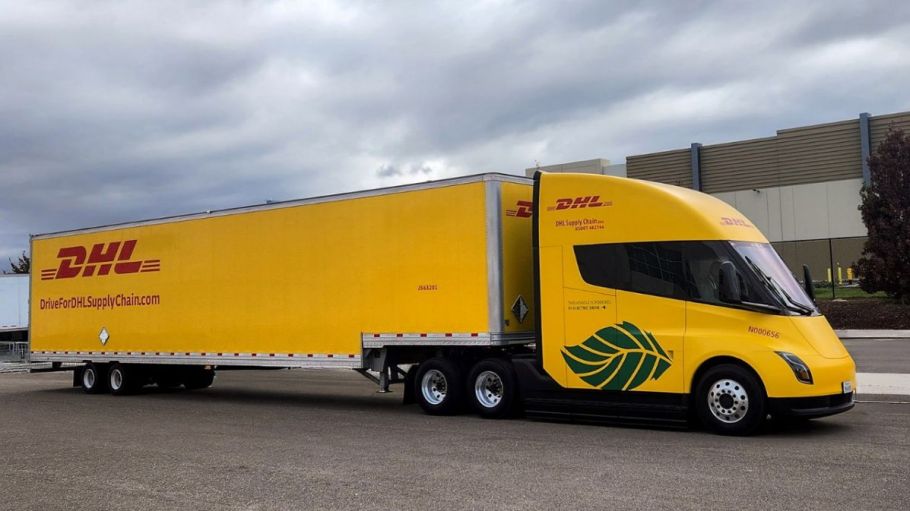
DHL Supply Chain unveiled its first Tesla Semi truck earlier this month, a year after completing its first successful pilot, as the contract logistics provider continues to scale its North American electric vehicle fleet.
The company says it now operates more than 150 heavy-duty Class 8 electric vehicles across the continent, plans to add more semis in 2026 as Tesla begins its volume production.
Stephan Schablinski, vice president of GoGreen North America at DHL Supply Chain, told Transport Topics that more deliveries are expected to begin from next year’s second half onward. Schablinski said DHL wants to operate the Semi tractors in other states beyond California, including Ohio and Pennsylvania.
Related Stories
According to the company, 30 percent of DHL’s medium- and heavy-duty trucking fleet is expected to be battery-electric or powered by another zero-emissions technology by 2030.
The Tesla Semi pilot took place in Livermore, Calif. over two weeks in October 2026, where the all-electric truck covered over 3,000 miles of regular routes. The trial included one long haul of 390 miles, and was fully loaded with a gross combined weight of 75,000 pounds.
“Our pilot of the Tesla Semi exceeded expectations, proving its ability to efficiently haul a typical DHL freight over long distances on a single charge,” said Jim Monkmeyer, president of transportation, DHL Supply Chain North America, in a statement. “Integrating the Tesla Semi into our fleet is an important step toward achieving our decarbonization goals and delivering more sustainable solutions for our customers.”
According to Tesla, the Semi can travel up to 500 miles on a single charge, and can recover up to 70 percent of range in 30 minutes. Class 8 trucks typically have a range of less than 250 miles on one charge.
Dan Priestley, director of Semi at Tesla, said the DHL partnership will “help us make the product even better for future global markets.” Tesla says the start of serial production of the Semi remains on schedule for late 2025 with a ramp up to capacity in 2026.
The truck currently travels approximately 100 miles per day in central California, DHL says, and requires charging about once per week. Additionally, it is projected to reduce greenhouse gas emissions by 50 metric tons annually.
With the Tesla Semi within its fleet, DHL can further accelerate its transition to net zero-emission logistics, a call the logistics giant aims to reach by 2050. On a shorter-term basis, the company is also pushing to reduce absolute carbon dioxide equivalent emissions from 40 million metric tons to 29 million in 2030 to stay aligned with Science Based Targets initiative (SBTi) requirements.
Tesla is one of multiple companies that DHL has worked with for electric trucking adoption since 2020, with the company teaming up with BYD, Volvo Trucks, Daimler Truck, Scania and now-defunct Nikola on separate deployments. DHL Supply Chain also owns and operates more than 50 Orange EV yard trucks that are deployed at 30 sites across the country to move trailers and shipping containers.
The Livermore facility does not have any other battery-electric trucks other than the Tesla Semi, according to Schablinski.
Beyond the long haul, EVs have been a priority for DHL’s wider last-mile delivery ambitions.
As of October, DHL said it has 39,000 total EVs worldwide in pickup and delivery services, representing more than 41 percent of pickup and delivery vehicles. The company aims to increase this share to 66 percent in 2030.
Decarbonization at the logistics giant also extends to its air cargo operation, which accounts for 68 percent of DHL’s emissions. DHL has already used 188,000 metric tons of sustainable aviation fuel (SAF) between 2020 and 2024 and will double that figure this year. SAF now makes up 3.5 percent of the company’s total jet fuel mix, with the firm aiming to escalate this number to 30 percent by 2030.
DHL’s sustainability push recently pushed into ocean freight. This month, DHL partnered with ocean carrier CMA CGM to decarbonize container shipping, with the logistics companies committing to use 8,900 metric tons of a lower-carbon biofuel for ocean shipments.
Under that initiative, DHL and CMA CGM expect to slash roughly 25,000 metric tons of greenhouse gas (GHG) emissions for ocean freight shipped through DHL’s GoGreen Plus and CMA CGM’s ACT+ programs.
Those programs are designed to let customers pay a premium price to select more sustainable fuel options for their shipments.