The CEOs of five global shipping lines issued a joint declaration at COP28 in Dubai Friday. They want a firm cutoff date when the industry must stop building new ships powered only by fossil fuels and urged stronger climate action by the International Maritime Organization (IMO).
The executives also want the United Nations-established agency to set new regulatory conditions to accelerate the shipping industry’s transition to green fuels.
The execs include A.P. Moller-Maersk CEO Vincent Clerc, CMA CGM Group chairman and CEO Rodolphe Saadé, Hapag-Lloyd CEO Rolf Habben Jansen, Mediterranean Shipping Company (MSC) CEO Soren Toft and Wallenius Wilhelmsen president and CEO Lasse Kristoffersen.
Related Stories
Their joint declaration seeks the establishment of four regulatory cornerstones that they call “indispensable” elements of a globally viable legal framework for greenhouse gas (GHG) reduction.
First, the companies would work with the IMO to create an end date for when they’d have to finish building vessels that run on fossil fuels and develop a clear “GHG Intensity Standard” timeline to encourage investment confidence, both for new ships and the fuel supply infrastructure needed to accelerate the energy transition.
The co-signatories also support the adoption of a new GHG pricing mechanism to make green fuels like methanol or ammonia competitive with traditional fuel during the transition phase when both are used. The pricing mechanism must also feature an increasing regulatory incentive to achieve deeper emissions reductions, the CEOs said. Any revenue generated by the mechanism should go to an R&D fund and to investments in developing countries to “ensure a just transition that leaves no one behind.”
Additionally, the shipping firms aim to accelerate the transition to green fuels through “vessel pooling.” This means monitoring and assessing the emissions performance of a group of vessels instead of just individual ships. This will help funnel investments to efforts that make the biggest GHG emissions-reducing impact.
Lastly, the co-signatories want to incorporate a “well-to-wake” lifecycle methodology within any established regulatory framework. This approach assesses GHG emissions from the fuel production process to the end-use by a ship.
“A.P. Moller-Maersk wants to accelerate the green transition in shipping and logistics and a crucial next step is to introduce regulatory conditions which ensure that we create the most greenhouse gas emission reductions per invested dollar,” said Clerc. “This includes an efficient pricing mechanism to close the gap between fossil and green fuels and ensuring that the green choice is easier to make for our customers and consumers globally.
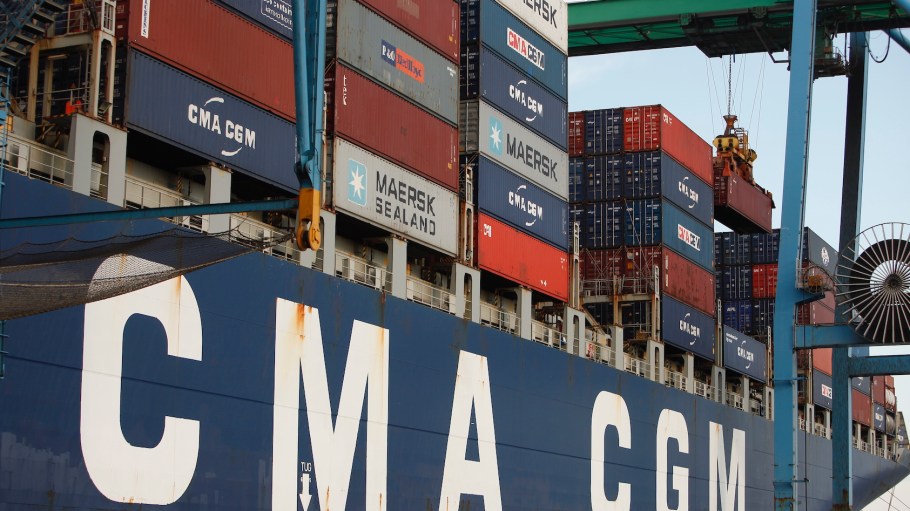
Saadé said the new commitment is fully in line with CMA CGM’s ambition to be net zero by 2050, with the company already investing close to $15 billion in decarbonization work. The company expects to have almost 120 vessels capable of being powered by decarbonized fuels by 2028.
“Our Group has also launched several large industrial partnerships to diversify our sourcing with even more decarbonized fuels,” Saadé said. “In 2023, the CMA CGM Group will reduce its CO2 emissions by around 1 million tons.”
Hapag-Lloyd’s Habben Jansen also said the commitments aligned with the container shipping company’s goal of achieving a net-zero carbon fleet by 2045.
“Our collective responsibility for a sustainable future and clean practices is paramount,” said Habben Jansen. “We believe that a regulatory framework and clear targets are crucial to accelerating the introduction of alternative fuels and reducing our carbon footprint.”
MSC’s fleet renewal strategy to assist in the decarbonization effort includes 100 dual-fuel vessels, according to Toft. Like CMA CGM, MSC is targeting net zero by 2050.
“The support of governments across the world will be an essential element to reach our common goal and among those efforts we want to see an end to delivery of ships that can only run on fossil fuels,” said Toft. “Without the full support from other stakeholders, particularly energy providers, it will be extremely difficult to meet those objectives—no one can do this alone. Today it feels like we are one step closer in this regard, but concrete supply of alternative fuels and globally recognized GHG pricing are essential to achieve our goals.”
Wallenius Wilhelmsen, the lone roll-on/roll-off (RoRo) shipping and vehicle logistics company of the five firms represented, recently ordered four methanol-capable, dual-fuel vessels to be delivered in 2026.
Kristoffersen shared the same sentiment as Habben Jansen, calling on the IMO to develop a global regulatory framework to reach net-zero goals well before the current timeframe.