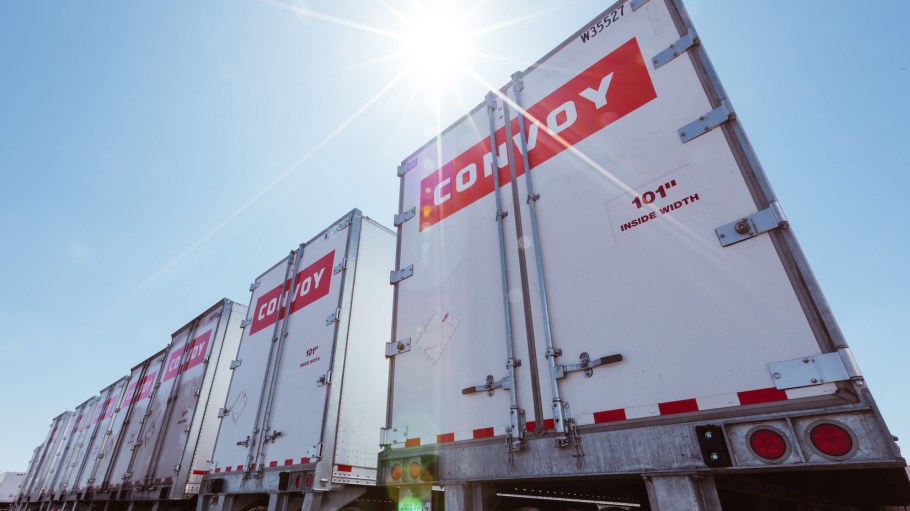
A “perfect storm” including 2023’s freight recession and an industrywide pullback in venture funding has led digital trucking brokerage Convoy to turn off the lights, CEO Dan Lewis told employees Thursday morning.
The company will close down its core business operations, which served as a marketplace to match shippers with trucking carriers, the co-founder told employees in an internal memo confirmed by Convoy.
An undetermined number of Convoy’s more than 500 employees will no longer work for the company after Thursday, with a small group staying on to handle the wind-down and navigate potential strategic options under evaluation
Related Stories
Convoy’s downfall comes just 18 months after the company raised $260 million at a $3.8 billion valuation. But since then, the Seattle-headquartered freight tech firm had four rounds of layoffs, closed an office in Atlanta, and saw co-founder Grant Goodale step away from his day-to-day role as chief experience officer.
In August, reports surfaced that the platform was weighing strategic alternatives, including a potential sale. Lewis told employees that Convoy spent over four months “exhausting all viable strategic options for the business,” but no buyers or investors stepped up.
“However, none of the options ultimately materialized into anything sufficient to keep the company going in its then current form,” Lewis told staff.
Convoy doesn’t disclose revenue numbers, but sales slumped as a result of the downturn in freight rates and trucking demand. Trucking spot rates dipped to their lowest points since June 2020, according to data from DAT Freight & Analytics, with line-haul van rates declining 14.8 percent year-over-year to $1.56 per mile. Reefer rates and flat rates are down 11.1 percent and 13.6 percent, respectively, to $1.92 per mile and $1.85 per mile.
Amid the declines, shippers can find more attractive freight rates with larger asset-based carriers, taking away business from Convoy, which works with smaller trucking companies. Convoy made its money via brokerage fees, keeping a percentage of each transaction made through its marketplace.
Convoy’s app automates the pairing of shipments with carriers—effectively saving money for shippers, while reducing the legwork and hassle for carriers in finding loads to transport. Truck drivers who downloaded Convoy’s app could find work without going through brokers who typically use emails and phone calls.
The factors that played into Convoy’s demise also played into changes occurring at another digital freight brokerage, Flexport. A data sharing partner of Convoy since 2021, Flexport laid off 20 percent of its employees after founder Ryan Petersen returned as the company CEO. Like Convoy, Flexport had meaningful revenue declines and couldn’t find a way to profit amid the collapsing freight market that not only experienced dips in demand, but an influx of capacity.
While Flexport is not going out of business, it is refocusing on its core freight booking business as it looks to cut costs across the board.
For Convoy, lenders are still negotiating with potential buyers of its technology stack, according to a report from The Information. Lewis reportedly told the company’s investors, which include high-profile names including Bill Gates and Jeff Bezos, that they won’t get any money back even if Convoy’s tech finds a buyer.
In the memo, Lewis wrote that the company ultimately needed outside funding to get into the financial position required to withstand “the increasing pressures of the industry.”
“Amidst these freight and financial conditions, M&A activity has shrunk substantially and most of logical strategic acquirers of Convoy are also suffering from the freight market collapse, making the deal doing that much harder,” he wrote.
Both funding and M&As in logistics technology have seen declines this year amid the overall uncertainty across the sector. According to Pitchbook, venture capital funding into the sector year-to-date totaled $4.3 billion as of Sept. 15, down 69 percent from the $13.9 billion in capital deployed through Sept. 15, 2022.
M&A volume across transportation and logistics in that time frame is down 29 percent to 165 deals made, according to data from S&P Capital IQ, from 233 in the year-to-date prior.
Ironically, on the same day Convoy ceased operations, another tech-driven freight brokerage, Transfix, closed a $40 million Series F funding round led by New Enterprise Associates (NEA) and G Squared, with participation from Canvas.
Transfix, a direct competitor of Convoy, initially was going to go public last year, but the company opted out of the decision due to the ongoing market conditions.
The company said new capital further strengthens its financial position and supports a path to profitability.