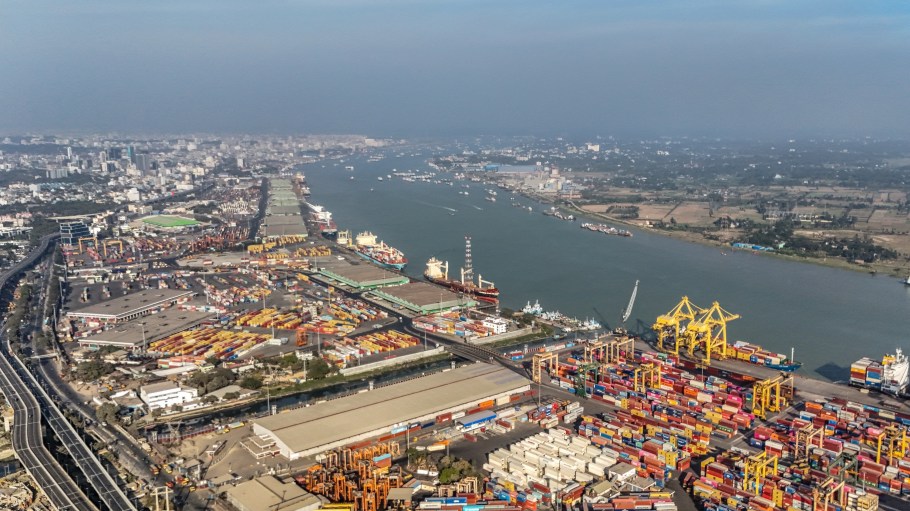
Cargo movement in and out of Bangladesh’s largest seaport came to a standstill Tuesday after dockworkers and other port employees intensified strike action that halted operations at the gateway.
The action stems from their disapproval of the Chattogram Port Authority’s (CPA) looming lease of the New Mooring Container Terminal (NCT) to DP World. Under the advisement of the Bangladesh interim government, the CPA is currently negotiating a 15-year contract where the U.A.E.-based terminal operator giant would manage the gateway.
Related Stories
Dockworkers and businesses associations like the Bangladesh Garment Manufacturers and Exporters Association (BGMEA) have long been opposed to the government’s decision to lease multiple of the country’s largest port terminals to foreign operators, as they are considered strategic national assets.
The employees, who had been observing an eight-hour partial strike for three days since Saturday, enforced a 24-hour work abstention starting Tuesday morning.
On Tuesday, the Chattogram Bandar Rokkha-Sangram Parishad (which translates loosely in English to the Chattogram Port Protection Action Committee) demanded cancellation of the lease negotiations, and warned that the work stoppage would extend indefinitely if the government doesn’t withdraw the decision.
“We had hoped that the government would accept the demands of the workers and employees and withdraw from the lease process,” said committee coordinator Md. Ibrahim Khokon during a press conference at Chattogram Port Tuesday. “But we have seen that instead of moving in that direction, the government and the port authority have started harassing and taking repressive measures against protesters through transfers and other processes. We call for an end to this harassment. Our indefinite work stoppage will continue until the government announces cancellation of the lease process.”
The Sangram Parishad leaders alleged the government pressured members of the port’s negotiation team to accept the deal while confining them at the Bangladesh Investment Development Authority office in Dhaka.
If the deal goes through, DP World would oversee a terminal that handles around 90 percent of Bangladesh’s containerized cargo. The operator would also run the terminal’s adjacent overflow container yard. Chattogram Dry Dock Limited, a ship repair company under the control of the Bangladesh Navy, has managed the terminal since last July.
Operational activities were largely suspended across the port’s three terminals due to the strike escalation, including NCT, General Cargo Berth (GCB) and Chattogram Container Terminal (CCT), with clearance and shipment of import-export goods backlogged.
The first two days of the strike over the weekend saw an estimated 40 percent decrease in total containers handled at Chattogram Port (also known as Chittagong Port), leaving the boxes piling up at its terminals, according to Bangladesh publication The Business Standard.
All cranes and equipment are shut down, forcing the suspension of cargo delivery operations. Consequently, thousands of trucks arriving to deliver export goods or collect imported cargo are now stranded at the port’s gates.
Vessel movements had not been disrupted until the Tuesday labor action, according to a report from Bangladesh publication The Daily Star.
Prior to today’s disruption, the stalemate over the prior three days had remained limited to operational activities at the port’s main jetties. On Monday, protesters disrupted the loading and unloading of containers and cargo at the jetties.
Tuesday’s protests began at around 10 a.m., when demonstrators blocked harbor pilot operations, forcing a suspension of ship movements between the port jetties and the outer anchorage. CPA-appointed pilots normally maneuver vessels between the jetties and the outer anchorage—roughly 14 nautical miles—through the Karnaphuli channel.
Those protests started at the dock office, where tugboats, pilot boats and mooring boats are all deployed. At one point, protesters forced staff out of the office and locked it from outside. They then reportedly prevented crew members from operating the supporting vessels required for safe maneuvering.
CPA officials told The Daily Star that four vessels were scheduled to depart and eight vessels were due to arrive from the outer anchorage during today’s high-tide window between 10 a.m. and 2:30 p.m.
Initially, none of the scheduled movements took place due to resistance by the workers.
One such ship, the container vessel MSC Polo, was set to leave but failed to depart as protesters obstructed other logistics support services required for navigation, CPA officials said.
The MSC Polo had already postponed its scheduled departure once, having pushed back the exit Monday due to a shortage of export containers amid the strike.
Two vessels finally ended up departing around 2 p.m. at the end of high tide after the authority arranged a tugboat.
Workers had begun a series of intermittent labor actions in September in protest of the lease, while lobbying groups have accused the port authority of hiking service charges to deliberately make the port’s operations look more profitable to DP World.