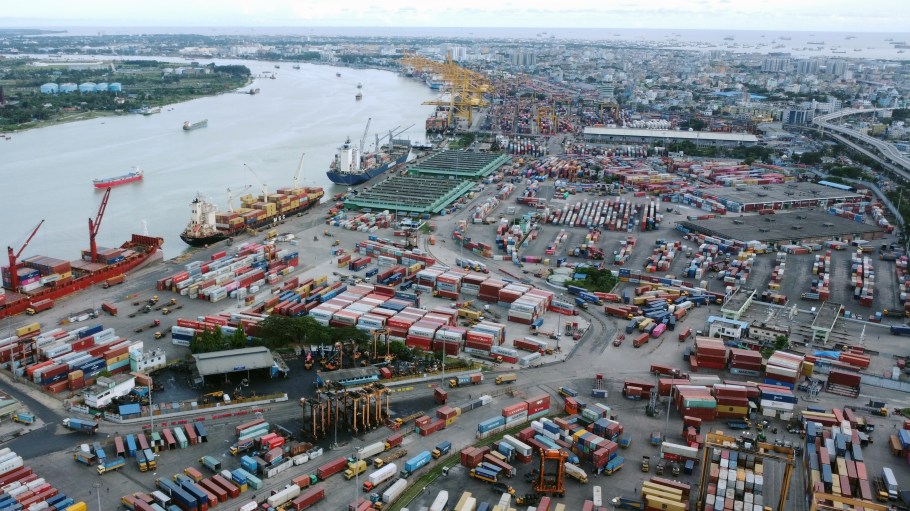
The oft-congested Chattogram Port endured more worker unrest months after a customs officials strike and a customs server disruption contributed to a weekslong backlog at the Bangladeshi gateway.
On Wednesday, members of the Chattogram Port Berth and Terminal Operators Merchant Workers Unity Council formed a human chain in front of the port in protest of the manner the port’s operator handles wages and benefits.
The council is seeking more direct representation by the Chattogram Port Authority (CPA), calling to bring all workers employed under different independent companies within the labor wing of the port.
Related Stories
The members say they want to ensure that workers at the New Mooring Container Terminal and Chittagong Container Terminal are paid at the same rate as those at the port’s General Cargo Berth.
Among the demands, the unity council demanded that private company names be removed from workers’ port ID cards, that scheduling and pay be handled directly by the port authority, and that the pay scale for fiscal year 2025–26 reflect an already promised 10 percent annual raise.
The workers also demanded that retirement benefits be confirmed within 90 days of retirement, and that retired workers or employees receive a pension until death.
“If our demands are not met, we will be forced to launch tougher movements in the coming days,” said Md Ariful Islam, member secretary of the unity council.
Chattogram Port, known widely as a hotbed for congestion both at its berths and in its container yards, is currently undergoing expansion as cargo is expected to reach record levels in 2025.
By late August, the port already expanded its container storage capacity by nearly 10 percent in recent months, raising the number from 53,518 20-foot equivalent units (TEUs) to 59,000 TEUs.
“The initiative is part of the authorities’ ongoing efforts to make the port more business-friendly and to provide maximum service to traders,” CPA Secretary Md Omar Faruk told Bangladeshi publication The Business Standard at the time. “With enhanced capacity, container congestion will not be an issue at the port. And operational efficiency and service indicators at Chattogram Port have significantly improved in recent months.”
To alleviate the congestion, the CPA freed up additional space in existing yards and opened two unused sheds outside the main port area.
According to the CPA, the port plans to raise capacity to around 62,000 TEUs by the end of 2025. The port typically manages between 47,000 and 48,000 TEUs in storage without disruption.
By the beginning of September, congestion did ease at Chattogram Port, with average waiting time at berth decreasing from 4.5 days to 1.19 days in a three-week span, according to data from logistics giant Kuehne+Nagel.
The firm said yard occupancy for containers stood at 85.4 percent as of the data released Sept. 5, with four vessels waiting for a berth. As of Aug. 23, daily container ship handling rose from an average of 10 vessels to as many as 12 to 13, the CPA said.
Chattogram Port, also known as Chittagong Port, handles more than 90 percent of the country’s foreign trade. The port has seen an influx of goods after as Bangladesh and neighboring India have imposed restrictions on what can be traded through the countries’ land ports. Bangladesh closed three land ports since August due to the idle activity.
As the CPA juggles the port’s fight against congestion with concerns about employee satisfaction, it is also taking more measures to modernize the gateway.
The port authority recently unveiled a partnership with the HSBC to introduce a fully automated digital payments system at the port.
Through this collaboration, HSBC is introducing a bespoke, cashless solution that enables businesses to settle port bills digitally from their respective banks, removing the need to visit the port to settle such payments.
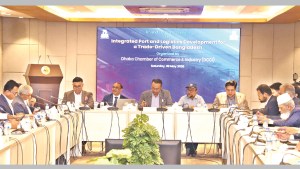
Both parties hosted a panel discussion that highlighted ongoing technological investments and strategic partnerships aimed at improving user experience and supporting port stakeholders in adopting digitalization.
“An additional 1.5 million TEUs are expected to pass through our port in the next five years,” said CPA Chairman Rear Admiral S M Moniruzzaman at the event. “We must develop our efficiency and capacity to prevent the port from becoming a non-tariff barrier, instead of an enabler, to our trade ecosystem.”
According to Moniruzzaman, the digital payment system is aimed at streamlining payments and cutting processing times, as well as attracting more investment to compete with regional peers.