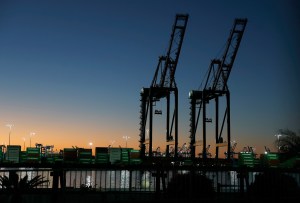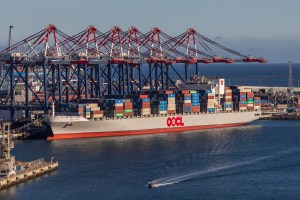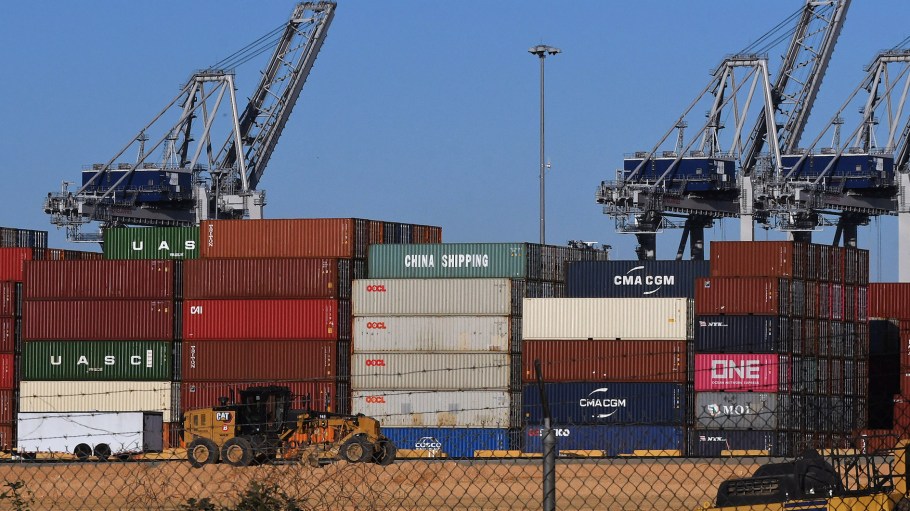
Cargo imports into the U.S. may have already topped out in August, and missed their initial projections—a further signal of the sluggish peak shipping season.
Inbound cargo volume at U.S. ports were initially forecast to reach 2 million 20-foot equivalent units (TEUs) in August and stay at that level through October. But the ports handled 1.96 million TEU, according to the Global Port Tracker from the National Retail Federation (NRF) and maritime consultancy Hackett Associates.
That was up 2.3 percent from July—marking the busiest month this year for inbound container shipping—but down 13.5 percent year over year. The drop was steeper than the 11.4 percent projected in preliminary data last month.
Related Stories
“Cargo volumes will still be strong the rest of the year, but not as high as we expected a month ago,” said Jonathan Gold, vice president for supply chain and customs policy, NRF, in a statement. “Retailers stocked up early this year as a safeguard against supply chain labor issues and are well-situated to meet consumer demand. Shoppers are spending more than they did last year, but the rate of growth we’ve seen the past couple of years has slowed and retailers are working to strike the right balance of supply and demand.”
Ports haven’t reported September numbers yet, but the Global Port Tracker projected the month at 1.94 million TEU, down 4.3 percent year over year. October is also forecast at 1.94 million TEU, down 3.1 percent year over year. Both months are down from prior 2 million TEU projections, with the October numbers down from an expected 0.1 percent year-over-year volume uptick.
Descartes Systems Group had a more bullish calculation for September, saying that U.S. container import volumes in the month increased by 0.3 percent compared to August, reaching a total of 2.2 million TEUs. Compared to a year ago, TEU volume was slightly lower by 0.6 percent.
The logistics technology company indicated that the numbers are still an improvement over pre-pandemic spending levels, with total TEUs up 8 percent from September 2019. U.S. imports over the first nine months of 2023 were 2.5 percent higher than in the same period three years ago, according to Descartes’ data.
The question now is whether discretionary spending improves into the end of the year. According to the NRF, consumer spending grew an inflation-adjusted 1.8 percent year over year in the second quarter rather than the 2.3 percent originally estimated. And the trade association said last month that it expects retail sales for the year could come in at the low end of its forecast of 4 percent to 6 percent year-over-year growth.
Slow spending could lead to an increase in blank sailings as carriers look to cut costs.
“We are already seeing this in the operational decisions carriers are making,” Hackett said. “They have slowed down their ships in an attempt to cut capacity without having to take vessels out of service as new, larger ones ordered when demand was higher are delivered. Even so, ships are not sailing fully loaded, and freight rates are declining as a result. That’s a further indication that no cargo growth from current levels is expected on the near-term horizon. Perhaps 2024 will be better.”
As U.S. ports maneuver through the slow container market, multiple ports in Israel are maneuvering through the aftermath of the Hamas terrorist attack.
In its latest maritime security threat advisory posted on Monday, maritime risk intelligence company Dryad Global said that “due to the re-escalation, Israeli ports are deemed to be at heightened risk.”
According to Reuters, two of the main Israeli cargo ports—Ashdod and Haifa—remain open for now. The status of the ports is vital to the nation at war, with 99 percent of all goods moving in and out of Israel via the seaports.
“Over the past weekend, merchant ships have both entered and left the ports of Ashdod and Haifa,” Dryad Global wrote. “In the case of Haifa, the risk from rockets launched from Gaza remains low, due to their limited range, but an escalated response from Lebanese Hezbollah could pose a significant threat. The Red Sea port of Eliat, distant from Gaza, presents a somewhat diminished risk given the current targeting capacities [of Hamas].”
Another of Israel’s ports, Ashkelon, and its oil terminal have been shut in the wake of the conflict. Ashkelon, a southern coastal city, is less than 10 miles from the northern border of the Gaza Strip, the Palestinian territory where Saturday’s surprise attack originated.
Sourcing Journal reached out to The Israel Ports Company, which maintains and upgrades Israel’s three commercial seaports in Haifa, Ashdod and Eilat.