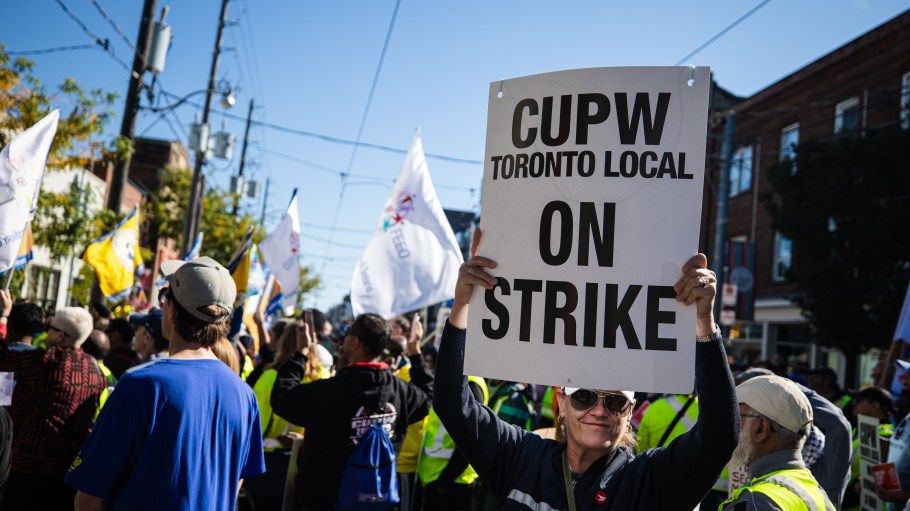
More than one week into a nationwide strike, Canada’s postal workers union expressed their disappointment with Canada Post’s most recent contract offers Friday.
The Canadian Union of Postal Workers (CUPW) called the national courier’s latest proposals “worse than what we rejected in August” amid expected workforce adjustments and the cutting of signing bonuses, among other changes to the contracts.
While the new deals maintain the prior 13.6 percent compounded wage increase over four years, Canada Post added in measures for the delivery firm to cut employees via attrition.
Related Stories
CUPW officials will receive a six-month notice before any workforce changes, Canada Post says. Layoffs will only be used if other attrition and voluntary departures don’t achieve reduction targets.
“With thousands of employees set to retire over the next few years, reducing the size of the workforce through attrition will always be the first choice, but it cannot be the only option through this transformation,” said Canada Post in a Friday update.
Additionally, Canada Post is scrapping its existing “job security for life” provisions for employees in the urban segment, which require the carrier to keep providing full pay to a worker until they decide to leave, even if there’s no work for them.
Under the newer terms, the union would see their signing bonuses cut, which amount to $500 to $1,000 per employee.
“Due to the company’s deteriorating financial situation, a signing bonus for employees is no longer on the table,” said Canada Post. “Canada Post’s new offers are within the limit of what the Corporation can afford while maintaining good jobs and benefits for employees over the long-term.”
Canada Post is offering up to seven weeks’ vacation and pre-retirement leave, as well as a cost-of-living allowance that protects against the effects of unforeseen inflation.
The 55,000-member CUPW launched the strike on Sept. 25 after the Canadian government directed Canada Post to implement sweeping changes across the Crown corporation. The work stoppage is the second over the past year, with union walking off the job for four weeks during the 2024 holiday season.
According to union president Jan Simpson, the employer’s offers took “major steps backwards” in the wake of the federal announcement.
“Canada Post and the government have repeatedly stressed the urgency of signing new collective agreements, but they are making a mockery of the collective bargaining process with these insulting offers,” said Simpson in a statement. “Canada Post seems hell bent on making workers’ pay for the financial crisis it created and trying to turn the public against the very workers who keep this service alive.”
As part of the changes, Canada Post is planning to end door-to-door delivery for 4 million addresses, instead shifting this mail to community mailboxes. Among other measures, the courier plans to shift non-urgent letter mail to be moved by ground instead of air and reduce the number of delivery days in a week.
The modernization plan also includes lifting the 1994 ban on closing rural post offices that covers nearly 4,000 locations.
Outside of the government’s directives, Canada Post is also proposing to remove a provision that could make room for the closure of as many as 493 urban and suburban post offices.
While CUPW argues that the post office closures would “backfire economically,” all proposed modifications to the agency’s business model were designed to save money for the financially struggling delivery service, which has lost $5 billion Canadian dollars ($3.6 billion) since 2018. In the first six months of 2025, pre-tax losses amounted to $448 million Canadian dollars ($321 million),
The moves also are adapting to the new reality where mail delivery is far less ubiquitous. While Canada Post delivered 5.5 billion letters in 2006, that number has dwindled to roughly 2 billion in 2025.
Mail and parcels have not been processed and delivered throughout the strike.
The two sides have been in negotiations for a new collective bargaining agreement for more than 18 months. On Friday, the union indicated it would review the more than 500 pages of each of the latest offers.
On Sept. 29, Canada’s Jobs Minister, Patty Hajdu, told The Canadian Press she hadn’t ruled out federal intervention to end the strike, but urged Canada Post to quickly table a new offer to the union.