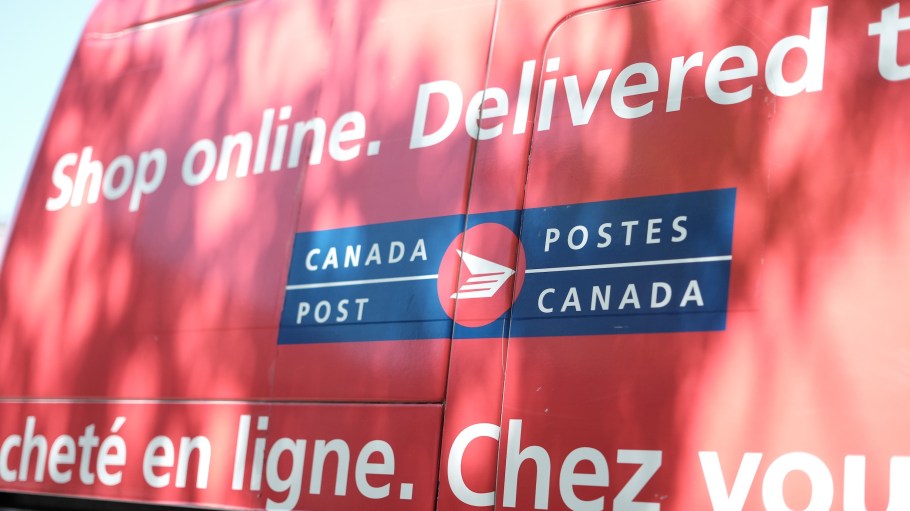
Canada Post and its 55,000-member postal worker union are taking different sides on how they want to resolve their 18-month-long labor dispute.
Over the weekend, the Canadian Union of Postal Workers (CUPW) requested the national courier to take the talks to binding arbitration, which would enable the companies to select a neutral third party that rules on terms of a new contract.
But Canada Post rejected the proposal, citing that it would be a “long and complicated” process that would likely last more than a year. The Crown corporation has been under substantial financial distress in recent years, losing nearly $3 billion since 2018. In a Sunday update, it stressed that arbitration would accelerate those challenges.
Related Stories
Canada Post also said the move would take the vote out of employees’ hands. The courier is awaiting to see if jobs minister Patty Hajdu will request the Canada Industrial Relations Board to force a union vote on its “final offers.”
“A timely resolution to negotiations that begins to address these challenges without delay, while respecting the important role employees play by allowing them to vote on the company’s future path, is the way forward,” said Canada Post in a statement.
The union disagreed, saying a government-imposed vote would not bring lasting labor peace between the parties regardless of the vote’s outcome.
“This refusal constitutes yet another demonstration that CPC is not interested in a reasonable outcome to this round of negotiation,” the union said. “A forced vote may fail to end the labor conflict and risks further division, prolonging uncertainty for all parties. Arbitration would end the labor dispute immediately and create certainty for all Canadians.”
The CUPW-represented employees across rural and urban units have stopped working overtime shifts since May 23, when the extended deadline for their negotiations with Canada Post brass passed. Both units are seeking their own separate contract.
Although the overtime ban was preferable to a full strike at the carrier, parcel volumes already slipped 65 percent on a year-over-year basis days after the ban took place. This suggests that Canada’s businesses moved volumes to other carriers whether it be UPS or FedEx, or the country’s own Purolator.
Brands had already gotten impacted by the month-long strike at Canada Post that lasted through much of the holiday season, causing parcel backlogs throughout the supply chain. This resulted in more businesses making earlier preparations to shift couriers in the event of a second strike at the start of May.
Lululemon athletica is still using Canada Post in select instances, but has been experiencing delays. The athleisure company recommends customers that default to shipping via Canada Post to place an order with an alternative address that will instead ship with another courier, if available.
“If your order is shipping by Canada Post, we’ll attempt to ship it with another courier,” said the retailer in a notice online. “If it can’t be shipped, your order may be cancelled.”
Another Vancouver-based apparel retailer, Aritzia, says the Canada Post labor action will affect deliveries to P.O. boxes and remote zones.
Aritzia’s comment reflects part of the battle between the carrier and the union, with an industrial inquiry commission recommending as part of the negotiations that Canada Post could close more rural post offices and expand community mailboxes in their place.
Over the past year, multiple labor disputes across Canada’s supply chain have been sent to binding arbitration after parties couldn’t come to a deal. The country’s labor minister, Steven MacKinnon, ended last August one-day work stoppage involving 9,300 union workers on Canada’s two Class I railroads by enforcing the two sides to go to court.
Less than three months later, MacKinnon ended a lockout across ports in British Columbia and Quebec by imposing arbitration on the parties.
The arbitration process on the railroads settled a three-year deal for 6,000 Teamsters-represented workers at Canadian National Railway (CN) in April.
On Friday, the nearly 3,300 workers for Canadian Pacific Kansas City (CPKC) reached a new contract under the arbitrator that lasts four years through the end of 2027.
Both deals include 3 percent annual wage increases.
Although the Teamsters Canada Rail Conference has yet to comment on the CPKC contract, the union was not thrilled about the results of the CN arbitration two months ago. In a statement, union president Paul Boucher said the contract “closely resembles the status quo” and “failed to secure any concessions related to scheduling, rest or fatigue protections.”
As for union workers at Canada’s ports, the arbitration process hasn’t begun yet at West Coast hubs like Vancouver and Prince Rupert.
Arbitration was briefly avoided at the Port of Montreal in March when the Maritime Employers Association and Local 375 branch of the Canadian Union of Public Employees requested a mediation period. However, those mediated talks failed. An arbitrator has yet to be named for those talks.