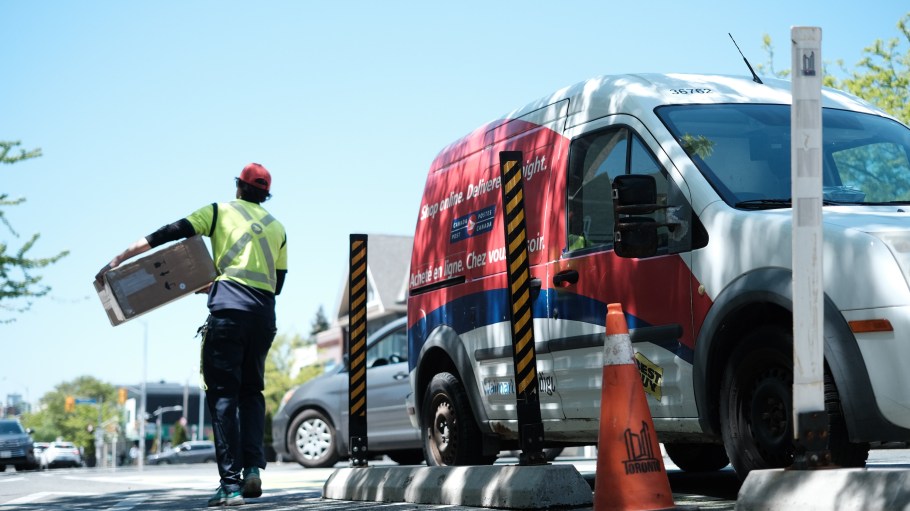
Canada Post put out what it said was its “final offers” to the Canadian Union of Postal Workers (CUPW) on Wednesday as both parties remain deadlocked in negotiations for new contracts for urban and rural mail carriers.
The 50,000 CUPW-represented postal workers instituted a nationwide overtime ban after the negotiation deadline ended on Friday. Rallies are planned across Canada on Saturday.
According to the national courier, the newest offers include a signing bonus of up to $1,000 Canadian dollars ($728) depending on role, the elimination of mandatory overtime for the urban unit and lower inflation thresholds for cost-of-living allowance payments across all employees.
Related Stories
But the offers did not include any improvement over the prior cumulative wage increase proposal of 14 percent over four years, or any response to the union’s concerns about contracting out deliveries to third parties.
The union also took umbrage with Canada Post’s contention that part-time flex staffing and weekend delivery and dynamic routing for urban employees are both “non-negotiable.”
“Canada Post says this was its final offer. But this fight is far from over,” union president Jan Simpson said in response.
Canada’s Minister of Jobs and Families Patty Hajdu and Secretary of State for Labour John Zerucelli are meeting with union officials in Ottawa on Friday to discuss the negotiations.
While the overtime ban isn’t the full-blown strike that Canada Post and its customers had worried about, “uncertainty related to the recent resumption of strike activity has caused the company’s business to drop significantly,” the courier said in a statement.
Delivered parcel volumes are down 65 percent from the same time last year as of Wednesday, according to Canada Post, down from the 50-percent annual drop already experienced at the end of the week prior.
The talks coincided with the release of Canada Post’s annual report, which revealed that the Crown corporation posted a pre-tax loss of $841 million Canadian dollars ($610 million). Since 2018, Canada Post has racked up pre-tax losses of $3.8 billion Canadian dollars ($2.8 billion).
The last time the parcel delivery firm made a profit was 2017.
The original month-long strike during the 2024 holiday season took a massive toll on Canada Post’s losses in 2024, with negative impact amounting to $208 million Canadian dollars ($151 million).
Parcels revenue and volumes—which had already declined through the first three quarters—fell sharply for the full year, by 20.3 percent and 19.9 percent, respectively. The strike, alongside the entrance of more low-cost last-mile delivery entrants in the space, were the primary reasons for the declines.
Letter mail, which initially was the backbone of Canada’s post office, has seen a substantial decline as well. While Canada Post delivered 5.5 billion letters in 2006, that number since dwindled to 2 billion in 2024 despite there being 3.3 million more addresses throughout the country.
On these grounds, the company called its delivery model both “outdated” and “unsustainable” various times throughout its annual report.
“Our current structure was built for a bygone era of letter mail—the status quo has led us to the verge of financial insolvency and is not an option,” Doug Ettinger, president and CEO of Canada Post, said in a statement. “The need to change, respond to our challenges and secure this important infrastructure for the future is more urgent than ever before.”
Simpson responded to the report saying that it left out important details, namely a “failure to raise stamp rates before 2025, even though every other major postal operator raised rates significantly between 2018-2023.” She said the report did not identify how much in costs were related to the Covid-19 pandemic.
DHL union workers prep for imminent meeting
As the battle at Canada Post rages on, DHL Express preps for a possible work stoppage throughout the country.
A group of 2,500 union truck drivers, couriers, warehouse and clerical workers at DHL Express are scheduled to meet with company representatives at the bargaining table this Sunday to continue negotiations on a new deal.
Talks are expected to last from Sunday throughout the next week, until June 8.
The DHL employees are represented by 320,000-member Unifor, Canada’s largest private sector union.
Although both parties have already been at the negotiating table for a new contract for 25 days, both sides remain far apart on all issues, the union says. DHL Express has said it is committed to negotiating in good faith, and that the parties have “made some progress.”