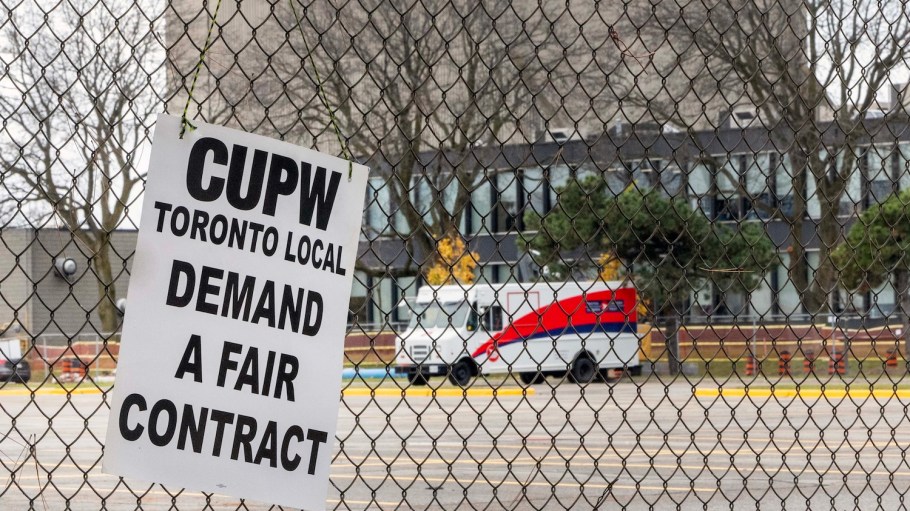
As a nationwide strike of roughly 55,000 Canadian postal workers enters its third full week, the Canada Post presented the union with what it called a “comprehensive framework” Sunday in hopes to restart a mediation process and reach a new agreement.
The framework includes proposals aimed at bringing “greater flexibility” to the Post’s delivery model, the agency said. While the Canada Post said the framework also demonstrated “movement on other key issues,” no other details were provided.
Related Stories
The Canadian Union of Postal Workers (CUPW) has been on strike since Nov. 15, halting all mail and parcels from being processed or delivered in the time since, further putting the Canadian supply chain under strain during the holiday shopping season.
Those seeking to deliver parcels in the country before the strike concludes will have to instead conduct shipments through other logistics companies like UPS, FedEx, DHL and Canadian courier Purolator, but shipping costs could vary and in many cases be more expensive than those shipped via Canada Post.
While the Canadian government appointed a special mediator in the days after the strike began, negotiations between both parties broke down last Wednesday. Additionally, both parties have accused the other of stalling negotiations.
The union has demanded wage increases in line with inflation and cost-of-living adjustments as well as safer work conditions. In total, the CUPW is asking for a 23.8 percent compounded wage increase of the next four years, while Canada Post is offering 11.5 percent over the same time frame.
According to the union, between 2017 and 2023, non-labor spending at Canada Post grew by 56.5 percent, while wages rose by only 14.1 percent.
Another key issue appears to separate both parties—working on weekends. Canada Post, which traditionally doesn’t deliver mail and parcels on Saturday and Sunday, is pushing to expand parcel deliveries into the week by scheduling carriers for five days in a week on a seven-day calendar.
According to Labour Minister Steven MacKinnon, the mediator believed the parties were “too far apart” on some issues, causing the breakdown.
CUPW and Canada Post have both since adjusted their demands in hopes that the mediator will restart the process.
In a post on X Sunday night, McKinnon appeared to throw cold water on hopes of a quick resolution.
“Mediation will only resume once the special mediator has clear evidence that both parties have sufficiently modified their respective positions,” said MacKinnon. “Unfortunately, there has been no such evidence to date.”
In the middle of the negotiations, the union filed an unfair labor practice complaint with the Canada Industrial Relations Board over the layoffs of some striking employees. The CUPW called the layoffs an “intimidation tactic” that violates Canada’s Labour Code.
No details have been provided on the extent of the layoffs, which Canada Post has said are temporary. The agency also denied any violation of the labor code.
The stalled talks impact U.S.-to-Canada shipments as well, with the United States Postal Service (USPS) suspending mail acceptance to Canada last Friday.
The USPS decision came as Canada’s postal operator said it couldn’t process or deliver international mail or services due to the CUPW strike.
Although Canada’s federal government has had a recent proclivity to intervene in recent labor disruptions across the Canadian supply chain, MacKinnon says binding arbitration is not currently an option.
MacKinnon invoked arbitration in August when both major Canadian railroads locked out their employees, and then implemented it again when ports in Montreal and British Columbia locked out thousands of workers.
In bringing the negotiations to arbitration, employees are required to return to work under the terms of their original expired contract. A third party is tasked with establishing a new collective bargaining agreement between the employer and the union employees.
As has been the case in previous supply chain work stoppages, the Canadian Chamber of Commerce urged the federal government to intervene in a Friday letter.
“This strike is damaging to our retail sector and has considerable impacts on northern, rural and remote communities,” the letter said. “This is yet another blow to our supply chains, with a disproportionate impact on Canadian entrepreneurs and small businesses engaged in e-commerce, many of whom are counting on doing a considerable amount of business during the holiday season. This is only exacerbated in northern, rural and remote communities where alternatives to Canada Post are not available.”
That letter highlighted the various labor woes Canadians have endured since last summer.
“We saw more than three weeks of strikes last year across the ports in British Columbia and the St. Lawrence Seaway, and as you know all too well, labour disputes over the past few months that paralyzed Canada’s rail network and shut down our largest East and West coast ports. Added to the lack of predictability resulting from disputes with Canada’s border agents, as well as Air Canada’s cargo network, there has simply been no reprieve for Canadians counting on stable prices and predictable movement of goods.”