The largest container ports in Bangladesh and India are continuing to feel the heat of congestion as record cargo volumes flow through their gateways.
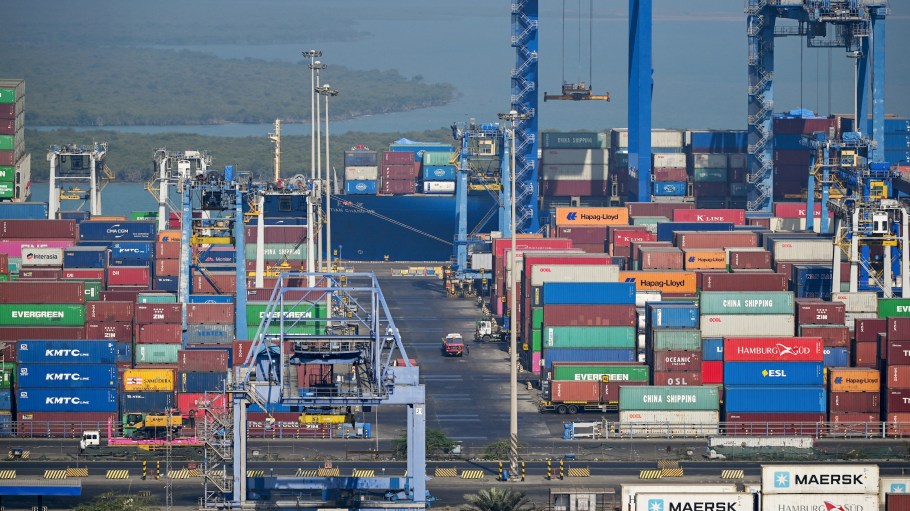
At Bangladesh’s Chattogram Port, a summer surge in traffic has been triggered by India’s clampdown on land-based trade routes. And on India’s west coast, Mundra Port is grappling with acute landside congestion that threatens freight flows into the northern part of the country.
Data from Kuehne+Nagel’s weekly port operational update released Friday morning suggested that Mundra and Chattogram both were “slightly disrupted,” marking two of three ports across the Middle East-Indian subcontinent with that designation.
Related Stories
The Port of Salalah in Oman was the third port with disruption, with the remaining 12 tracked by Kuehne+Nagel operating at “business as usual” levels.
The good news for Chattogram is that the severity of congestion has declined in recent weeks.
For Chattogram Port, also known as Chittagong Port, average waiting times of vessels have eased from three weeks prior, when vessels were waiting 4.5 days to berth. That number has shrunk to 1.19 days over the past week.
Yard occupancy for containers is 85.4 percent, with the Chattogram Port Authority is strictly limiting port stays, especially for gearless vessels. At the time of publishing, four vessels were waiting for a berth, according to K+N.
Conversely, Mundra Port has seen more berthing delays. The average waiting time to berth over the past week has been 1.38 days, down from a 1.48 day average the week prior, but up from a one-day average two weeks earlier.
In the case of Chattogram, there was simply too much cargo flowing in and out of the port in August. The New Mooring Container Terminal (NCT), the largest container-handling facility at the port, processed 122,517 20-foot equivalent units (TEUs) in August, a 27.6 percent increase from the year prior.
The port now expects total 2025 throughput to come in at 3.7 million TEUs across all terminals, a 13 percent jump over 2024 full-year totals.
Chattogram Port is central to Bangladesh trade, handling more than 90 percent of cargo exiting and entering the country.
The flood of cargo cramming the port further kicked up a notch after India imposed sweeping restrictions in May by banning several Bangladeshi exports via land ports, including ready-made garments, jute products and processed foods. This came in retaliation for Bangladesh banning yarn imports from India via land ports the month prior.
With the restrictions, shipments through land ports plummeted through the summer. According to Bangladesh’s tax and customs collection agency, the National Board of Revenue (NBR), volumes via these gateways plunged 26 percent in July and 52 percent in August as exporters had to reroute goods out of the country via ocean.
Due to the idle activity, Bangladesh closed three land ports on the Indian border at the end of August, and suspended operations at another.
“We are ready to handle the additional pressure created by increasing exports to India via the seaport,” said Omar Faruk, secretary of the Chattogram Port Authority, telling Bangladeshi publication The Business Standard that the port had expanded capacity by 10 percent.
At Mundra Port, the congestion outside the port has disrupted the flow of rail-bound cargo into northern India. According to an August update from Australia-based third-party logistics provider Transolve Global, delays for railed freight are reaching 15 to 20 days “due to a deteriorating slowdown in import clearance out of heavily congested container yards.”
Mundra can handle up to 30 trains a day, transporting roughly 5,000 TEUs to 6,000 TEUs daily on average.
According to a report from supply chain publication Journal of Commerce, container lines that offer regular calls at Mundra have told customers the backlog is increasing supply chain risks for the trade as train turnarounds “remain increasingly chaotic.”
Mundra Port owner Adani Ports and Special Economic Zone Limited (APSEZ) highlighted August’s record levels of intermodal container movement on the railroads.
Mundra handled approximately 97,000 TEUs across 756 import cars, exceeding the earlier record of 94,000 TEUs. For double-stack container handling, in which railroad cars carry two layers of intermodal containers, the port set new benchmarks with 542 cars carrying 31,000 imported TEUs. Total double-stack volumes, including exports, reached about 50,000 TEUs across 885 cars, surpassing the previous month’s record of approximately 46,000 TEUs.