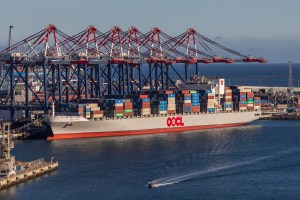
Dockworkers at Bangladesh’s Chattogram Port escalated a strike Saturday in protest of the interim government’s plans to lease terminal operating licenses to foreign companies.
The labor action, which started in September, reportedly swelled up to roughly 200 dockworkers at the port over the weekend.
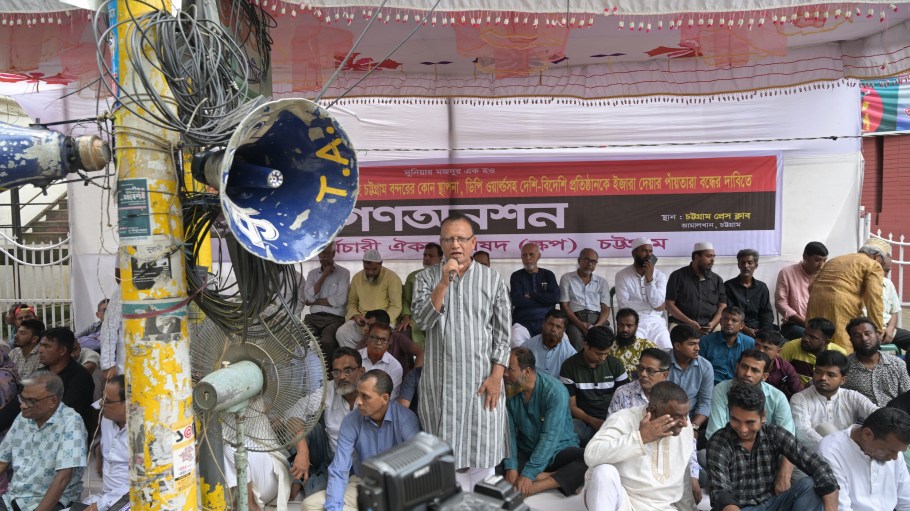
The port wasn’t the only area seeing labor disruption, with a hunger strike taking place in front of Chattogram’s press club on Saturday. Leaders of Chattogram’s United Front of Workers and Employees (SKOP), which collectively represents 90 percent of the unionized labor force in Bangladesh, demanded that the interim government scrap the terminal-leasing plan.
Related Stories
SKOP leaders said that if the government did not immediately cancel the leases, they would announce tougher measures, including total work stoppages and port blockades.
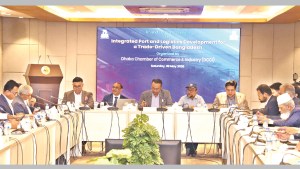
Bangladesh’s government has plans to hand over the management of multiple hubs, including Chattogram’s largest terminal, New Mooring Container Terminal (NCT), to foreign operators by December. The government has still never overtly specified which companies would be involved in the project.
UAE-based DP World has long been tied to New Mooring Container Terminal, with the marine terminal operator having expressed prior interest in investing in the gateway.
A.P. Moller-Maersk’s APM Terminals subsidiary has been a major part of the development of Laldia Char Terminal at Chattogram Port, which began construction in May. APM is contributing part of a wider $800 million foreign direct investment in Laldia, which will build out three container jetties across 32 acres of land.
“Foreign expert operators would increase the foreign investment and enhance the efficiency,” Chattogram Port Authority chairman S.M. Moniruzzaman told French news agency Agence France-Presse (AFP).
The port operator isn’t the only entity that believes in the benefits of having global terminal giants like DP World and APM Terminals in charge.
“We need a globally reputed operator to increase the port’s capacity,” Kabir Ahmed, president of the Bangladesh Freight Forwarders Association, told AFP. “It will enhance cargo handling, boost revenue and strengthen the country’s reputation.”
Chattogram isn’t the only port anticipating new management at one of its hubs.
Terminal Investment Limited, the terminal operating wing of Mediterranean Shipping Company (MSC) is expected to take over the Pangaon Inland Container Terminal, which is part of the Port of Dhaka. MSC has offered $400 million to modernize and operate the terminal, which has been largely underused in recent years due to delays and customs bottlenecks.
In October, Mohammad Yousuf, the senior secretary of Bangladesh’s Ministry of Shipping. said the New Mooring and Pangaon terminals would be leased to a foreign operator for 25 years, while Laldia would be run by a foreign firm for 30 years.
The first protest rally at Chattogram took place on Sept. 22, in which SKOP leaders called out the expected DP World and APM leases as a “betrayal to the nation.”
The organizations urged the government to scrap the reported agreements and prioritize local capacity building instead. They warned that leasing out the terminals could threaten national interests and jeopardize thousands of jobs.
Disruptions at the oft-congested Chattogram Port, also known as Chittagong Port, pose concerns to the wider global apparel supply chain, given that the market is the second-largest exporter of garments behind China. More than 92 percent of the total export and import cargo in and out of Bangladesh goes through the port.
“Chittagong Port is the main driving force of the country’s economy,” said SKOP central leader Anwar Hossain during the Saturday hunger strike. “The NCT, built entirely with domestic funding and equipped with modern technology, is currently the most successful container terminal in the country. Yet, the government’s decision to hand it over to the foreign company DP World is against national interests and suicidal. This decision will not be accepted under any circumstances.”
The Chattogram Port Authority recently implemented new service charges that hiked average prices by roughly 40 percent, driving the major ocean carriers to tag on surcharges of their own.
The country’s apparel exporters were unhappy with the move, with one former vice president of the Bangladesh Garment Manufacturers and Exporters Association speculating that the new charges were designed to make port operations look more profitable before the foreign operators took over the lease.
Beyond the expected lease agreements in December, the Chattogram Port Authority is also expected to award the operation of two other container terminals under the port’s Bay Terminal project to DP World and other lead investor and developer PSA Singapore at a later time. Those terminals are expected to be operational by 2030.
PSA Singapore, which operates the Port of Singapore and 66 port terminals worldwide, had the largest market share of global port throughout in 2024, at 7.2 percent, according to Drewry.