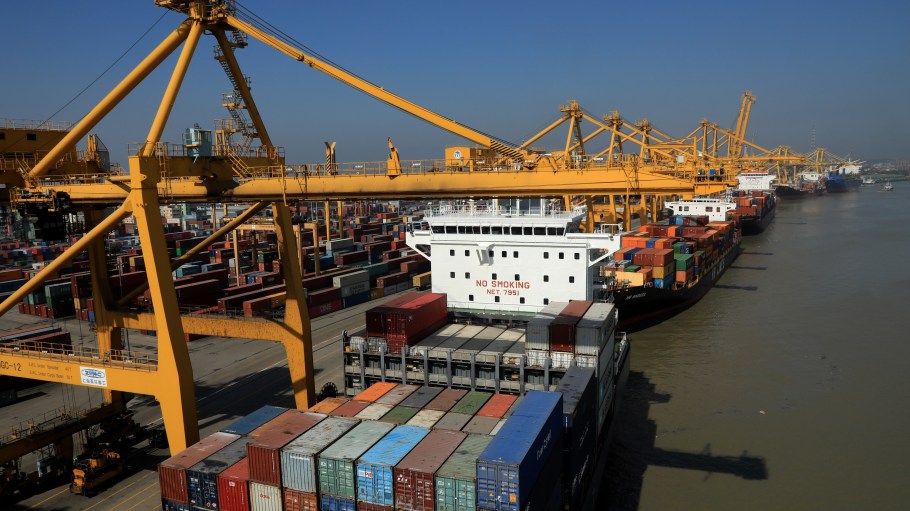
Customs facilities in Bangladesh have endured processing delays for exports and imports for two weeks, leading to concerns of more cargo pileup and backlogs at the country’s ports and inland container depots.
According to customs officials interviewed by Bangladeshi publication The Daily Star, the customs system used across the facilities now functions for only 10 to 15 minutes every two hours, causing serious delays in the clearance procedures of import and export shipments.
The customs houses use Asycuda World, an automated system for customs data processing designed to handle end-to-end online submissions of daily bills of lading. But the breakdowns have become increasingly frequent, the report said.
Related Stories
On Thursday, the National Board of Revenue (NBR) directed customs houses in Chattogram, Benapole, Mongla, and Dhaka to stay in operation on Friday and Saturday to mitigate the backlog. However, clearances still could not proceed based on the system’s limited functionality.
On average, the Chattogram customs house handles around 3,500 to 4,000 bills of entry per day. When the system goes down, even the simplest clearance takes up to five times longer than usual, the Daily Star said.
The customs house submitted a report Saturday indicating that the server slowdown had negatively impacted import-export assessments since July 1, further complicating congestion issues that have persisted at the port.
When the company upgraded its software last September, a similar slowdown happened due to a glitch that prevented customs officials and clearing and forwarding agents from accessing the system properly.
Chattogram Custom House acting commissioner Shafi Uddin provided a three-point recommendation to the NBR’s IT team in the report.
Uddin recommended archiving any data older than five years to reduce server load, as well as enhancing server capacity based on the number of active users. He also sought to resolve the ongoing issues by seeking technical support from the system’s operator, the Asycuda team under the United Nations Conference on Trade and Development (UNCTAD).
An unnamed NBR IT official told The Daily Star that it would be “prudent” to consider setting up a dedicated server exclusively for the Chattogram Custom House. Officials including clearance and forwarding agents at the facility reportedly represent 80 percent of total users of the Asycuda World system.
By Thursday, the seven-day average waiting time for vessels awaiting at Chattogram Port was 5.28 days, up from 4.22 in the week prior, according to data from Kuehne + Nagel.
Chattogram Port, Bangladesh’s biggest seaport, has already been dealing with various disruptions in recent weeks, experiencing a monsoon last week that prevented feeder vessels from collecting cargo from mainline ships anchored on the hub’s outskirts. That rainfall also impacted Sri Lanka’s Port of Colombo, with some transshipment cargo delayed one to two weeks, Kuehne + Nagel said.
But weather hasn’t been the only issue pervading Bangladeshi port operations.
To close out June, customs workers at Chattogram Port walked off the job over two days, which suspended the transportation of import and export containers to and from the port, further building out congestion in its waters and at the local inland container depots (ICDs).
The port also saw severe space constraints due to the extended Eid al-Adha holiday in early June, which slowed vessel operations at two terminals due to time consuming cargo unloading. On top of that, an ongoing railway worker shortage continues to lengthen dwell times for containers waiting at the port.
Both the Chattogram Port, also known as Chittagong Port, and the ICDs, have yet to fully clear the backlog from these events, combined with July’s software disruptions.
According to the Chattogram Port Authority, the port’s yards had 44,246 twenty-foot equivalent units (TEUs) of containers as of Sunday morning, taking up nearly 83 percent of the space dedicated for the purpose. This is up from the 79 percent yard occupancy rate at the end of June.
One vessel, Maersk Jakarta, was unable to take more than 100 TEUs of export containers when it left the port on Saturday. Another Maersk ship, the Nusantara, postponed its departure Sunday as the containers it was scheduled to pick up could not be sent from the private ICDs in time.
The 21 ICDs, all located in the Dhaka area and connected by rail and truck to the Chattogram port, saw the number of export containers reach 14,512 TEUs on Sunday. This nearly doubles the typical 8,000 TEUs spread across the yards, compounding the recent delays experienced when moving cargo to the port.