Bangladeshi garment exporters appear to have found workarounds to ship merchandise internationally months after neighboring India revoked the country’s access to its transshipment service.
According to a report from Bangladeshi publication The Daily Star, exporters that previously sent goods via the Bangladesh-India land borders to access India’s airports and seaports have instead been using alternative hubs in recent months across ocean and air.
Apparel exporters have had to make plenty of adjustments in 2025 as Bangladesh and India have seen their trading relationship go south.
Related Stories
A month after the transshipment ban, India imposed restrictions on Bangladesh’s ready-made garments (RMGs) passing through the land ports, effectively forcing exporters to instead ship goods to the country via ocean freight. India expanded on this ban in July to include woven fabrics, jute and flax yarn.
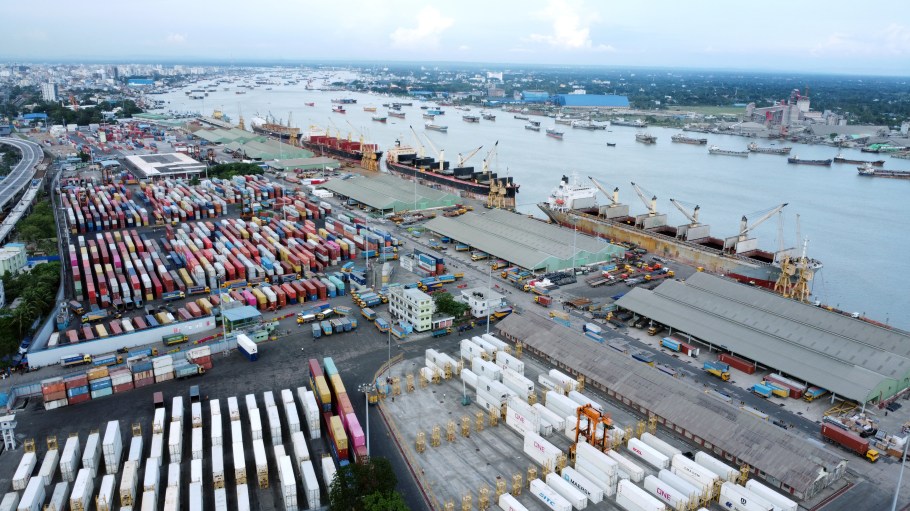
With the land bans in place, exporters often leverage ocean carriers out of Chattogram Port to send product to Sri Lanka’s Port of Colombo, where vessels will then carry goods to other destinations via ocean or air. Smaller vessels out of Chattogram will also travel to the Port of Singapore and Malaysia’s Penang Port for transshipment purposes.
Additionally, exporters looking to directly transport garments via air are booking flights out of Sylhet’s Osmani International Airport, which launched air cargo operations soon after India’s transshipment ban. Inditex has been using the air cargo service since its debut in April.
The opening of Sylhet’s air cargo operations has also freed up space in Dhaka’s Hazrat Shahjalal International Airport (HSIA), which had gotten so swamped in recent years that Bangladeshi exporters elected to use the transshipment option to fly goods out of India’s airports.
Between January and March this year, ahead of the transshipment ban, about 34,900 metric tons of garments worth $462 million were shipped to 36 countries through Indian airports, according to the Bangladesh Garment Manufacturers and Exporters Association (BGMEA).
Faisal Samad, a director at the BGMEA, told the Daily Star that the country is currently in a lean season for air freight, “so space on cargo flights is not an issue at the moment.” Restrictions
On average, 450 metric tons of dry cargo are shipped daily from Dhaka and Sylhet airports in the offseason, increasing to roughly 1,200 metric tons during peak periods such as November and December, according to the Bangladesh Freight Forwarders Association.
SM Ragib Samad, the executive director of Dhaka’s HSIA, said cargo flights out of the airport are kept out of any potential flight restrictions to facilitate export movement.
“In November and December, we will take extra measures to ensure smooth operations during the peak season,” Samad told the Daily Star.
Bangladesh’s apparel exporters had to scramble for new ideas after India closed off the transshipment access, with the world’s most populous nation coming to the decision due to the overwhelming congestion in its own airports and ports.
Recent government statistics appear to suggest that the country’s apparel exports have largely shrugged off the logistics shifts, with the Trump administration’s “reciprocal” tariffs taking up the lion’s share of concern.
For the third quarter, Bangladesh’s RMG exports grew 4.8 percent from the year prior to roughly $10 billion, according to data released from the country’s Export Promotion Bureau (EPB).
Breaking down by product segments, the knitwear sector grew by 4.3 percent, while the woven sector saw exports increase 5.4 percent.
Year-over-year, RMG exports to the U.S. spiked 8.6 percent to $2 billion, while those sent to the E.U. increased 3.6 percent to $4.8 billion. The E.U. remains the largest market for Bangladeshi garment exports, taking up a 47.6 percent share. The U.S. comes in at a distant second at 20.2 percent of the export total.
Although the category had a strong quarter, September turned out to be a significant slump for apparel exports, with the number declining 5.7 percent to $2.8 billion.
EPB figures show that knitwear exports fell by 5.75 percent, while woven garments dipped 5.5 percent.
Leaders from the BGMEA and the Bangladesh Knitwear Manufacturers and Exporters Association (BKMEA) have both attributed the September decline to the recent return of the U.S.-imposed tariffs, which came back into effect in early August. The tariff rate was revised downward to 20 percent from the initial 37 percent duty implemented in April.
With the tariffs firmly in place, representatives from both associations said most buyers are either delaying or not placing new orders.