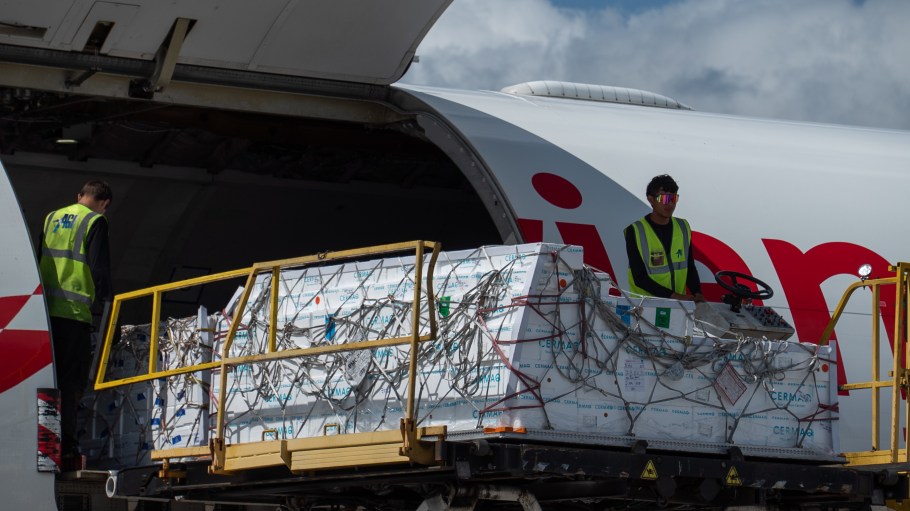
Air cargo demand escalated in April amid sweeping tariffs implemented on U.S. trade partners as importers rushed to get more product into the country.
Total demand, measured in cargo tonne-kilometers (CTKs), rose by 5.8 percent compared to April 2024 levels, and 6.5 percent for international flights, according to data from the International Air Transport Association (IATA). On a seasonally adjusted basis, CTKs increased by 2.3 percent from the month prior.
The April demand growth was an improvement over the March increase of 4.4 percent and February’s rate contraction of 0.1 percent.
Related Stories
“Seasonal demand for fashion and consumer goods—front-loading ahead of U.S. tariff changes—and lower jet fuel prices have combined to boost air cargo,” said Willie Walsh, IATA’s director general, in a statement. “With available capacity at record levels and yields improving, the outlook for air cargo is encouraging.”
Capacity, measured in available cargo tonne-kilometers (ACTKs), is outpacing demand. Air cargo space has increased by 6.3 percent compared to the year prior, and 6.9 percent for international operations.
The closure of the de minimis provision on May 2 also played a role in the demand growth. Under that trade exemption, companies could ship parcels with less than $800 worth of goods into the U.S. tax free.
In axing that arrangement, e-commerce companies would need to fly out more cargo ahead of the early May deadline to avoid an extra 120 percent import tax. That tax was amended to 54 percent later in the month.
However, a U.S. federal court injunction on the Trump administration’s tariff policies imposed under the International Emergency Economic Powers Act (IEEPA) on Wednesday is putting the future of the tariffs in doubt.
That decision is expected to be appealed to a higher court, and it is likely the administration will look to other legal avenues to implement some form of duties.
The current 30-percent tariffs levied on Chinese imports and the “reciprocal” 10-percent country-specific tariffs on dozens of other trade partners are part of the injunction, which went into effect once the court ruling took place. The de minimis suspension also falls under this purview.
“Shifts in trade policy, particularly in the U.S., are already reshaping demand and export dynamics. Airlines will need to remain flexible as the situation develops over the coming months,” said Walsh in a statement.
This flexibility could be key for airlines, particularly if de minimis remains back on the table for an extended period.
“If the ruling removes the U.S. suspension of de minimis for Chinese goods, we could see a rebound in B2C volumes via air cargo,” said Judah Levine, head of research at Freightos. “But with bipartisan interest in limiting Chinese e-commerce channels, and as platforms like Temu and Shein have already pivoted toward ocean and domestic fulfillment, the rebound may be partial or short-lived.”
Ahead of the de minimis ban, Asia-Pacific airlines saw the second-largest year-over-year demand growth for air cargo at 10 percent, with capacity increasing by 9.4 percent compared to April 2024. Latin American carriers saw the strongest demand growth at 10.1 percent, with capacity jumping 8.5 percent.
In total, cross-border shipments gained 6.5 percent year-over-year in April 2025.
Tariff policy reversals including a 90-day pause on the previous 145-percent tariffs slapped on Chinese goods resulted in a recovery from Asia, as well as the softened import tax on formerly de minimis-eligible goods, prompted a brief spike in trans-Pacific tonnage via air.
According to WorldACD, air cargo from China and Hong Kong to the U.S. rose 19 percent from the week prior in the week of May 12-18.
That followed two weeks of significant week-over-week declines and takes tonnages from China and Hong Kong to the U.S. back up close to their level in early April and in late February, prior to volumes surging in March ahead of the higher “Liberation Day” tariffs.
In total, chargeable weight from China and Hong Kong to all markets increased 8 percent from the week prior.
Regardless of how the tariff situation plays out for goods flown out of China and the Asia Pacific region, the uncertainty is leading the air freight sector to a slower year than originally anticipated.
The IATA is expected to update its prior demand forecast, which had called for a 6-percent increase in 2025, at its annual general meeting in New Delhi from June 1-3.
According to the lobbying group’s director of sustainability and economics, Andrew Matters, a downgrade is likely in order.