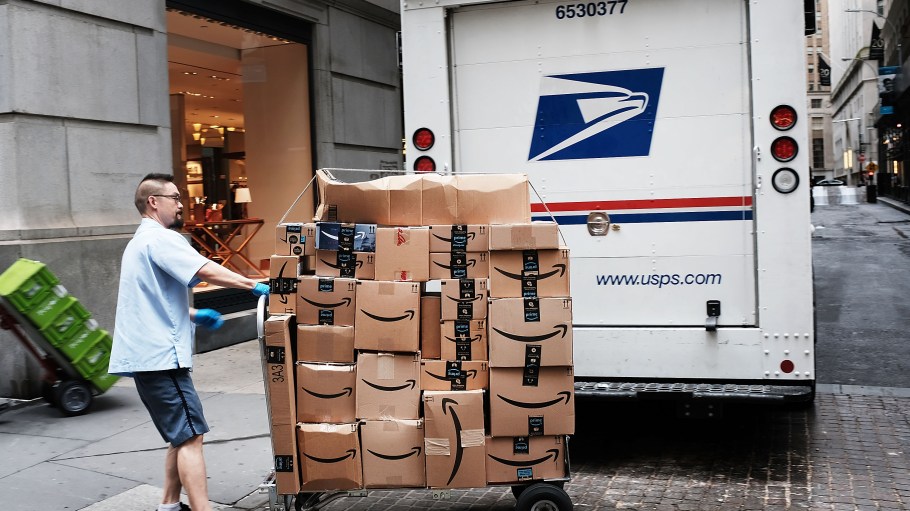
With Amazon’s current contract with the U.S. Postal Service (USPS) set to expire Oct. 1, 2026, there are rumblings that the logistics networks’ longtime alliance may be getting closer to its end.
A Washington Post report indicated that Amazon’s ambitions to build out a national delivery network could coincide with a decision not to sign a new deal to extend the USPS partnership. While the parties had reportedly been negotiating since February, the talks have “largely concluded with no deal.”
Related Stories
Talks between Amazon and USPS had been ongoing over “negotiated service agreements,” which are contracts that lock in rates and prioritize faster deliveries for the agency’s biggest customers. WaPo said plans for a decoupling are not final and could change.
Postmaster General David Steiner reportedly met virtually with Amazon CEO Andy Jassy on Nov. 14, with the report saying the tech titan still “hopes to reach an agreement.”
The USPS declined to comment.
Such a situation would be a massive blow to USPS, as the new Postmaster General tries to engineer the multi-year turnaround that his predecessor, Louis DeJoy, could not. Amazon’s possible departure would compound the agency’s already messy finances, with the delivery service incurring $9 billion in net losses in 2025, on top of $9.5 billion in losses the year prior.
Amazon has long been the Postal Service’s top customer, the WaPo report said, generating more than $6 billion in annual revenue for the agency in 2025. That would account for roughly 7.5 percent of the courier’s $80.5 billion in operating revenue for the fiscal year.
The report follows a recent push from Steiner for the USPS to focus primarily on growth, namely by expanding its first-mile and last-mile delivery assets. The Postal Service recently reentered a new partnership with UPS to deliver low-cost last-mile parcels, with Steiner saying the mail carrier has already begun discussions with multiple retailers to power their last-mile capabilities.
This decision may have been the catalyst for talks breaking off between both couriers.
According to WaPo, Steiner plans to hold an auction in early 2026 that would sell access to postal facilities to the highest bidder, rather than directly to Amazon.
This would put Amazon in direct competition with other national retail brands and regional shipping firms for USPS access.
An Amazon spokesperson said the company was “surprised” by the auction, but called USPS “a longstanding and trusted partner.” Both parties had discussed ways to extend their partnership, the spokesperson said.
“We still have a lot to work through,” according to the spokesperson. “Given the change of direction and the uncertainty it adds to our delivery network, we’re evaluating all of our options that would ensure we can continue to deliver for our customers.”
Amazon has played the role of “frenemy” of sorts within the wider delivery industry, which it largely disrupted during its growth in the 21st century.
Like its USPS partnership, the online marketplace is also the largest customer of UPS, generating 12 percent of the parcel delivery company’s revenue in 2024. But to kick off the year, UPS made it a goal to halve Amazon’s volume flowing through its network by the second half of 2026. While Amazon brings in the top line, many of the parcels are more costly to ship, bringing down UPS margins.
FedEx recently reestablished a new last-mile ground delivery partnership with Amazon, where it would transport select large packages to residential areas. While the logistics competitors had previously ended their relationship in 2019, one reason FedEx agreed to the revival was that the heavier packages help the company push up domestic shipping rates.
Amazon’s ability to gobble up volume and market share in parcel delivery has further impacted these relationships. While USPS still has the largest volume and market share in the sector, according to the 2024 Pitney Bowes Parcel Shipping Index, Amazon is projected to surpass the national courier by 2028.
Last year, Amazon handled 6.3 billion parcels on 7.3 percent growth. This remained behind the 6.9 billion parcels delivered by USPS, but that growth came at a softer 3.2 percent pace.
Amazon had already been applying pressure to USPS on a national scale with its escalating investments in same-and next-day delivery. The company has thus far poured $4 billion into expanding into more than 4,000 rural towns and communicates, which would triple its rural network upon its completion in 2026.
The Wall Street Journal first touched on this in a July 2024 report, indicating then that Amazon’s move was designed to have more control over its deliveries and lessen the company’s exposure to the USPS, which had been leaning on higher shipping rates and had reduced pickups in some areas.