A year of weak parcel demand didn’t stop Amazon’s logistics network from gobbling up more market share.
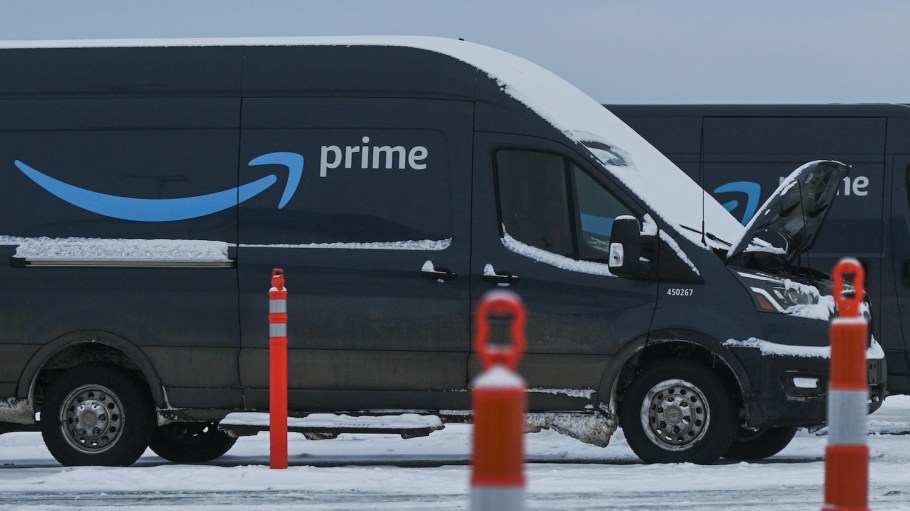
The e-commerce giant’s carrier business surpassed UPS parcel volume for the first time in 2023, according to the Pitney Bowes Parcel Shipping Index, which measures parcel volume and spend for shipments that weigh up to 70 pounds.
Total U.S. parcel volume was up 0.5 percent from 21.5 billion in 2022 to 21.7 billion in 2023, with revenue declining 0.3 percent to $197.9 billion—the first parcel sales decline in seven years.
Related Stories
After seeing total volume increase 15.7 percent to 5.9 billion parcels, Amazon now has the second-largest market share in parcel delivery at 27 percent of volume, the index said. The tech titan commanded 23 percent of market share last year, less than the 24 percent held at UPS.
The United States Postal Service (USPS) generated the highest parcel volume, but the 6.6 billion packages were still down almost 1 percent from last year, taking 31 percent of market share, the index said.
Throughout 2023, volume for both UPS and FedEx as calculated by Pitney Bowes dipped 10.3 percent and 6.1 percent, respectively. UPS now has a 21 percent market share with 4.6 billion parcels, while FedEx has an 18 percent share at 3.9 billion packages.
“Amazon leapfrogging USPS [in volume] wouldn’t be a surprise, but I think the more important question comes down to revenue (and ultimately profits),” said Jason Miller, interim chairperson, department of supply chain management at Michigan State University’s Eli Broad College of Business. “UPS and FedEx are focusing on yield more so than market share growth (which is reflected in the much higher average price point they are charging).”
According to the Pitney Bowes index, UPS and FedEx remain the top players in revenue despite Amazon’s focus on gaining volume. While Amazon Logistics is calculated to have taken 14 percent of market share by revenue in 2023, it still has a long way to go to reach the levels of UPS (35 percent) and FedEx (32 percent).
The good news for brands and retailers is that they have access to accelerating capacity levels throughout logistics, regardless of option, according to Satish Jindel, president at SJ Consulting Group.
“Shippers need to know that the parcel market is in a state it has never been in the last 40 years,” said Jindel, who is a founding member of Roadway Package System, which FedEx acquired and rebranded into FedEx Ground in 2000. “Total parcel capacity is at 125 million packages a day, and the demand is at 80 million. What does that do? It means the shippers have greater influence on managing their pricing.”
Jindel cited data from USPS, which indicates that the agency’s package processing capacity reached 70 million prior to the 2023 holiday season. He noted that the courier more than doubled its capacity since 2020 amid prior concerns ahead of that year’s presidential election, when more consumers mailed in ballots due to the Covid-19 pandemic.
The four largest carriers shared more of the market with smaller competitors in 2023, as “other” carriers saw their combined volumes grow 28.5 percent to roughly 640 million parcels. Revenue among these companies grew 32.5 percent to $5.6 billion in 2023.
“My sense is that, consistent with most markets where there is secular growth, an expanding market allows for more competitors to enter who will target niche customers,” Miller told Sourcing Journal. “This tends to hold in most industries where there are a small number of massive generalist firms and then a secondary set of smaller players serving more specific market needs.”
Jindel had a contrasting opinion on the addition of new last-mile delivery players.
“When the market is saturated with capacity, it’s not a good time to enter the business,” he said.
Currently, Jindel said Amazon should have the inside track to gain more traction in logistics since they already have a B2C business model that complements their ability to pick up and deliver goods from other third-party businesses.
“They can do it very effectively as an operation, but they are struggling with the technology side of it,” Jindel said. “Those other shippers rely on third parties to do a lot of technical and IT work to enable them to ship and bill and manage service for the customer. Amazon is struggling to understand that and enable that.”
Pitney Bowes forecasts that overall U.S. parcel volume will reach between 23 billion and 35 billion by 2029, with the company listing the “most likely scenario” at 29 billion packages, boosted by a 5 percent compound annual growth rate (CAGR) between 2024 and 2029.
At least through 2024, Jindel doesn’t expect much of an uptick in parcel demand outside of the normal 4 percent to 5 percent growth.
“What’s going to make the demand pick up?” Jindel asked. “People have had too many costs, and aren’t sitting one a lot of excess cash to spend. And what they have, they’re spending it on services and entertainment.”