Amazon says its regionalized fulfillment strategy is getting products to the customer faster than ever. And while faster delivery usually costs more, the e-commerce giant claims it’s cutting costs by driving fewer miles and requiring fewer package handoffs.
According to Doug Herrington, CEO of Worldwide Amazon Stores, the company plans to double the number of same-day delivery sites “in the coming years.” Same-day delivery is available in more than 90 U.S. metro areas, Herrington wrote in a blog post.
Related Stories
But one expert believes Amazon has even bigger expansion ambitions.
Marc Wulfraat, president of supply chain consulting firm MWPVL International, estimates that Amazon currently operates 48 sub-same-day (SSD) facilities, which cover 100,000 to 330,000 square feet and fulfill orders in less than five hours after customers hit the buy button. Wulfraat, noting another four are under construction, said Amazon could be looking to scale up to 150 facilities in the next three years.
“These buildings are unlike the ones that have been closed, delayed or cancelled in that they provide ultra-fast service to customers that live close to the SSD facility,” Wulfraat told Sourcing Journal. “We expect this program to triple in size in the near future.”
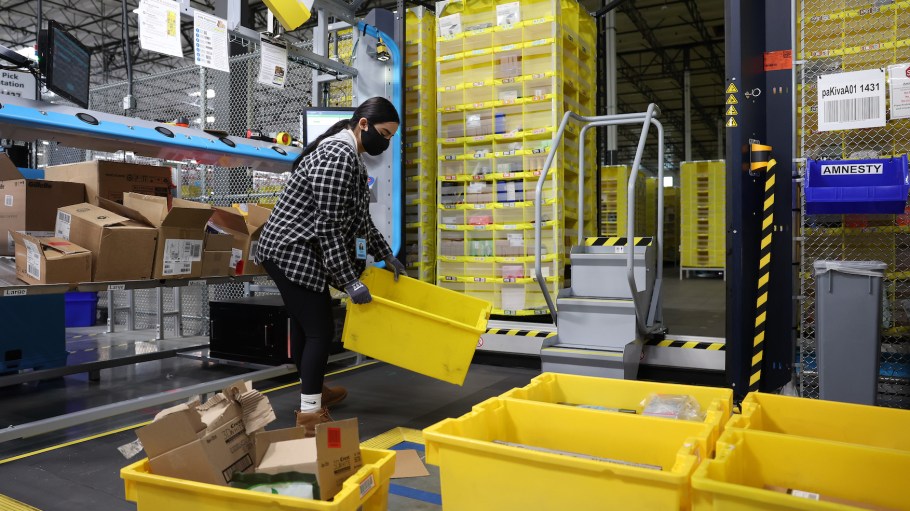
SSD facilities are close to the metropolitan areas they serve. They’re designed for speed with smaller physical footprints, streamlined conveyors and a more efficient picking and packing system. They circumvent the need to send a package to a sortation center and then to a delivery station.
Herrington said same-day facilities average just 11 minutes to pick a customer’s item and put their package on the outbound dock, more than an hour faster than traditional fulfillment centers.
“And these hybrid facilities allow us to fulfill, sort, and deliver all from one site—making the entire process of delivering customer packages even faster,” Herrington wrote. “Selection varies by city, as we regularly update our product offering based on what we’re seeing as top customer items purchased or based on seasonal demand in the area. And with connections to the larger Amazon fulfillment centers nearby, we dramatically increase the number of items available for fast delivery.”
The changes are paying off. Since the beginning of the year, Amazon cut the distance between the facilities the customer by 15 percent, with 12 percent fewer touch points in the middle mile network.
“You can look at same-day facilities like a traditional retailer would look at a store. Similar to what Target has done with same-day services,” said Rick Watson, CEO and founder, RMW Commerce Consulting. “How far the package travels from the last facility to the consumer is about 40 percent of the cost. This can go down significantly if local drivers/routes can travel directly from from these same-day facilities, rather than handing off to another carrier or facility.”
Amazon used to fulfill e-commerce orders from any of its U.S. sites. But now, since it has eight interconnected regions serving smaller geographic areas, more than 76 percent of orders are fulfilled from within the customer’s region.
“The national network had become too big and unwieldy,” Watson told Sourcing Journal. “This essentially has broken their supply chain problem down into many sub-problems which are more tractable than trying to solve it in one nationwide network.”
Herrington said the company has delivered more than 1.8 billion units to U.S. Prime members the same or next day so far this year—nearly quadrupling this metric versus 2019.
“We use increasingly advanced machine learning algorithms to better predict which items customers in various parts of the country will want and when they will want them, and we work with our vendors and selling partners to store those products closer to customers,” Herrington said.
The same-day and one-day delivery success is a far cry from two years ago, when the company’s need for more warehouse space to meet surging e-commerce demand slowed its fulfillment ambitions. At the time, Amazon said that its falling one-day delivery percentage hadn’t rebounded to pre-pandemic levels.
But with e-commerce demand coming down since the Covid peak, Amazon’s regionalization push marked an opportunity to invest in better delivery service levels, according to Neil Saunders, managing director of GlobalData Retail.
“This is important at a time when Amazon is facing more competition from traditional retailers and newer entrants like Temu,” said Saunders. “Amazon’s logistical prowess is a real advantage and one that rivals will struggle to match…It’s also the case that those customers who use same-day delivery tend to be more loyal to Amazon and use the retailer more.”