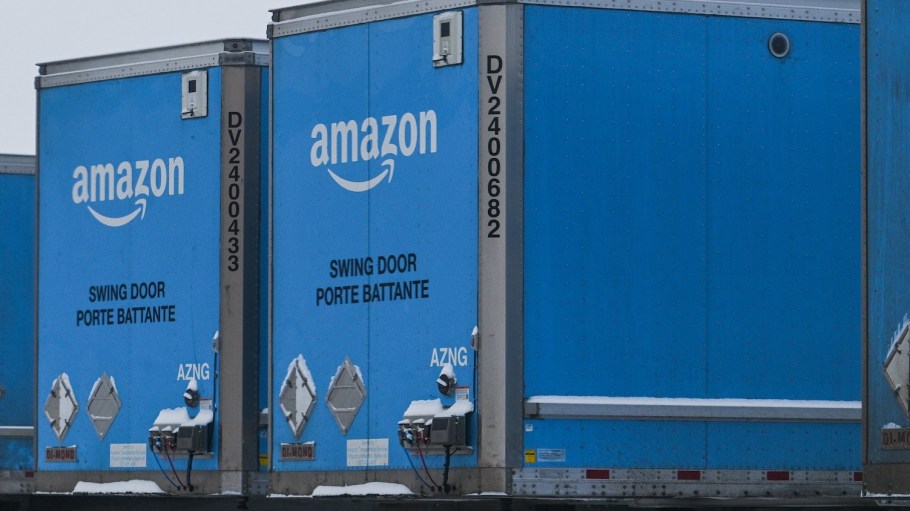
About 200 workers at an Amazon warehouse in Quebec have won unionization after the Canadian province’s labor arbiter certified their application.
Employees at the “DXT4” warehouse in Laval, Quebec, will join the Confédération des Syndicats Nationaux (CSN), which represents 330,000 workers in the public and private sectors in all regions of Quebec and across Canada.
The province’s Administrative Labour Tribunal (ALT) accredited the union on Friday, after calculating that a majority of the workers at the Laval warehouse signed union cards.
Related Stories
According to the union, Amazon workers have cited many reasons for dissatisfaction with their working conditions that would drive them to unionize: low wages compared to the norm, the “frenetic” pace of work, “woefully inadequate” health and safety measures.
The certification took place weeks after warehouse workers across the pond in Coventry, England won the right to a unionization vote. The date for that vote has not been set yet.
Before the tribunal made its decision, Amazon said it would contest any ruling that approved the union. A hearing has been set for June 10. The tech titan takes issue with the card check certification process, namely because a union application can be accredited without a vote.
“We believe it’s important for all employees to have their voices heard, but card check auto-certification does the opposite. For example, if someone joins a union at a previous employer or before being hired by Amazon, the law assumes they want that union to represent them at any future employer—whether they actually want that or not,” said Amazon spokesperson Barbara Agrait. “And if a simple majority of people at an employer have joined a union at any point (whether while there or at a previous company), then there’s no vote and representation is automatic for all employees—including maybe dozens or hundreds of employees who didn’t even know it was being considered.”
According to Quebec law, the labor tribunal must certify a union even if the employer refuses to agree to part of the bargaining unit if a majority of workers want to be unionized.
Other unionization efforts are currently brewing in Canada. In April, Unifor filed applications to represent workers at two Amazon warehouses in New Westminster and Delta, B.C. However, the union subsequently withdrew its applications upon accusing the online retailer of providing a “suspiciously high” employee count. Nevertheless, the labor organization has vowed to continue the unionization push at both locations.
Amazon delays low-inventory-level fees again
Amazon has again delayed one of its recently implemented and controversial seller fees. For the second time, the e-commerce giant is postponing the full implementation of a “low-inventory-level” fee that it charges third-party sellers for using the popular Fulfillment by Amazon (FBA) service.
Seller fees have gotten Amazon in hot water from third-party merchants on its platform, even garnering attention from the Federal Trade Commission (FTC) for the hefty chunk of revenue apparently extracted from the sellers.
According to a post on the company’s Seller Central forum, Amazon will extend a credit all FBA low-inventory-level fees incurred between April 1 and May 14, past the initial date of May 1.
“We have been listening to seller feedback and working with our seller partner community to explain our updated fees, which are designed to more accurately reflect underlying input costs for Amazon and sellers, give sellers more choice for how they inbound their inventory to our sites, and ultimately help spread inventory across our fulfillment network so we can deliver products faster and increase sales for our selling partners,” an Amazon spokesperson said in a statement.
Along with the extension of the transition period, Amazon rolled out other changes to the low-inventory fees, stating that they would not apply to products that have sold fewer than 20 units in the last week. All fees incurred due to excessive inbounding and processing times caused by Amazon or Amazon-managed services will be credited back to sellers by the 15th of the subsequent month.
Amazon’s seller services revenue of $34.6 billion in its most recent quarter was up 36.5 percent from two years earlier, more than triple the pace of growth of its fulfillment expenses, which were $22.3 billion in the period.
Throughout 2023, Amazon generated $140 billion alone in seller services revenue.
Amazon has been shown to be flexible about setting up charges in the past, reneging last fall on a proposed 2 percent fee that would have been tacked on for third-party sellers using the relaunched Seller Fulfilled Prime (SFP) delivery program. At the time, the move appeared to be a way to generate more revenue from sellers who shipped Prime-eligible products out of their own warehouses instead of Amazon’s.