Worldly is envisaging a “new era” of cleaner, greener supply chains with Higg Facility Environmental Module (FEM) data-fed visualizations.
The technology platform—aka what hosts Cascale’s Higg Index suite of social and environmental measurement tools—has upgraded its arsenal with additional compliance and supply chain intelligence solutions. Worldly now offers the Insights Hub and Eco Scores: what the sustainability tool formerly known as Higg Co said will build resilient, future-focused supply chains faster.
Related Stories
“Brands, retailers and suppliers across the global consumer goods industry face growing pressure to meet climate goals, maintain compliance and drive business performance—all with greater speed and at global scale,” said Scott Raskin, CEO of Worldly. “With the deep, intuitive analytics of Insights Hub, our customers can transform complex supply chain data into clear, strategic action and make faster, smarter decisions across sourcing, procurement, sustainability and executive leadership.”
Considering the comprehensive impact intelligence platform used by over 40,000 global brands, retailers and manufacturers throughout the supply chain, the new hubs consider how those players utilize product and primary supply chain data to drive scalable decarbonization. In turn, the expanded solutions allegedly provide quick, actionable insights; allowing a given value chain’s various collaborators to more clearly see where risk(s) exists for faster extinguishment.
“Having the ability to visualize supplier data—across countries, across our full portfolio—is incredibly powerful,” said Cerian Atwell, sustainability lead at Marks & Spencer. “It helps us set realistic targets and identify which supplier programs will have the greatest impact.”
Eileen Fisher shared similar sentiments, as the Circular Biosphere Project member allegedly uses data to collaboratively “build connection and clarity.”
“Quantitative data isn’t the destination—it’s the starting point for deeper, more meaningful conversations,” Susan Scow, sustainability impact specialist at Eileen Fisher, said. “As we dig further into tiers two and three of our supply chain, maintaining strong, individual relationships with suppliers year over year becomes critical.”
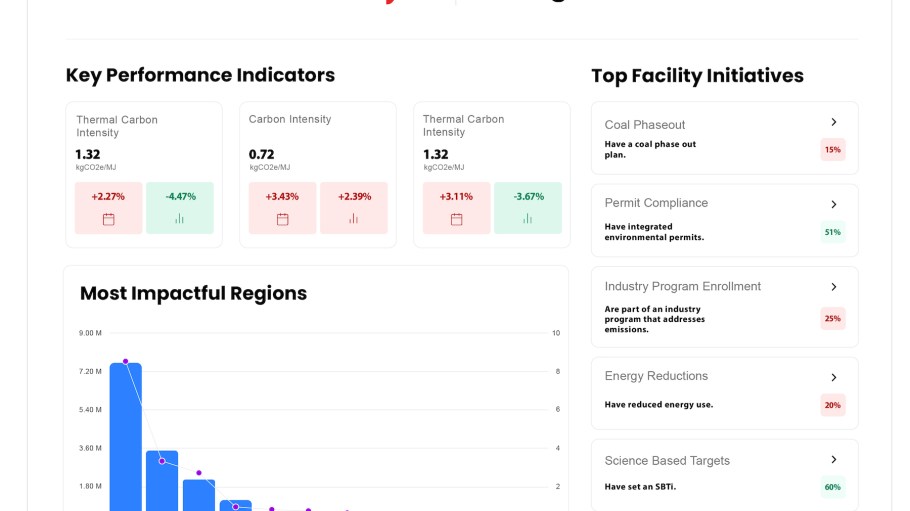
Worldly argued its Insights Hub is an industry first, featuring a “focused dashboard” of the top five decarbonization key performance indicators (KPIs) that “every business” should consider (see: chart). That includes: a company’s total supply chain carbon emissions, the carbon intensity of an individual facility—or specific group of facilities—electricity and thermal carbon intensity (CI), what percent of electricity is onsite purchased renewable and, finally, the energy intensity of a plant’s production.
“Aligning on CI gives us a common language to measure and compare impact—across countries, facilities and production processes,” said Paul Goff, traceability and sustainability senior product manager at H&M. “It strips out variables like production volume, which can cloud the picture, and focuses on how clean the energy is. It’s simple, it’s comparable, and it’s actionable—exactly what we need to drive real decarbonization across the industry.”
The Eco Scores segment, meanwhile, expands on Worldly’s Product Impact Calculator (PIC) abilities.
Launched last September, PIC was pitched as a data measurement tool for apparel and consumer goods companies to establish the “much-needed foundation” for measuring their product line’s Scope 3 emissions. Now, those businesses can produce “Eco Scores” to model and calculate those emissions using supplier-provided primary data; consider textile mills and gins, where Worldly alleged that over 80 percent of environmental impact occurs. The PIC can pick up primary data from finished goods suppliers, too. In turn, brands and manufacturers should make more precise calculations when reporting Scope 3 emissions.
For France—where product labeling regulations require a certain je ne sais quoi—the Cascale collaborator introduced the French EcoScore. This “game-changing transparency and accountability solution” is Worldly’s way of supporting companies in meeting regulatory expectations ahead of market demand to curb risk.
And this is “just the beginning,” according to Raskin, as the Insights Hub is working to include metrics on water, waste and social performance, among other efforts.
“As climate-related disruptions accelerate—from factories in flood zones to sourcing regions facing wildfires and extreme heat—businesses need to see their data in geographic and environmental context,” Raskin continued, noting Worldly will soon give users access to detailed operational data with localized climate risk. “This insight will help our customers identify where their supply chains are vulnerable, take proactive steps to protect workers, and build the resilience needed to navigate an increasingly uncertain world.”