New year, old news: The apparel industry has immense indirect emissions.
For most clothing brands, over 90 percent of greenhouse gas emissions come from the supply chains and product life cycles, not their own operations. Traditional reporting methods often rely on broad averages or estimates—which can miss real hotspots or opportunities, according to Worldly.
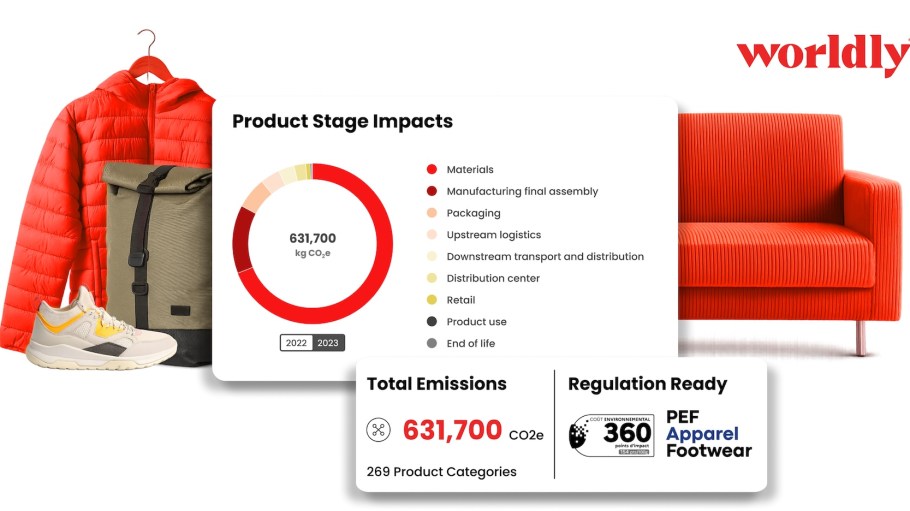
The sustainability and supply chain intelligence platform announced a major upgrade to the Product Impact Calculator, its tool for measuring a product’s carbon footprint and indirect supply-chain emissions. Cascale’s strategic partner said the expanded PIC gives consumer goods companies a scalable, data-driven way to measure and manage Scope 3—the (usually) largest share of a product’s environmental footprint, which regulators increasingly require.
Related Stories
“Scope 3 used to be a guessing game,” said Scott Raskin, CEO of Worldly. “With this expansion, brands no longer have to choose between speed and accuracy—they can have both.”
While Worldly first designed the PIC to measure apparel’s more evasive emissions, the tool has moved beyond its original 40 categories: The new schema now supports 269 categories—a 572.5 percent increase—across seven distinct industries. The tool now integrates primary supplier and material input data, making emissions calculations more precise and actionable than spend-based methods or rough averages.
The expansion lets multi-category brands move beyond “spend-based” estimates for Scope 3 emissions by using primary data from over 40,000 companies to identify emissions hotspots and model decarbonization scenarios. By integrating supplier data and focusing on high-impact variables such as product weight, organizations can achieve significant improvements in emissions accuracy, according to the Higg Index’s exclusive licensee.
“The PIC gives companies the clarity they need,” Raskin said. “To design better products, run smarter supply chains, report more accurately and move forward strategically nd responsibly.”
The updated tool combines supplier and material data with lifecycle insights, so brands can see the impact of individual styles rather than relying on rough spending proxies. For example, companies can model the lifecycle emissions of a cotton T-shirt versus a recycled polyester jacket—across production, transport, washing and end-of-life—to identify where the biggest impacts occur.
With product-level visibility, apparel brands can see which materials (or supply partners) contribute most to emissions, and model the impact of design (or sourcing changes to focus decarbonization efforts using real data, the Higg Index-hosting platform said. Apparel makers can test “what if” scenarios—different suppliers, materials, or packaging—and quantify carbon savings. Brands using the tool can also integrate supplier emissions data and get audit-ready Scope 3 figures faster.
The outputs align with international sustainability frameworks, according to the public-benefit technology company.
As global regulations accelerate, Worldly said the PIC can serve as a standardized data foundation to meet emerging legal requirements. The expanded tool considers compliance with the EU’s Corporate Sustainability Reporting Directive (CSRD) and the digital product passport (DPP), as well as environmental labels, such as France’s Environmental Cost.
By generating data that brands can use for reporting and product labeling frameworks, early adopters of the enhanced tool cited improved visibility, faster modeling and more confidence in making green(er) choices.
“We’ve identified emissions hotspots, explored decarbonization scenarios and prioritized actions backed by real numbers,” said Shasta O’Loughlin, head of ESG at KMD Brands. “Worldly’s PIC gives us highly tangible insights we can use across teams and in preparation for upcoming regulations.”
After early PIC adopter Komar onboarded “thousands of products to unlock material-level visibility and guide investment decisions,” clearer Scope 3 emissions data allowed the company to focus investments for the greatest impact.
“Rather than doing calculations manually or using another third-party, we can use the PIC to save time and money while achieving accurate simulations. We can see what would happen if we changed from Supplier A to Supplier B or changed the boiler from one type to another,” said Thiwanka De Fonseka, Komar’s chief sustainability officer. “Using the PIC makes our internal work much easier and gives us great confidence in our results.”