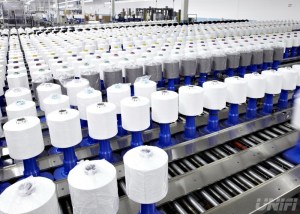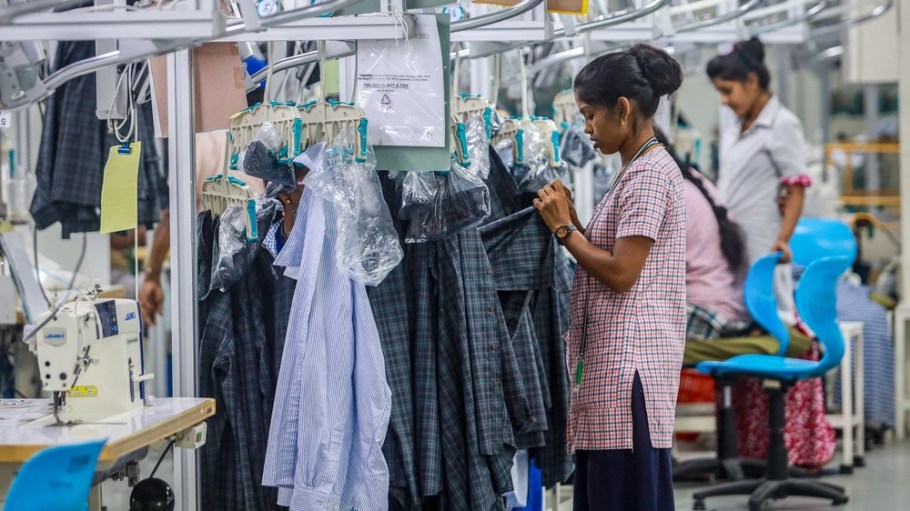
The World Bank warned in a new report that the Trump administration’s 20 percent “baseline” tariff on all freight from Sri Lanka as of Aug. 7 could shrink the South Asian nation’s garment exports to the United States by as much as 12 percent, imposing pressures on employment that could disproportionately affect the livelihoods of tens of thousands of low-skilled workers and women.
While the 20 percent levy is a reduction from the higher tariff rates of 44 percent and 30 percent announced in April and July, it would still be stacked on top of the Sri Lankan Most Favored Nation rate of 16.8 percent, albeit with slight variations depending on the product, Anthony Obeyesekere, the World Bank’s senior economist for Sri Lanka and Maldives wrote in the Sri Lanka Development Update, published earlier this month.
Related Stories
The United States is Sri Lanka’s largest single-country export destination, racking up $3.2 billion worth of shipments in 2024 that made up 22 percent of total exports and contributed 3.2 percent of its gross domestic product. Of these, more than half, or 56 percent, comprised garments for popular brands such as Calvin Klein, Gap Inc., H&M Group, Nike and Victoria’s Secret.
The parity in tariff rates with garment-producing rivals such as Bangladesh, Cambodia and Vietnam suggests “limited possibility” for trade diversion, Obeyesekere said. Conversely, given the limited overlap with India’s export base, it’s unlikely that Sri Lanka would reap much benefit from the 50 percent tariff on India, which took effect in late August after Washington sought to punish Delhi for purchasing Russian oil and weapons.
“Sri Lanka’s primary exports to the U.S. are undergarments, performance wear and higher-end clothing, which are relatively price inelastic,” he wrote in the report. “According to industry experts, Sri Lanka does not compete on price but rather on quality, better labor standards, sustainability, traceability and compliance, suggesting that buyers of Sri Lankan exports may be less price sensitive. Even so, manufacturers operate on very thin margins (2-5 percentage points) and would be unable to absorb the entire additional 20 percent tariff.”
Other challenges that could diminish Sri Lanka’s export competitiveness include the modest size of its workforce, a dearth of domestically raw materials and intermediate products, and high construction and electricity costs.
If garment exports tumble by the International Finance Corporation’s projected $220 million, Obeyesekere said, the jobs of as many as 16,000 people could be put at risk, particularly when coupled with cascading effects from a global slowdown. Beyond addressing its structural issues, he said, Sri Lanka must look to improve its edge by diversifying its markets and products.
“Improving market access to Japan, Australia, and Korea through preferential trading arrangements and shifting with evolving consumer preferences from natural fibers to man-made fibers can aid diversification efforts,” Obeyesekere wrote. “In the medium-term, shifting toward innovative, higher-value categories, such as performance, athleisure, and shapewear, where brand stickiness and compliance command high premiums, could help Sri Lanka absorb the tariff impact and sustain growth in the sector.”
Yohan Lawrence, secretary-general of the Joint Apparel Association Forum, Sri Lanka’s foremost garment industry trade group, agreed that Sri Lanka’s focus must be on innovation, diversification, and skills, ensuring that the nation is “recognized globally not for low-cost production, but for the quality, ethics, and creativity that define the ‘Made in Sri Lanka’ brand.”
“The World Bank’s latest update reinforces what we in the industry have long emphasized: that apparel remains central to Sri Lanka’s economic recovery, sustaining hundreds of thousands of livelihoods while navigating global tariff and market pressures,” he said. “The report’s findings highlight the need for stronger policy alignment in trade facilitation, energy costs and labor participation to safeguard our competitiveness.”
Despite the World Bank’s detailed macroeconomic perspective, however, it failed to “capture the lived realities of workers whose real wages have been eroded by inflation,” said Abiramy Sivalogananthan, regional coordinator for South Asia at the Asia Floor Wage Alliance, a workers’ rights group.
Sri Lanka’s garment workers have borne the brunt of years of economic and political upheaval, which pushed inflation levels to impossible highs, devalued the national currency and caused the prices of basic commodities to soar beyond reach. Their minimum wage of 21,000 Sri Lankan rupees, or $70, is roughly 13 percent of what would constitute a living wage, according to one estimate.
“Wage reforms must go beyond fiscal efficiency and place workers’ dignity, economic security and the right to a living wage at the center of policy discussions,” Sivalogananthan said.