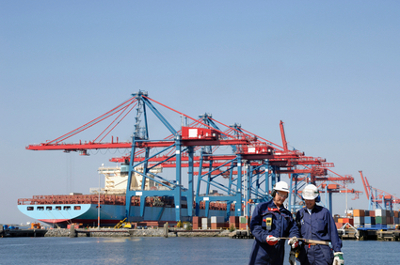
The West Coast port backlog brought on by an ongoing contract negotiation between dockworkers and their employers is clearing more quickly than expected.
Mid-May was when industry experts predicted things would be back to normal, but the date could come sooner than that.
Rachel Campbell, media relations manager for the Port of Los Angeles said, “Things are moving along a lot faster than we thought,” adding that, “Currently there are only eight container vessels at anchor outside LA/Long Beach ports, as compared to a high of 31 during this period of congestion.”
At the nation’s largest ports, ships idling at anchor are never the norm, but when workers started slowing down as negotiations dragged on, not enough was getting done.
Related Stories
But in looking at dispatch summaries for ships in port in L.A. and Long Beach as of the first shift Tuesday, 57 percent were idle, waiting to be worked on, compared to 46 percent on March 5.
“There is a high idle time,” Campbell explained, “But there’s been a steady decline in the amount of wait time. The ships are able to get in and leave faster.”
At the peak of the pile-ups in February before the tentative agreement was reached, dwell time was almost nine days, and now it’s six or seven days, Campbell explained.
Since February, the ports launched a couple of programs designed to improve efficiency and target the congestion, one of which is called the “Peel Off” program.
The Port of Los Angeles teamed with stevedoring company The Pasha Group, harbor trucking firm Total Transportation Services Inc. (TTSI), several marine container terminal operators and a group of major retailers to create the program, which involves “peeling off” containers of high-volume customers to a nearby dock yard where they are sorted for destination to inland distribution centers.
“The trucks are doing exactly what everyone needs them to do – make more turns every day,” TTSI president and CEO Vic La Rosa said in a statement last month. “This single step eliminates multiple inefficient moves so cargo flows faster and more reliably.”
Shortage of chassis, or the wheeled trailers trucks use to haul cargo containers, had also been a contributing factor in the pile-up, and both the L.A. and Long Beach ports are keeping good on their previous promises to improve efficiency at the docks.
According to a February statement, non-interoperable chassis pools created a chassis imbalance at marine ports and added to the delays. A new pact launched in February, in partnership with Direct ChassisLink Inc. Flexi-Van Leasing Inc. and TRAC Intermodal, allows more than 80 percent of chassis in service at the L.A. and Long Beach ports to be used interchangeably, which, according to the Port of L.A., “will greatly improve the ease and efficiency of obtaining chassis.”
“This is a major step forward in addressing the congestion issues that have challenged the San Pedro Bay cargo flow in recent months,” Port of Los Angeles executive director Gene Seroka said. “The gray chassis pool, along with other initiatives underway to improve efficiencies, will help our marine terminals move effectively towards restoring cargo flow through this important gateway.”
Campbell said, “I think working in cooperation with the Port of Long Beach on some of these programs has made a big difference. We’re partnering up to tackle the problem head on and our execs have sat down and hashed out ideas time after time about what to do here. And labor demand is pretty hight right now, they [dockworkers] are working at full force.”
Dockworkers represented by the International Longshore Warehouse Union (ILWU) and their employers, represented by the Pacific Maritime Association (PMA), were at odds for 10 months over the terms of a labor contract, but problem is now approaching an official end as the dockworkers’ delegates voted last week to approve the tentative agreement on the terms reached in February.
“They’ve moved the agreement forward, so I think that’s pretty much covered everything,” Campbell said. “So with that hopefully being ratified everything should get back to normal.”
A secret ballot membership ratification vote will seal the deal and the final tally will take place May 22.