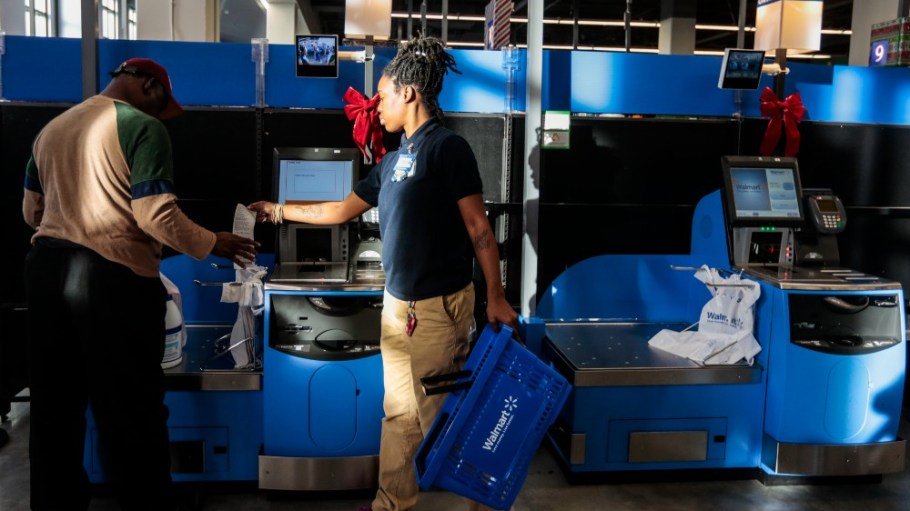
Walmart is the latest big-box retailer to back away from self-checkout.
The Arkansas-based corporation is following in the footsteps of Dollar General and Target by quietly removing self-checkout lanes from a handful of stores in what it claims is a bid to better the consumer experience.
“As part of our announced plans for additional investments and improvements to facilities across the country, we’ve decided to remove self-checkout lanes and replace them with staffed lanes at select locations,” including stores in Shrewsbury, Mo. and Cleveland, Oh., a Walmart spokesperson told Sourcing Journal.
Related Stories
The move comes months after three New Mexico stores eliminated self-checkout in 2023.
“These decisions were based on several factors, including feedback from associates and customers, shopping patterns and business needs in the area,” they added. “We believe the changes will improve the in-store shopping experience and give our associates the chance to provide more personalized and efficient service.”
Walmart declined to share its forward-looking strategy on the matter or confirm whether self-checkout would be eliminated from other locations in the future. It also declined to share whether increases in shoplifting and retail crime played a role in the decision.
The move to pare back self-checkout is an about-face for the retailer, which leaned into contactless, convenient in-store checkout processes during the height of the Covid-19 pandemic. In 2020, Walmart announced the launch of a new Coral Way, Fla. store built around retail innovation, from roaming associates to help shoppers check out using on-the-spot POS systems to fully automated self-checkout lanes designed for large carts.
At the time, the retailer’s regional vice president of Neighborhood Market operations Patrick Shanks said he believed store associates would appreciate the leveraging of automation to lessen their workload. “Associates across the country tell us they want to spend less time on repetitive tasks and more time helping customers,” he said. By expanding tools like self-checkout, “associates will be on the sales floor where they can help customers—fast,” he added.
While the company was full steam ahead on advancing self-checkout capabilities four years ago, it appears to have slowed its roll—and it’s not the only one.
During a Q4 earnings call earlier this year, Dollar General CEO Todd Vasos lamented the role that increased retail shrink has played in reducing the franchise’s profitability. To address the issue, it has begun converting some or all self-checkout registers to employee-assisted operations across 9,000 nationwide stores. At the locations where self-checkout is still an option, transactions will be limited to five items or less.
“And finally, over the first half of the year, we plan to completely remove self-checkout from more than 300 of our highest shrink stores,” Vasos added.
Meanwhile, Target announced last month that it plans to roll out Express Self-Checkout, which limits guests to buying 10 or fewer items at self-checkout stations, at 2,000 stores across the country. The decision comes after the retailer piloted the program at 200 locations last fall.
“The result: Self-checkout was twice as fast at our pilot stores,” the company said in a statement. “By having the option to pick self-checkout for a quick trip, or a traditional, staffed lane when their cart is full, guests who were surveyed told us the overall checkout experience was better, too.”
In addition to limiting cart size for self-checkout, Target is also opening more checkout lanes staffed by flesh-and-blood store associates. Meanwhile, it said it will empower store managers to set self-checkout hours for their stores based on their location’s unique needs, routing shoppers to conventional checkout lanes during certain times.