Victoria’s Secret and Bath and Body Works parent L Brands has a five-year streak of financial success that makes it the envy of specialty retail.
Between 2009 and 2014, sales at the company’s almost 3,000 stores and rapidly growing e-commerce sites have jumped 46 percent from $7.8 billion to $11.2 billion. Net income has skyrocketed 141 percent from $811 million to $1.9 billion. Adjusted earnings per share have grown from $2.06 five years ago to $3.50 in 2014. Total shareholder return on a 1-, 3-, 5- and 10-year basis puts it at or near the top of all publicly-held retailers.
Victoria’s Secret, known for its scantily-clad supermodels and wildly popular fashion show televised on CBS each year, is the company’s largest business. Its $7 billion in 2014 sales, which include those from the very successful PINK brand, gives it a 35-40 percent share of the U.S. innerwear market, according to market research firm NPD.
Related Stories
The company’s other key brand, Bath and Body Works, last year sold $3.4 billion worth of scented lotions, creams, gels, soaps, mists, body washes and candles in dozens of scents with names like Cherry Blossom, Paris Amour, and White Tea and Ginger.
The two brands are fixtures in every top mall in the U.S., and their rapidly growing direct-to-consumer (online) businesses now total $1.8 billion.
Dominating the U.S. retail scene is not enough for the bath and boudoir giant, however. For the past year or so, CEO Les Wexner has been telling analysts that its goal is to become the best in the world.
But while other U.S. brands are rushing to Europe, Asia and South America looking for growth—and hitting snags along the way because they didn’t do their homework on the local markets—L Brands is proceeding cautiously and methodically, not wanting to mar its impressive sales and earnings growth with missteps abroad.
Three years ago, the company entered into a license agreement with Kuwait-based M.H. Alshaya to open Victoria’s Secret lingerie specialty stores in the Middle East. Analysts estimate that L Brands collects royalties of between 10-15 percent of sales while Alshaya does everything else. There are now a total of 13 Middle East stores, in places like Dubai, Kuwait, Saudi Arabia and Qatar, with four more slated to open in 2015.
In 2012, the company opened its London flagship located on New Bond Street in the city’s main fashion shopping area. At more than 40,000 square feet, it has enough space to carry the full Victoria’s Secret lingerie, Swim, Sport and PINK assortments, and is setting new traffic records driven by a significant portion of foreign visitors. As of the end of 2014, the company had a total of 10 stores in the U.K., with four new ones planned for 2015.
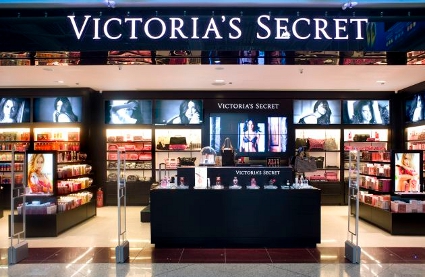
The vast majority of the company’s almost 400 international locations, however, do not carry lingerie. Though they bear the Victoria’s Secret nameplate, they are officially called Victoria’s Secret Beauty and Accessories (VSBA), and sell primarily fragrance products, makeup bags, cell phone cases, small leather goods, sunglasses and other non-lingerie items. These franchised stores are operated by partners in Asia, Europe, Russia, the Middle East, Latin America and elsewhere. L Brands has little or no capital invested in these businesses, most of which are located in airports, but collects a royalty based on sales. Of the 120 new international stores opening in 2015, 112 will be VSBA.
Though the Bath and Body Works international business is smaller, it is growing rapidly, currently totaling 80 franchised locations outside North America and 50 new ones slated to open in the next year.
Despite the apparent success of the full-line owned-U.K. stores, it seems the company feels that its international business model, focused on franchised VSBA selling mostly beauty and accessories, is the right direction for the international business. Total international revenues nearly tripled to $336 million in 2014 from the prior year, and operating income doubled to $78 million, or 23.2% of revenue, compared to a 17.1% operating income rate for the whole company. Wexner has been quoted as saying he sees the opportunity to grow the VSBA concept to 1,000 stores globally.
On the most recent quarterly earnings conference call, Martin Waters, who heads L Brand’s international business told analysts, “I’m really happy with the capital-light partnership model, and have no plans to change it.”
He then added, however, “The international business is small, we are still developing, we’re still growing the foundation, so I would say watch this space and stay close.”