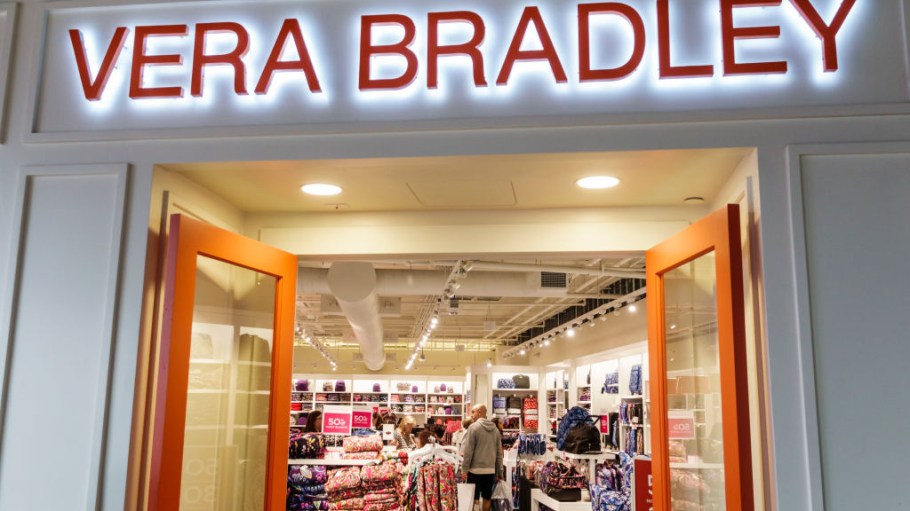
Vera Bradley Inc.’s largest shareholder wants profits, not cash burn.
Fund 1 Investments on Monday sent a letter to the company’s chairman Robert J. Hall and the specialty retailer’s Board of Directors indicating that it wasn’t happy with the brand’s turnaround efforts.
“We, as your largest shareholder, simply want Vera Bradley to return to its winning ways,” the letter said. In its first year of being public, Vera Bradley generated $366 million of revenue and nearly $50 million of free cash flow, translating into a $1.5 billion enterprise value company. Today, analysts expect $380 million of revenue—essentially the same topline as when the company IPO’d.”
Related Stories
The letter went on to note that the same $360 million plus in revenue is “expected to burn cash,” and that the $1.5 billion enterprise value has an implied “negative value today, adjusted for the acquisition of Pura Vida.”
The accessories firm completed its initial public offering on Oct. 21, 2010. It paid $75 million in 2019 for a 75 percent majority stake in the direct-to-consumer jewelry brand Pura Vida. Vera Bradley subsequently acquired the remaining 25 percent in January 2023 for $10 million.
Fund 1, which beneficially owns 10 percent of the outstanding common stock of the accessories brand, said Vera Bradley not only has a history of value destruction and questionable capital allocation, but that it is also operating in a backdrop of “extremely negative macro sentiment for fashion brands.” Moreover, it also charged that the public float is now less than $60 million.
“It is clear to us that the best option for Vera Bradley and its shareholders is to commence a strategic alternatives process and pursue opportunities to fix the company under the umbrella of a larger organization or in the private markets,” the letter said, adding that it has already had a conversation with the board indicating an openness to maximizing shareholder value. It also cited several benefits to operating outside of the proverbial “glass fishbowl” of Wall Street where management can focus on the business without having to deal with shareholder meetings or quarter earnings reports.
Fund 1 also said it believes that either a strategic or financial buyer would be able to acquire the brand at an attractive premium for shareholders. It also said if the company is sold to a financial buyer, the board should consider a transaction where existing stakeholders could partake in the transaction to maintain or increase their interests, which Fund 1 said it “would be willing to do.”
“Vera Bradley’s Board of Directors and management team are committed to acting in the best interest of the Company and we are open to constructive engagement that supports our goal of enhancing value for all shareholders,” Vera Bradley CEO Jackie Ardrey said in a statement to SJ.
She added that the Board maintains open communications with its shareholders, and regularly reviews the company’s strategic priorities and assess potential opportunities. “We remain highly focused on executing our brand transformation plans, listening to customers, and nurturing the green shoots we’ve seen,” Ardrey said.
For the third quarter ended Nov. 2, the company posted a net loss of $12.8 million, or 46 cents a diluted share, against net income of $5.1 million, or $16 cents, a year ago. Net revenues dropped 29.9 percent to $80.6 million from nearly $115 million.
Ardrey said at the time that the third quarter was “extremely challenging” as the company was still in the early stages of its “Project Restoration” initiative to shift its business model and transition the brand’s positioning.
She said the company entered the fourth quarter with no debt and $13.7 million in cash, and that it was “prudently managing the business through a conservative lens.”
Ardrey joined the company as president and CEO on Nov. 1, 2022, succeeding Robert Wallstrom upon his retirement as CEO. Former president Daren Hull left the company in January 2023 as part of a company restructuring. Prior to his departure, Hull spoke at Sourcing Journal’s Fall Summit in October 2022, where he said his greatest concerns for Vera Bradley surround its supply chain, such as logistics expenses, legislation, increased material pricing, increased cost of transportation, and tariffs. At the time, the accessories firm and other fashion companies were still adjusting to the changes—including consumer spending patterns—brought upon by the COVID-19 pandemic.
Activist investors have been particularly active in the fashion space. The year started with Gildan Activewear investor Browning West seeking it ouster the apparel firm’s CEO so it could reinstate former CEO Glenn Chamandy to the post. The activist was successful in its quest. More recently, earlier this month Macy’s Inc. was pressured by activists Barington Capital Group and Thor Equities to spin off Bloomingdale’s and Bluemercury, among other changes. In July, Macy’s ended talks with activists Arkhouse Management Co. and Brigade Capital Management, who had offered $6.9 billion, or $24.80 a share, to take the retailer private.