One startup has been working toward scaling a plug-and-play way to connect designers’ creations with knitting manufacturers.
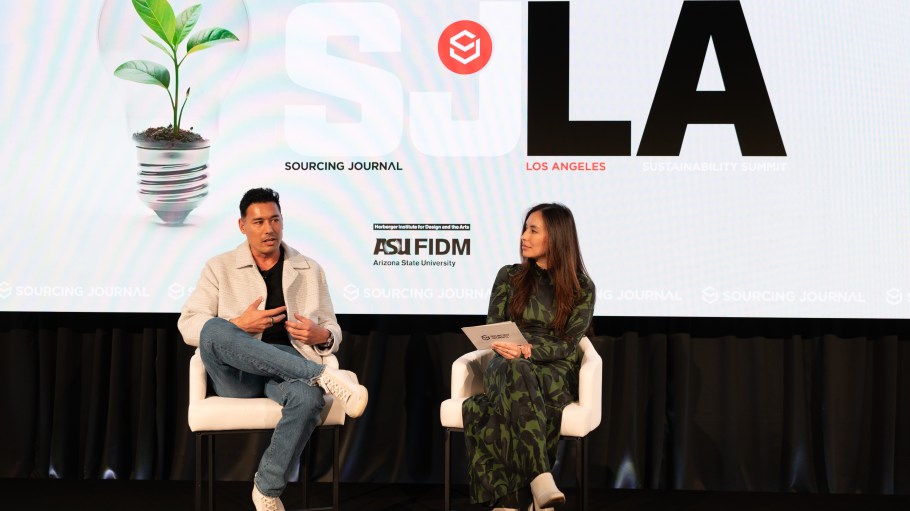
At Sourcing Journal’s Los Angeles Sustainability Summit, Garett Gerson, co-founder and CEO of Variant3D, sat down with Kate Nishimura, Sourcing Journal’s senior news and features editor, to discuss the merits of 3D visualizations that can be shared with manufacturers directly.
To him, the technology draws parallels to what 3D printing is able to do for other industries.
Related Stories
“3D knitting is the closest thing to 3D printing textiles that the industry will ever get to,” Gerson said.
Gerson said that his experience working in fashion and apparel showed him that software systems meant to accelerate the design process are often disjointed, making it difficult for designers and planners to leverage them together for meaningful impact.
To help mitigate that for others, he co-founded Variant3D, which enables faster prototyping, quicker time-to-market for brands and the opportunity for brands to connect with manufacturing partners.
“None of those softwares talked. They never interacted. And I thought, if I could build something that could integrate all of that—like a Figma for textile design, take a designer’s true intent and have you actualize it in real time and create a high-fidelity 3D model—well, hey, that’s the thing that everyone’s been talking about wanting for the last 20 years,” Gerson told the audience.
Still, Gerson said that, like other founders, he has had to present a primary value proposition that goes beyond sustainability outcomes alone. In essence, he said, teams want technology to make their jobs easier—and when sustainability can simultaneously be achieved, that’s a major win. 3D modeling for knit can result in low or no-waste production, but it’s also known for quicker turnaround times and the fact that many knit designs don’t require sewing during post manufacturing. Gerson said he has played up the latter advantages when selling brands on the idea of 3D knitting.
“It’s quite hard to sell sustainability, which I’ve found for the last few years, into brands. So what I’ve done is I pivoted, because in order to be more sustainable, you are going to save on cost, time, shipping, freight cost, all these things are key drivers to your bottom line of profitability in your product,” he said.
The company’s proprietary software, Loop, helps clients in a variety of industries—including fashion, apparel and footwear—to design in 3D to be knit later. Loop offers a pre-validated library of knit structures, and designers can customize the patterns, using colors, textures, materials and details. The idea is that Loop is able to dynamically respond to every change a designer makes, allowing them to see what the product would look like without the need for sample after sample.
Gerson said, specifically in the footwear market, this can be a boon to production cycles and lead times.
“It takes 18 to 24 months to bring a shoe to market—hundreds of iterations,” he said. “Then you [have] got to take it into production. We solve all that. It’s just a single click of a button and everything waterfalls downstream.”
Variant3D has its own knitting machines on a ranch in Malibu, California. Gerson said that, when he chose to bring manufacturing to that area of the country, he “wanted to prove industrial manufacturing could be anywhere, [that] you could run it off grid sustainably.”
Gerson’s co-founder, William Samosir, Variant3D’s chief technology officer, announced Loop earlier this year. According to Gerson, the system will become available to Variant3D’s clients on January 12. The startup continues to press forward in other ways, too; Gerson said the team is actively fundraising. He sees the Loop solution as the future for companies in a slew of industries.
“The rest of this year will be onboarding our clients, and then we’ll start integrating with some factories overseas and here domestically, and then also probably standing up something here in the U.S…and expanding that footprint,” he said in Los Angeles. “What ultimately [I’d] like to do is make this platform available to everybody, and democratize…this method of manufacturing.”