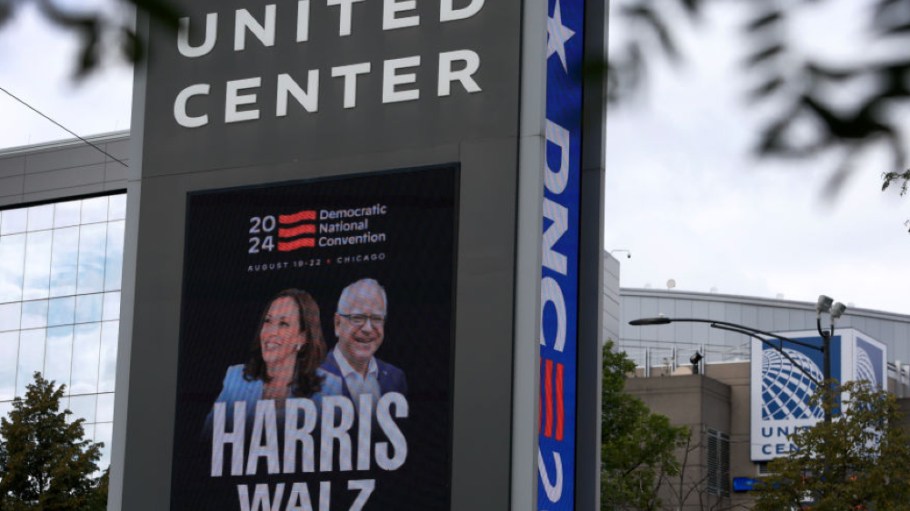
As the democratic party puts its best foot forward with the Democratic National Convention starting Monday, economic strategists have already begun analyzing party platforms.
Currently, the Democratic presidential front-runner vice president Kamala Harris—she’s expected accept the party nomination Thursday night—and her running mate Minnesota Governor Tim Walz have a slight national lead over Republican nominee and former president Donald Trump and his running mate U.S. Senator from Ohio J.D. Vance, according to a Washington Post-ABC-Ipsos poll. A CBS News/YouGov Battleground Tracker has Harris ahead with a projected 225 electoral votes and Trump with 219 as of Aug. 18. Key battleground states that are still considered toss-ups include Arizona, Georgia, Michigan, North Carolina, and Pennsylvania, among others. Florida appears to be leaning toward Trump, while Minnesota seems to be leaning towards Harris.
Related Stories
Meanwhile, some economists are analyzing the candidates’ stated political goals and implications for trade and tariff policies.
The global economics team at Goldman Sachs led by chief economist Jan Hatzius in a research note on Thursday concluded that increases on China tariffs would raise risks of a global trade war that would have “significant impacts” on growth and trade, while increases on tariffs on goods from other countries could result in them raising prices on consumers goods imports from the U.S.
The Goldman Sachs team is expecting “significant increases” in tariffs on China—it assigned a high probability at 90 percent odds—if former President Donald Trump wins re-election, the impact of which could slow growth and raise inflation in major economies such as the U.S. and Europe.
“In addition, shifting trade policy could prompt companies to rethink their supply chains, leading to a reallocation of global trade that benefits some countries but hurts others, particularly China,” the report said. The analysis suggests that higher tariffs could reallocate trade across various economies, with Mexico and Southeast Asia benefiting from tariff-driven trade reallocation, while China and other East Asian economies would face headwinds from shifts in net trade toward lower-cost countries.
Jaret Seilberg, a managing director at TD Cowen Washington Research Group said Friday that should vice president Kamala Harris win the U.S. presidential election, she is expected to continue Biden’s major regulatory policies. “We believe she is likely to favor moderation. We also see her as likely to have a more traditional view of monetary policy and trade,” Seilberg concluded.
Seilberg’s colleague and Washington strategist Chris Krueger is projecting that Trump’s “10 percent tariff is off the table along with the potential labor supply shock of deporting millions of undocumented immigrants.”
In contrast, a Trump win could see the repeal of Permanent Normal Trade Relations (PNTR) with China, which was passed after China joined the World Trade Organization in 2001. Krueger cited data from the U.S.-China Business Council that forecasted a broad raise of current tariffs from 19 percent to 61 percent—with subsequent Chinese retaliation—should Trump win and obtain a repealing of the PNTR.
Krueger also foresees broad impact to the labor market should a Trump win see him implement a stated goal in connection with the largest deportation effort in U.S. history. That could pave the way for other policy changes per the GOP Platform, including the repeal of DACA (Deferred Action for Childhood Arrivals; policy recipients are also known as “DREAMers”) and TPS (temporary protected status) for hundreds of thousands, a reinstatement of “Remain in Mexico,” and the return of a “Travel Ban” targeting immigration from specific countries, among other bans and limitations on access to the U.S.
According to TD Cowen research, “tariff risks are underestimated, particularly if implemented without control.” Analysts at TD Cowen noted that retailers have been pulling forward shipments ahead of peak shipping season, a move triggered by election and tariff concerns. In addition, there’s been concern about ongoing maritime-shipping disruptions in the Red Sea region.