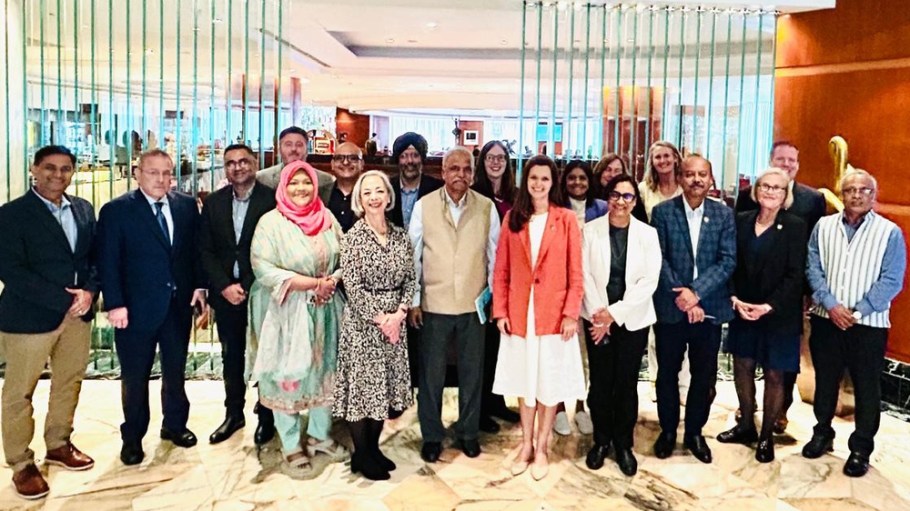
A U.S. delegation of government, brand and civil society representatives met with Bangladesh’s leadership in Dhaka over the weekend to affirm what they said was their shared commitment to “independent, democratic trade unions for Bangladeshi workers and the businesses that employ them.”
Led by State Department special representative Kelly M. Fay Rodríguez and Department of Labor deputy undersecretary Thea Lee, the group included officials from the Agency for International Development better known as USAID, labor experts from UNI Global Union and the Worker Rights Consortium, and executives from the American Apparel Footwear Association and member brands Gap Inc., Calvin Klein owner PVH Corp. and The North Face parent VF Corp., which collectively buy roughly $1.8 billion of clothing every year from the South Asian nation. Bangladesh is the third largest supplier of garments to the United States.
Related Stories
Delegates met with interim government leader Muhammad Yunus and members of the Bangladesh Garment Manufacturers and Exporters Association at what a statement described as a “unique moment for democracy and governance” for the country, which is navigating a future without disgraced former prime minister Sheikh Hasina’s iron-fisted rule for the first time in 15 years.
It’s during this fragile period that “resolving longstanding challenges to the exercise of labor rights will be critical to ensuring national economic prosperity,” the U.S. Embassy in Bangladesh said Tuesday. “Worker empowerment is essential to sustainable and inclusive economic growth, respect for human rights, democratic resilience and gender equity and inclusion.”
The United States said it recognizes that the well-being of workers in the global economy is a “shared responsibility” for governments, businesses, regulators and labor unions, which must work together to ensure “good, safe working conditions” where fundamental rights such as freedom of association and collective bargaining are respected.
Miran Ali, an advisory member of the support committee that will buttress the BGMEA’s work until a new board is elected, said that the trade group’s administrator had “productive discussions” with the U.S. representatives over human rights and trade—two issues that have become especially fraught in the wake of production delays that originally stemmed from the pro-democracy uprising but were then exacerbated by torrential weather and seemingly unquellable worker unrest over unpaid wages and other demands.
Early this week, the Bangladesh government announced the formation of a six-member committee that will review the “labor and business environment” at Beximco Industrial Park, the heart of one of the country’s biggest textile operations and a hotbed of turmoil over outstanding arrears, which the Ministry of Labour and Employment said it will be helping cover with help of its finance counterpart.
Beximco, which did not respond to a request for comment, is one of Bangladesh’s largest private employers, serving brands such as PVH Corp., Target and Zara owner Inditex through an expansive phalanx of washing, spinning, knitting, weaving, printing, dyeing and cut-and-sew services. It’s also facing a liquidity crunch—as well as potential receivership—following the arrest of one of its co-founders on charges of corruption, embezzlement, money laundering and murder. The buyers likewise did not respond to emails asking if they would be continuing their relationship with Beximco.
Despite fears that the lingering climate of uncertainty would quail buyers, the challenges that sourcing from Bangladesh presents don’t appear to be insurmountable, at least from the United States’ point of view.
“The United States is committed to working with Bangladesh to ensure that industry practices support stable employment, quality working conditions and living wages that allow Bangladeshi workers and their families to thrive,” the U.S. Embassy in Bangladesh said. “The United States values our partnership with Bangladesh, spanning more than 50 years. We are grateful for the opportunity to support the people of Bangladesh at this historic moment, and for the chance to join here together in Dhaka.”
Still, the world’s second-largest exporter of clothing after China will have a steep road ahead, Mohiuddin Rubel, an additional managing director at Denim Expert and, until recently, one of the BGMEA’s directors, previously told Sourcing Journal. A reliable power supply remains a perennial issue, as does Bangladesh’s increasingly vulnerable banking system, which is struggling to keep balances afloat. Spiking manufacturing costs have also made the relentless downward pressure on already razor-thin margins more difficult to manage in the absence of more responsible purchasing practices.
Steve Lamar, president and CEO of the American Apparel and Footwear Association, said that the trade group looks forward to a “continued strong, competitive, socially responsible and sustainable industry” in Bangladesh and will continue to work with the country to “ensure worker welfare and promote the ideals of equitable democracy and for all stakeholders to take part in open dialogue and inclusivity.”
He added that the delegation was part of ongoing cross-stakeholder efforts to “strengthen and grow the partnership between the U.S. and Bangladesh, growing its reputation back as a trusted trader.”