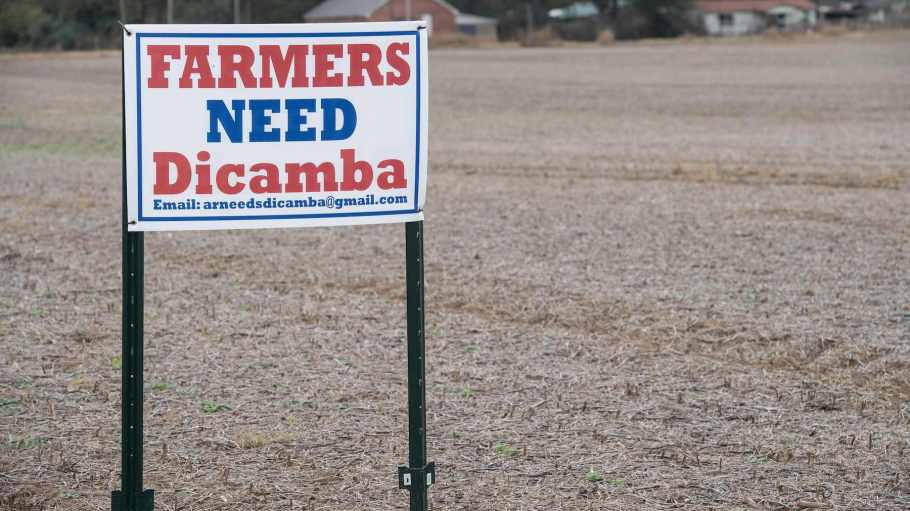
Southwest cotton growers have been “boll-ed” over by a last-minute court ruling that could greatly diminish yields and send prices of the natural fiber on an steep upward trajectory.
A United States court banned three commonly used weedkillers, alleging that the Environmental Protection Agency (EPA) broke the law by allowing them to be on the market.
On Feb. 6, the United States District Court for the District of Arizona ruled that three dicamba—a broad-spectrum herbicide targeting broadleaf weeds—weedkillers cannot be used in American agriculture’s 2024 growing season, vacating the 2020 registrations for the use of Bayer’s XtendiMax, BASF’s Engenia and Syngenta’s Tavium.
Related Stories
As a result, higher cotton prices in the U.S. could be on the horizon.
And the National Cotton Council, for one, is “extremely disappointed” with the ruling.
“The impacts of this ruling will be felt across the Cotton Belt as dicamba-tolerant varieties account for more than 75 percent of U.S. cotton acres,” the organization said in a statement.
Not to mention, the ruling comes at an “especially problematic” time of the year; many producers have already mapped out their cropping decisions, having secured seeds and begun preparing the fields. Plus, the National Cotton Council said, there’s not enough time to secure an alternative herbicide for the 2024 planting season.
“Without widely available alternatives, losing the foundational herbicides in the dicamba-tolerant weed control system will put millions of acres in jeopardy of reduced production,” the National Cotton Council continued. “The loss of over-the-top dicamba products exacerbates an already difficult economic situation with current prices below the costs of production.”
While cotton prices have risen slightly of late, overall futures have traded in a narrow range of roughly 80-90 cents for close to 18 months following a drastic spike higher coming out of the pandemic.
The council is now urging the EPA to appeal the decision as the court’s ruling is “another blow” that will “stifle the development and adoption” of new technologies that increase productivity and bring forth environmental benefits like reducing greenhouse gas (GHG) emissions.
The EPA is currently reviewing the decision—a 47-page ruling by U.S. district judge David Bury that said the EPA made a “very serious violation” by reapproving dicamba—a representative told Sourcing Journal.
Meanwhile, dicamba producer BASF said it is reviewing the order and assessing its legal options while awaiting direction from the EPA.
“Agricultural input supply chains, which are still recovering from 2020 disruptions, are complex and will be significantly affected by the unanticipated chemistry demands on more than 40 million dicamba-tolerant soybean and cotton acres directly impacted by this order,” the German chemical giant said in a statement. “Many farmers rely on over-the-top applications of dicamba as a valuable tool to control resistant weeds. These weeds can significantly impact yields as they compete for the same water and nutrients as the crop, which can lead to significant financial harm to the farmer.”