The denim and larger apparel industries have long flirted with hemp as a sustainable alternative fiber, but commercial-scale supply chains in the U.S. remained elusive—until now. This spring, Panda Biotech and TDMI Twin Dragon debuted the first Made in the Americas hemp denim collection at Kingpins Amsterdam—a harbinger that hemp, once an afterthought in the U.S. textile market, could become a viable material for American mass production again.
Powered by mechanically cottonized, American-grown hemp fiber—produced without chemical degumming or water-intensive processing—the collaboration underscores Panda’s emergence as the only U.S. player currently delivering traceable, high-performance hemp fiber at commercial scale.
Related Stories
“Our hemp fiber today is as good as, if not better than, degummed fiber—without the chemical waste stream,” said Scott Evans, chief operating officer at Panda Biotech.“We brought it back and we made it better. That’s what will make hemp take off again.”
From field to fiber, now at scale
It’s no secret that U.S.-grown hemp has had a slow, uneven climb into the textile market. Most domestic production has skewed toward consumables, construction materials like hempcrete, or animal bedding. But creating hemp fiber that could compete with global players—chiefly China and Europe—in quality, scale and price has remained largely out of reach.
This wasn’t always the case. Hemp was once a primary American textile—during World War II, it was classified as a strategic material and widely used to make rope, canvas and webbing for the U.S. Navy. But the industry was dismantled twice over: first by the Marihuana Tax Act of 1937, then by the Controlled Substances Act of 1970. As China and Eastern Europe advanced their processing technologies and built world-leading fiber supply chains, American infrastructure never caught up. Even after cultivation was legalized again in 2018, that gap remained. Without industrial-scale processing in place, brands had little choice but to rely on overseas suppliers.
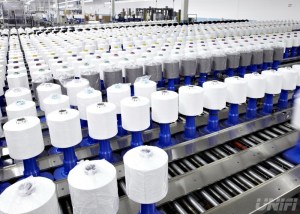
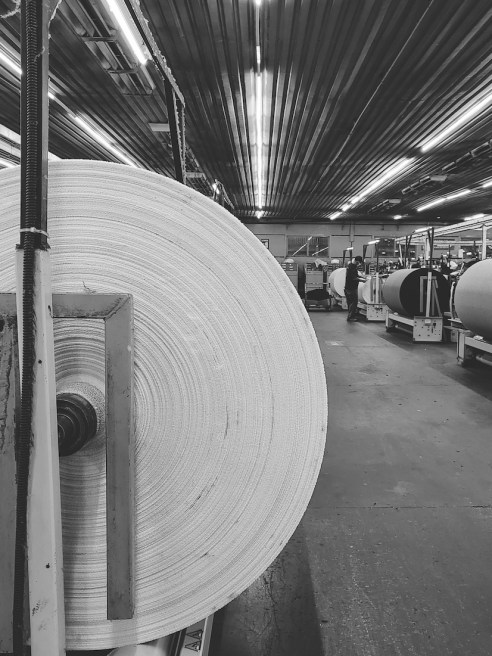
Panda Biotech set out to change that equation. Its 500,000-square-foot facility in Wichita Falls, Texas—a dusty North Texas town better known for cattle and cotton than cutting-edge manufacturing—now operates four industrial decortication lines, giving it unmatched capacity to produce mechanically-cottonized hemp fiber. All four lines are running, though not around the clock; the company can scale output to match demand.
Founded by energy executive Bob Carter and led by President Dixie Carter, Panda Biotech emerged from a family legacy in large-scale infrastructure. The Carters previously built one of the country’s largest privately held natural gas power portfolios before shifting focus to hemp in 2019. That background in industrial systems and capital-intensive projects positioned them to bring scalable fiber processing to a U.S. hemp market still largely operating on mom-and-pop farms and as pet projects.
Crucially, Panda understood that fiber processing couldn’t be separated from farming. In earlier U.S. pilot projects, farmers were often forced to haul bulky hemp stalks hundreds of miles to reach a processor—a system that proved both uneconomical and unsustainable. Panda flipped this model, embedding itself directly in the grower network and building tight, regional supply chains.
Its Pay-to-Grow program anchors this approach. The model reduces risk for farmers by providing free seed, guaranteed payments at planting and harvest, and per-pound fiber payouts—giving growers both upfront security and a clear market for their crop. It also allows Panda to directly influence cultivation practices, ensuring that harvested fiber meets its quality specs and reaches the Wichita Falls gin in optimal condition. Today, about two-thirds of Panda’s acreage operates under Pay-to-Grow, with farmers clustered in North Texas and Southern Oklahoma.
That integrated strategy also informed a deliberate shift this year. “We initially targeted 25,000 acres, but after a strong first year we chose to dial that back to around 17,000 acres—our growers planted 15,000 this spring, and have another 2,000 planned for the fall,” said Mark D’Sa, senior vice president of business development at Panda Biotech. “We’re prioritizing feedstock quality and fiber yields from each acre. That shift hasn’t limited our ability to meet new demand—it allows us to scale more intelligently in step with what buyers want.”
The proof is in buyer demand
The April debut of Twin Dragon’s hemp denim collection at Kingpins Amsterdam was a strategic turning point. The global factory behemoth produced the collection in its Mexico facility, using Panda fiber supplied in commercial quantities. The line includes both rigid and comfort-stretch styles, ranging from 20 to 50 percent hemp blends.

Feedback from Kingpins was immediate and encouraging. “One of the brands we’ve worked with selected the fiber specifically because it matches the aesthetic they’ve been running for years,” Evans said. “The mills were taking orders at the show—we’ve already started shipping fiber to Twin Dragon to fulfill those.”
Brands showing active interest include Patagonia, which has long sourced its hemp from China but is now exploring Panda-supplied yarn through Twin Dragon’s Mexico operations to diversify within the Western Hemisphere. Jungmaven, an early U.S. hemp apparel brand known for its laid-back basics and commitment to hemp-forward fabrics, is also looking to shift its sourcing from imported to American-grown.
“We are creating high-performance, eco-conscious fabrics that meet the demands of today’s consumers and tomorrow’s planet,” said Twin Dragon CEO Dominic Poon. “This partnership marks a pivotal step forward in redefining what sustainable fashion can be.”
What makes Panda’s fiber compelling in denim? According to Evans, it’s a mix of durability, pliability and superior handfeel compared to typical chemically degummed hemp. “You’re getting a fiber that mills can spin efficiently, with fewer process losses and a handfeel that aligns with premium cotton denim.”
For comfort-stretch applications, spinners are experimenting with lycra and spandex blends, tuning yarn construction and loom settings to optimize performance. Consumer preferences appear to be following typical patterns: men’s jeans favor rigid or light-stretch styles, while women’s styles lean toward greater stretch.
Mechanical cottonization: the innovation driving the shift
Aside from leading the charge on industrial-scale processing of hemp, Panda’s biggest materials breakthrough is its proprietary mechanical cottonization process—an innovation that allows the fiber to slot seamlessly into existing cotton-based textile systems.
Where most global hemp textiles rely on chemical degumming—a water- and chemical-intensive method that strips the fiber—Panda achieves comparable softness and spinnability without that step. And that difference matters: chemical degumming not only generates significant waste*, it also strips hemp of some of its most prized qualities, including its natural luster, tensile strength and inherent antimicrobial properties.
“Our goal from the outset was to deliver a textile-grade fiber that doesn’t require chemical treatment,” Evans said. “It’s been gratifying to see that come to life.”
Panda backs its word up about waste with serious commitments. Its facility is certified to zero discharge of hazardous chemicals (ZDHC), and holds both Oeko-Tex Standard 100 and USDA Certified Biobased product certifications. Managing effluent is one of the hardest parts of traditional hemp processing; but Panda’s process sidesteps that entirely.
The company is also benchmarking its fiber against the physical characteristics of upland cotton—by far the most common variety grown in the U.S., prized for its short-staple length, minimal herd content and consistency in large-scale spinning operations. “The closer we can get to the look, feel and performance of cotton, the easier it is for mills to integrate hemp into existing systems,” Evans said.
Beyond denim, Panda is running trials with finer yarn counts and exploring applications in twills, canvas, shirting, and knits. U.S. and Central American partners are being prioritized for these next-gen developments, in keeping with Panda’s effort to maintain a Western Hemisphere value chain.
Supply chain readiness and commercial positioning
One of Panda’s key advantages is its ability to offer consistent, traceable fiber at a cost competitive with European imports—without demanding a significant premium. “If you can buy the same quality at the same price, and know it was grown and processed here, why wouldn’t you?” D’Sa said.
Panda’s internal traceability system currently allows it to track fiber down to the farm level, and while not yet rolled out to brands in consumer-facing formats, that capability is being developed. “We’d love for brands to be able to say ‘Texas-grown’ or ‘Oklahoma-grown,’” D’Sa noted.
The company is also positioning its supply chain to weather potential trade shifts. “We invested here long before the new tariff landscape emerged,” Evans said. “That’s not why we’re competitive. We’re competitive because of the proprietary mechanical process and the quality at scale we can now deliver to factories.”
To build long-term viability, Panda is looking for volume commitments—but the fiber is already selling rapidly. Fiber yield runs between 18 and 22 percent of feedstock input; Panda is also commercializing herd and micronized dust outputs, with applications in vacuum insulation panels and advanced plastics under development.
From aspiration to operational
For D’Sa, the numbers tell a compelling story. “Cotton plantings are down to around 6 million acres this year; hemp was about 54,000 acres nationally,” he said. “There’s nowhere to go but up. As we grow acreage and processing capacity in sync, the potential for this market is huge.”
Evans, the pragmatist, sees it in operational terms: “We’ve now produced fiber that’s equal to or better than degummed, across multiple product categories. And mills are validating it. That’s the real proof point.”
The resilience of the crop itself is also encouraging. “Last year we had drought; this year we had monsoons—and we still grew good hemp,” Evans said. “It’s a sturdy fiber crop with real soil health benefits. We’re seeing its potential across a range of conditions.”
The seed mix is evolving, too. Panda continues to trial Asian, Australian and domestic varieties, with an eye toward optimizing fiber quality for its process.
Ultimately, Panda’s leadership team believes U.S. hemp is ready to move from aspirational to operational—filling a real sourcing need for brands navigating the twin pressures of sustainability and supply chain resilience.
“Today, our mechanically-cottonized hemp is the best on the market,” D’Sa said. “Hemp’s return to American mass production is no longer a question of if—but how fast.”
This article ran in SJ’s Material Innovations Report 2025. To download the full report, click here.