Sri Lankan textile manufacturer MAS Holdings has introduced Fluid Channeling Fabric, a first-of-its-kind material developed by Twinery, its dedicated innovation arm.
The knit fabric is engineered to absorb and “channel” moisture away from the skin while maintaining a rapid-dry feel. Unlike topcoat treatments or layered solutions—which can trap heat, wear off or stiffen the garment—the Fluid Channeling Fabric is woven into the material. Using a combination of hydrophobic and hydrophilic yarns, it pushes sweat and fluids away from the body, drying quickly to visually erode any visible sweat patches.
Related Stories
“We made this material with a flat knit machine and I believe we can do the same with circular knits as well,” Malaka Chathuranga, technical lead at Twinery, said. “It’s not a coated material; instead, we’re using cross-sectional modified yarn.”
The Fluid Channeling Fabric’s targeted uses include performance apparel as base layers or outdoor and tactical gear applications, such as hiking apparel, as well as military uniforms and firefighter base layers. The intimate wear industry’s applications include nursing bras, period underwear and incontinence liners, while medical and healthcare can utilize Twinery for post-surgical garments and bedding.
“Another exponent application I can think of is like bedding material; you can separate the cellulosic part into two different layers. When you’re sleeping on top of it, your sweat, for example, can absorb but it will keep you dry—even car seats. I wonder whether we can use this for public transportation, too.”
Both the material’s look and its desired function are customizable as well.
“Since it’s a yarn-based solution, the color doesn’t have to be white,” Prabath Seneviratne, tech commercialization lead at Twinery, said. “We used white [as an example] so that it’s visible once you add the inks, but it can be any color.”
The Fluid Channeling Fabric has two primary applications: one for each side of the fabric. The first is hydrophobic (repels water) and the second is hydrophilic (absorbs water).
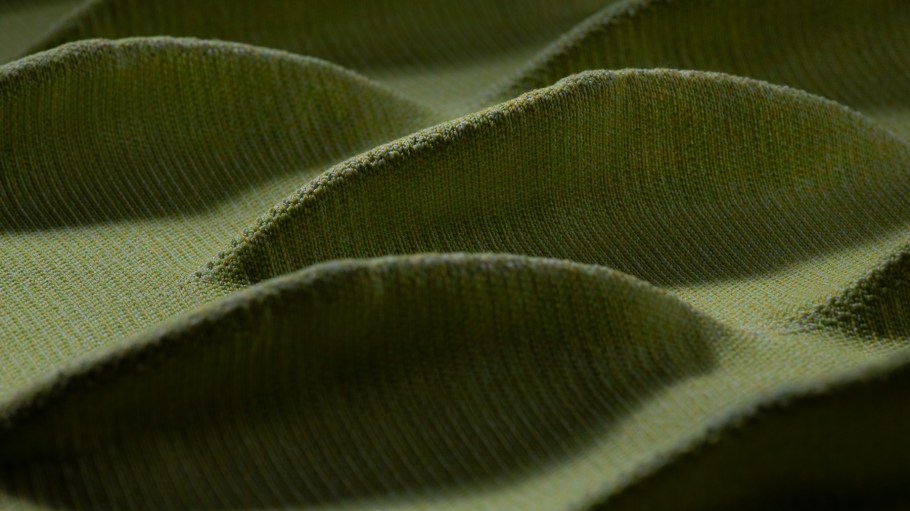
Here’s how it works: When moisture comes into contact with the hydrophobic side, it’s funneled into the “valleys,” where the hydrophilic yarn absorbs and transfers it to the absorbent layer. From there, it can evaporate, while the hydrophobic surface ensures the outer garment remains dry.

The first application is sweat-channeling and skin-touching as a hydrophobic side; when moisture comes into contact with this fabric, it’s directed through designated areas (the demonstration SJ saw resembled the icepick holes on the sticky side of an overnight pad) and absorbed into the bottom layer. From there, Twinery said, the fluid is further absorbed and distributed within the middle layer of the material.
“When we put the dye on that side, it quickly absorbs. But on the other side, you’re only seeing these small dots as the dyed color—those dots are a valley,” Chathuranga said. “So it’s an indentation; because of that reason, it won’t touch your outer garment.”
The second application is sweat-channeling and skin touching, too, just as the hydrophilic side. When moisture comes into contact with this fabric, it’s quickly absorbed and wicked away from the skin. The fabric “channels” the liquid toward the outer surface, where it settles in valley areas without reaching the outermost layer. This design, Twinery said, promotes evaporation while preventing visible sweat patches, offering a dry and comfortable feel.
“We’re mainly proposing this to use as a menstruation gusset; when a liquid comes into contact with this structure, it can absorb into these valleys and take it to the back-post layer and keep you dry,” Chathuranga said. “The idea is, since this platform is dry, you feel more confident—that’s the entire idea of this material.”
One method of making the fabric adheres to a schematic flow that begins with knitting a hydrophobic yarn—to form a first layer—before knitting a hydrophilic yarn and a reinforcement yarn together, to form a second layer. The flow then connects the first layer and second layer using a spacer yarn—the key component maintaining separation between the face fabrics.
“The spacer structure facilitates its fluid absorption capabilities,” Chathuranga said, adding that a very fine polyester hydrophobic yarn is used in the tuck layer to maintain this connection between the front and back layers. This fine yarn, he said, ensures connection while also contributing to the material’s absorption properties.
And this spacer yarn could be polyester, nylon, polypropylene, viscose, acrylic, cotton, wool or a combination thereof, per the patent filing. Ultimately, it forms a “plurality of valleys” on the upper surface of the first layer. Together, the three yarns (the hydrophobic, hydrophilic and reinforcement) define those valleys of depressions and channels.
The second layer includes a hydrophilic yarn and a reinforcement yarn. The hydrophilic yarn and the reinforcement yarn are plied together, configured into that plurality of valleys, the patent summary reads. In one embodiment, the fabric features an absorbent layer—cotton, rayon, a combination of the two—disposed between the first and second layers.
The reinforcement yarn, meanwhile, can be elastomeric—aka shrinkage yarn. The application of a stimulus (like steaming, relaxation drying or chemical treatment) to this shrinkage yarn can cause it to contract, thereby forming the plurality of valleys.
“Since the bottom most layer has some level of elastane, it pulls the topmost structure and creates a valley,” Chathuranga said. “That’s how the topmost layer is having the hydrophobic layer is having the valley and that valley is hydrophilic.”