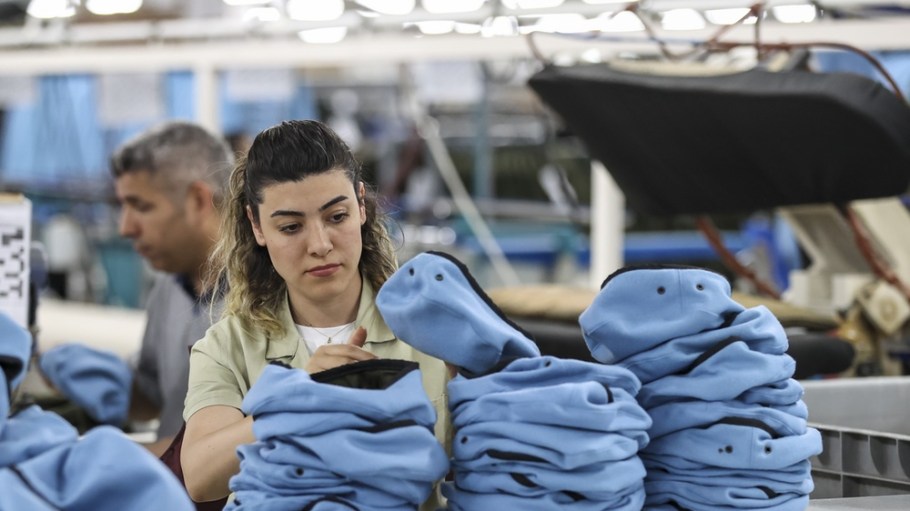
It’s official: a net minimum wage increase of 27 percent in Turkey will go into effect January 1.
The increase is a little more than the 25 percent forecast by analysts, and comes with assurances by labor and social security minister Vedat Isikhan that the increase would help more than a third of the working population, which is at minimum wage, and will permeate across sectors.
The gross monthly minimum wage will be 33,030 Turkish lira ($769.17).
Related Stories
However, labor unions are incensed, contending that the increase does not even match inflation, and keeps workers at “below hunger levels” and far below actual living costs.
Despite three rounds of negotiations by the Minimum Wage Determination Commission, which typically includes representatives from the government, employers and workers, the meetings were boycotted by Türk-İş, Turkey’s largest labor confederation.
Ergun Atalay, president of Turk-Is has called it “unacceptable,” stating that it “doesn’t meet worker demands for a survival wage, that it won’t cover basic costs like food, rent, and education amid high inflation.” He said that workers would not accept this figure, and called for a mid-year adjustment to reflect actual living costs.
Meanwhile, the labor minister reiterated that the decision reflects the government’s effort to “balance supporting incomes with controlling inflation,” citing the economic situation as “having survived regional wars, energy crisis and supply chain disruptions.”
Workers in the sourcing sector are particularly agitated as factories continue to close and declare bankruptcy, even as they struggle to cover basic costs. Inflation remains a dominant concern in Turkey, despite official claims that it is now under control, having fallen from a record 85.5 percent in October 2022 to an officially stated 31.07 percent in November 2025. Both union leaders and manufacturers argue that these figures underestimate the real cost pressures on households and businesses.
Meanwhile, there is much that worries manufacturers.
While labor costs continue to spiral, exchange rate fluctuations, high raw material costs, energy shortages, make it difficult to compete with other textile and apparel sourcing countries like India, Bangladesh, Cambodia, Vietnam.
Perhaps the greatest concern comes from Egypt, where production costs are significantly lower.
“Given the high inflation, this increase was expected,” Ahmet Öksüz, chairman İTHİB, the Turkish Textile and Apparel Exporters’ Association told Sourcing Journal. “Of course the workers expect more, and this is usual because of devaluation. As industrialists we are not saying that they should not receive this, and we also understand that the government has to reduce inflation. But to keep the inflation level down, the wage increase should be reasonable,” he said. He added that costs for manufacturers were already extremely high.
“$650 is the net wage, but the actual cost to manufacturers is closer to $1,000 per month once we include food, transportation, service taxes and benefits,” Öksüz said. “Manufacturing is difficult in many countries right now because costs have risen sharply while demand is weaker than it should be.”
Apparel exporters, in particular, have been hit hard. Turkish apparel exports totaled $15.5 billion in the first 11 months of 2025, from January through November, marking a 6.9 percent decline compared with the same period a year earlier. While Turkey retains a nearshoring advantage and a focus on design-led and higher-fashion items, bankruptcies have become widespread, and many manufacturers speak about already being pushed beyond their limits.
“We anticipate that we will conclude 2025 with approximately $17 billion in exports,” Mustafa Paşahan, vice president, Istanbul Apparel Exporters’ Association (IKHIB) told Sourcing Journal. He pointed out that the apparel industry maintained its strategic position through its value-added production, employment and export volume.
He said that the European Union (EU) continued to be the primary market. “We export 61 percent of our total apparel to EU countries. On a country basis, Germany ranks first, followed by the Netherlands and Spain. In terms of product groups, knitted apparel accounts for 53 percent, woven apparel for 35 percent, and ready-made goods for 12 percent,” he said while explaining that the advantage of sourcing competencies for Turkey remained: “quality, speed, flexibility, social compliance, and the advantage of being a nearshoring partner to the EU.”
While there has clearly been a trend towards repositioning global supply chains in 2025, and the need for supplier diversification, he observed that was not a threat for the Turkish industry, but rather “created a potential for renewed momentum in exports once the correct competitive ground is established.”
Among the factory closures in 2025, there were several long-established players, whose shutdowns have been watched with particular concern, as they have survived decades of change.
These include Naz Örme Kumaş, founded in 1996, and once one of the largest knitwear manufacturers, with a 10,000 square meter factory and a monthly production capacity of 800 tons, and Fame Tekstil, even older, having started in 1992 and a capacity of more than 300,000 garments per month. Other closures include Ugur Balkuv Triko, Settriko, Fabrilla Tekstil among others. Many of these supply large global retailers and brands including Hugo Boss, Mango, H&M, Zara, Marks & Spencer, etc.
Referring to the number of bankruptcies in 2025, Ahmet Öksüz explained that a combination of factors were responsible. “If a company is not financially healthy and needs to borrow money at a very high cost, that is not sustainable. Many were faced with financial issues. Also, so far the government provided 2,530 Turkish lira ($58.92) in wage support for workers at small and medium sized factories. Now, it is increased to 3,500 Turkish lira ($81.50) and has been extended to all the companies in the textile and related sectors. That will help.”
Manufacturer associations are now walking a fine line between government policy and labor demands as they look ahead to 2026.
Many are weighing difficult options: bankruptcy, restructuring to remain relevant, or relocating production to other countries in order to survive. Several manufacturers expect the sector to continue taking hits in 2026, citing the pace of factory closures and shifting sourcing geographies, partly driven by U.S. tariffs and cost advantages enjoyed by countries such as Egypt through free trade agreements.
Others, like IKHIB’s Mustafa Paşahan remain more optimistic, observing that the industry may well get stronger in 2026.
“In 2026, as the economic situation in our country recovers, we expect the cost pressures on our exporters to ease. Every crisis inherently carries certain opportunities,” he said. “We prefer to view this transition period for our industry and our country as an opportunity for “twin transformation” (digital and green) and productivity growth. With a correct political framework and internal transformations—such as lean production, digitalization, automation, and higher value-added products/design—the impact of unit labor costs per product can be reduced.”
“Alongside this transformation, we are working continuously on support models to balance the cost pressure on Turkish apparel exporters and are maintaining the necessary dialogues with our government,” he said.
Analysts predict a continuing drop in inflation for the coming year, potentially 25 percent by end-2026, depending on how the currency stabilizes. Officials also predict that the gross domestic product will pick up, expected to be 3.3 percent in 2025 and to accelerate to 4.2 percent in 2027. One of the positive indicators is the appointment of Murat Taşçı , a new chief economist.
Investment dynamics are also shifting.
Chinese giant Supreme Intelligent Technologies Co., for example, has brought in investment, seeing Turkey as a possible technology hub, and a strong base for the region. The joint venture announced with Turkish entrepreneur Temel Kamiloğlu is expected to be a step toward growth in the region.
As 2026 approaches, manufacturers said that they were still “armed with hope” pointing to events such as Texhibition 2026, scheduled for March 4–6 in Istanbul. “We already have a waiting list,” Öksüz said. “There is strong demand, and we are upgrading the exhibition every season.”
Clearly, industry associations are projecting positive energy and suggesting strategic shifts towards sustainability and market diversification, which they expect to intensify in 2026.
As one European buyer invested in several Turkish companies put it, “We’re wondering who will survive the spiraling costs and the power of geopolitics. But on the whole, we are cautiously optimistic for 2026.”