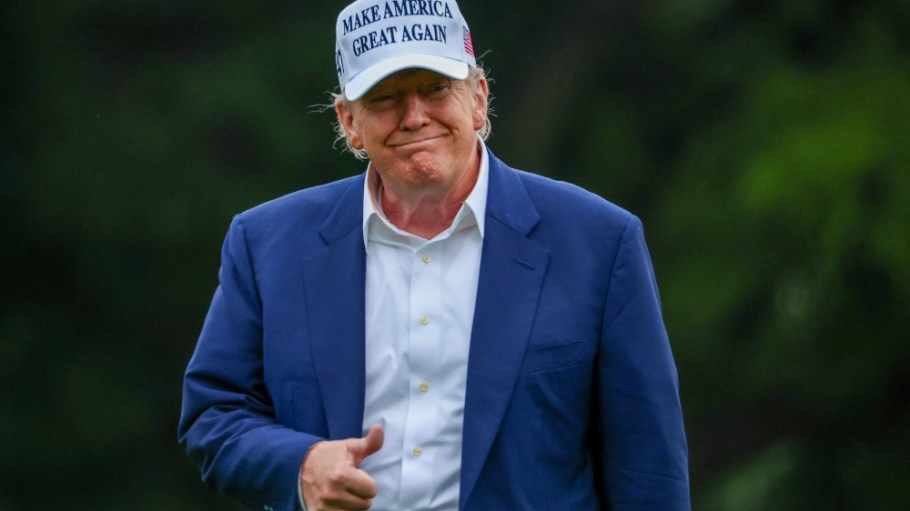
President Donald Trump has reiterated controversial comments made by his cabinet about the need—or lack thereof—for a domestic supply chain for shoes and apparel.
The president’s short second term has been defined by persistent tariff upheaval—a shifting strategy that he has said will serve to bring more production back to the U.S., resulting in new jobs and greater self-sufficiency. But as the president was boarding Air Force One in New Jersey on Sunday, he singled out the fashion sector—footwear and clothing—as one the country might do well enough without.
Related Stories
“We’re not looking to make sneakers and T-shirts. We want to make military equipment. We want to make big things,” he told reporters. “I’m not looking to make T-shirts, to be honest. I’m not looking to make socks. We can do that very well in other locations.”
The president said the country’s focus should be on chips, computers, tanks and ships—military equipment and technology, rather than soft goods.
The commentary on reshoring echoes a recent statement made by Treasury Secretary Scott Bessent, who also said that the U.S. doesn’t necessarily need a “booming textile industry.”
The National Council of Textile Organizations (NCTO)—and its members—reacted swiftly to the assertion, taking issue with the administration’s stance that textiles don’t represent a critical industry for America, though they serve manifold military and industrial applications in addition to contributing to the consumer products sector.
“The U.S. textile industry was proud to make lifesaving PPE during the first Trump Administration in response to Covid. The U.S. proudly makes over 8,000 different products to the U.S. military alone to ensure we do not have to rely on foreign adversaries to make essential products. This is a strategically important, relevant, and key industry,” Glas wrote in early May, adding that American makers of man-made fiber, yarns, fabrics, apparel and non-apparel sewn products produced $64 billion in goods last year, exporting $28 billion worth to other countries.
More than 30 manufacturing CEOs and cotton farmers wrote their own letter to the Treasury Secretary, telling him that he was mistaken in believing that there isn’t a robust supply chain for such products in the U.S.
American Apparel and Footwear Association (AAFA) president and CEO Steve Lamar said the administration’s trade policies—with tariffs at the center—aren’t helping domestic producers.
“We agree that tariffs are not the path to scaling up U.S.-made clothing and shoes. As we’ve said time and time again, tariffs are not the solution to strengthening or growing the 3.5 million American jobs already supported by the apparel and footwear industry,” he said following the president’s weekend comments. “Our domestic labor market simply does not have the labor demands to fulfill manufacturing for an industry that touches every American family.”
With 97 percent of Americans’ clothes and shoes imported from across the globe, many at high tariff rates, the administration should focus on “common sense solutions that can move the needle,” he believes.
Duties on foreign-made products and inputs end up costing manufacturers that rely on them to create finished goods, he argued. And the consumer ultimately pays the price.
There are pressing reasons to bolster the onshoring of certain products, like those to support the armed forces, he said. Lamar pointed to a strengthening of the Berry Amendment, which lays out stipulations for the procurement of military uniforms and certain tactical gear, like boots, as a should-be priority.
“Leveraging existing policies and practical approaches offer a real opportunity to boost U.S. apparel and footwear manufacturing and ensure that our troops are outfitted with goods that are 100-percent made in America,” he said.
The U.S. Footwear Manufacturing Association (USFMA) recently implored the administration to tighten up the law and to pass the Better Outfitting Our Troops (BOOTS) Act in Congress, which would require that all boots worn by all U.S. military personnel be made in America.
“If we truly want to support U.S. manufacturers—many of whom have generations of experience—we should focus on strengthening their capabilities, not burdening them with tariffs,” Lamar added.
Trump made some headway in smoothing over tensions with trade partners on Sunday. The president agreed to extend a 50 percent tariff deadline on goods from the European Union until July 9 (the date that the deferral of reciprocal tariffs on other trading partners across the globe will expire), presumably to allow for the pursuit of a trade agreement in the interim.
“I received a call today from Ursula von der Leyen, President of the European Commission, requesting an extension on the June 1st deadline on the 50% Tariff with respect to Trade and the European Union,” Trump Truthed.
Von der Leyen wrote on X that “Europe is ready to advance talks swiftly and decisively,” and that the trade bloc needs the extension to “reach a good deal” with the U.S.