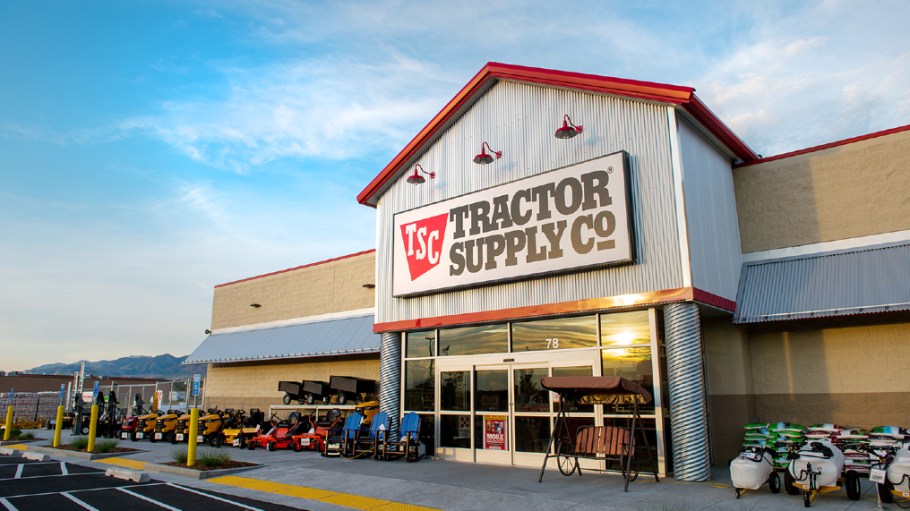
Tractor Supply Co.’s (TSC) new store goal by 2030 is 3,200, up from the prior plan of 3,000.
The target range was disclosed as part of the retailer’s Investor Day meeting held on Dec. 5. The company plans to open 90 Tractor Supply doors in 2025, along with 10 Petsense by Tractor Supply locations. As of Sept. 28, 2024, TSC operated 2,270 Tractor Supply stores across 49 states. It also has 205 PetSense stores across 23 states.
The Investor Day meeting provided a clear roadmap called Life Out Here 2030 eyeing robust growth based on an expanded total addressable market of $225 billion, up from the prior target of $180 billion. The Life Out Here strategy—TSC is the largest rural lifestyle retailer in the U.S.—was first disclosed in October 2020. That playbook over the last five years included scaling of its Project Fusion store layout and remodel program to 50 percent of its stores, completing 550 garden centers, adding 22 million members to its Neighbors Club loyalty program, growing digital sales by more than 340 percent, and opening 13 distribution facilities comprised of two distribution centers (DC) , one import center, and 10 mixing centers that help with just-in-time replenishment for its stores. Helping with future store growth will be the opening of TSC’s 11th DC in the Pacific Northwest in either late 2026 or sometime in 2027.
Related Stories
“Our Life Out Here strategy is working and it’s transforming our business,” TSC president and CEO Hal Lawton told investors during the meeting. “We’ve got some exciting new initiatives that we’re going to talk about today that will couple with our existing strategy and these shape up to create an exciting and compelling back half of the decade strategy for us and we’re certain it’s going to be another bright period of time for Tractor Supply.”
Lawton also said that the company builds and operates high-return stores, adding that it has a “purpose-built, low cost supply chain that last year moved 8.6 billion pounds of consumable, usable, and edible products, and we generate over $1 billion in sales a year in our online business.”
He also said that over the last 20 years, the company averaged double-digit sales growth, averaging nearly 4.5 points of annual comp growth, with just one down year during the Great Recession. “New stores have been a key driver of our growth during this period. Over the past 20 years, we’ve opened between 70 and 100 stores per year,” he said, adding that the new stores are “highly productive,” with a strong return profile and consistent comp store growth. Lawton said the “robust new store pipeline” defines TSC, which added nearly 500 doors to its chain since 2020. The company also acquired and integrated the Orschein Farm and Home operation, a 166 door farm and ranch supply chain TSC bought in October 2022 for $320 million in an all-cash deal. With the store target now at 3,200, Lawton said TSC has “at least a decade of new store growth ahead of us.”
In the 2030 plan, the retailer is looking to expand into new addressable markets. While it doesn’t have a direct head-to-head national competitor, it does compete against numerous category retailers in pet, home improvement, garden, apparel, and in other areas. Lawton new new initiatives include localization to tailer product selection to meet specific demographic and regional needs, which could provide a $50 million profit opportunity for TSC. Another area that the retailer is getting ready to accelerate is “final mile delivery,” which is expected to unlock direct sales opportunities in the B2B market with larger farms, small to medium businesses and event space. Curbside pickup and same-day delivery were introduced during COVID.
Lawton said that he expects certain headwinds to moderate in 2025, citing deflation as one factor that he said “should be neutral by midyear or earlier.” And while he said there are unknowns related to the incoming President-elect Donald J. Trump’s administration, Lawton expressed the retailer’s ability of navigate “circumstances as they evolve,” such as tariffs.
Executive vice president and chief supply chain officer Colin W. Yankee told investors that TSC that 84 percent of its sales units are forecasted using machine learning. “That allows us to predict the impact of demand drivers, including merchandising decisions, external events, and seasonality to increase our forecast accuracy. We’ve also driven more automation into our distribution network, deploying advanced labor planning tools for our leaders, and shift-scheduling apps” for staff, he said. The supply chain officer also said that its unique assortment requires the company to be “super flexible” in its network to move everything from “bags of dog food to nuts and bolts to a Carhartt jacket, home decor [and that it] can act globally and locally simultaneously.”
As part of the Life Out Here 2030 strategy, TSC has set long-term targets that include 6 to 8 percent in net sales growth, and 3 to 5 percent in comp sales increases.
The company also disclosed a 5-for-1 stock split, a move that Lawton said makes its shares affordable for employees to purchase via a discount through the company’s stock purchase program, as well as broaden access to outside investors.