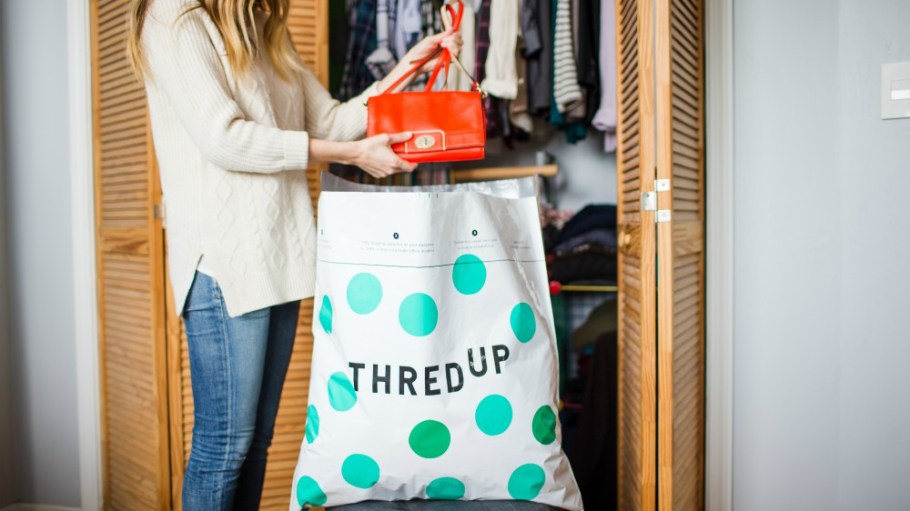
As the holidays creep up, some consumers plan to play secondhand Santa.
Data from ThredUp shows that 40 percent of shoppers’ holiday budgets will go toward purchasing secondhand gifts. That figure is 10 percentage points higher than the proportion of the dollars consumers spend on day-to-day secondhand purchases outside of holiday season.
To Alon Rotem, the resale platform’s chief strategy officer, that signals that resale is continuing its rise.
Related Stories
“Resale, especially in the holiday season and for gifting, is moving away from being an alternative thing, to really being a fundamental part of the holiday season,” Rotem told Sourcing Journal.
The company’s data shows that 62 percent of consumers said they rely on resale to save money while scoring stronger value, while 56 percent of shoppers said they think of secondhand as a way to “discover unique, one-of-a-kind items.”
The top category for secondhand gifts this year could be accessories; four in 10 consumers said they would consider giving a secondhand accessory, while 36 percent of consumers said they’re thinking about gifting women’s apparel.
Rotem said that, while dresses remain ThredUp’s overall best seller throughout the year, accessories find an interesting groove during the holiday season because of the eccentric touches they provide.
“[Accessories] tend to be one size fits all. They tend to be a little easier to personalize than clothing, which is a form-fitting thing, so it’s a little bit of a safer gift in some ways,” Rotem said. “There’s a lot of range with price on accessories, so you can get more for the same amount if you want to downsize your gift. And, with accessories, it’s a little easier to find a one-of-a-kind [item], because there’s just such a variety.”
ThredUp’s data shows that millennials are leading the charge on secondhand this holiday season. While 66 percent of all consumers said they would be open to giving secondhand gifts, 80 percent of millennials said the same thing. Meanwhile, Gen Z’s willingness to give secondhand items trailed behind the average—64 percent of Gen Zers said they would be willing to give secondhand items.
Rotem said part of that has to do with the trend cycle—he posited that while Gen Z often follows newer trends, millennials have a specific appreciation for items surfacing in resale right now, like 2000s wear and other, less trend-specific items.
He also noted that millennials—who are currently somewhere between 29 and 44 years old—have more financial savvy than many Gen Zers. That, he said, could lead millennials to spend differently than their younger counterparts.
“[Millennials] have had a little bit more life experience. They’ve been through the last recession and the financial downturn in 2008, so I think they’re…a little bit more financially mature and ready to make strategic trade-offs with how they spend their money,” Rotem said.
While about two-thirds of consumers said they would be willing to give secondhand products as gifts, more than two-thirds of shoppers said they would be excited to receive secondhand items. Rotem said that a major reason this mismatch continues to narrow is the loosening of stigma around secondhand.
“There are some people who are clinging to buying new because there’s more of an unwrapping or experience to it that they feel the recipient is going to appreciate, but I think that will change over time,” he said. “We’re working on helping consumers feel incredibly good, incredibly generous, incredibly smart, all of those positive qualities…[when] gifting used. The better job we do helping consumers see that reality, I think the more optimistic I am about secondhand over time.”