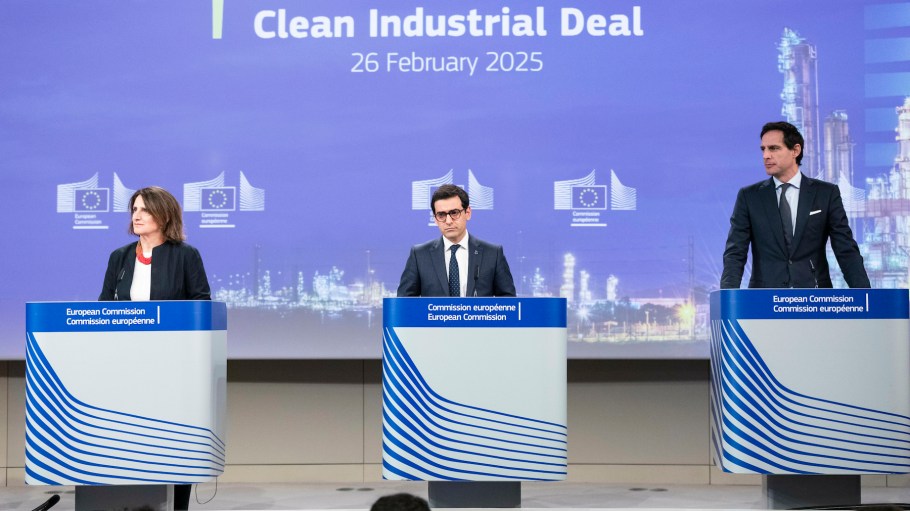
The European Commission proposed mobilizing nearly $110 billion (100 billion euros) for European Union-made clean manufacturing efforts in support of the Clean Industrial Deal (CID).
Championed by European Commission president Ursula von der Leyen, the landmark initiative would cut through the reported rep tape holding companies back from investing in green energy. Attempting to tackle the “fierce and often unfair” global competitiveness, the comprehensive strategy would accelerate decarbonization while securing Europe’s industrial edge.
Related Stories
“Europe is not only a continent of industrial innovation, but also a continent of industrial production. However, the demand for clean products has slowed down, and some investments have moved to other regions,” von der Leyen said. “We know that too many obstacles still stand in the way of our European companies from high energy prices to excessive regulatory burden. The Clean Industrial Deal is to cut the ties that still hold our companies back and make a clear business case for Europe.”
Notably, the comprehensive strategy explicitly links decarbonization with re-industrialization, framing sustainability as both economically and ecologically wise.
“This pact aims to position Europe as a world leader in clean industries—from boosting our production ‘made-in-Europe’ to beefing up regulatory and financial support to our most strategic industrial supply chains,” Stéphane Séjourné, executive vice president for prosperity and industrial strategy, said. “It also secures our unique European model of setting decarbonization not only as an environmental goal, but also as our economic growth strategy.”
The other main vein the CID would hit? The EU’s strategic independence. The initiative wants to position Europe as a global leader in clean industries, effectively driving internal economic growth and reducing reliance on external suppliers. Granted, this would require substantial investments made into clean technology as well as simplified regulatory frameworks. More strategically used public procurement to stimulate consumer demand for sustainable goods, too.
“Europe needs to be cleaner, more competitive and self-sufficient,” said Wopke Hoekstra, the European commissioner for climate, net zero and clean growth. “The Clean Industrial Deal is our business plan: a decarbonization strategy that re-industrializes Europe, driving competitiveness and boosting strategic independence. We’ve got a plan, and we’re putting it into action, starting today, to ensure a prosperous European future.”
That plan also includes positioning the EU as a circular economy world leader by 2030, as evident by the commission’s alleged adoption of a Circular Economy Act (CEA) in 2026. This would accelerate the circular transition, ensuring that “scarce materials are used and reused efficiently” while reducing Europe’s “global dependencies” and creating high-quality jobs to boot. The aim is to have 24 percent of materials circular by 2030, according to the European Commission.
While this act would theoretically do those things—which ultimately boil down to healing the planet and the economy—a few other things need to happen first.
Those things include lowering energy costs, boosting demand, securing funding and investment, promoting circularity, acting globally, and ensuring a skilled workforce—ultimately cutting red tape and effectively “exploiting the scale of the single market,” per the European Commission’s CID roadmap. That would require heavier lifts, such as streamlining the permitting processes for clean energy projects and harmonizing carbon accounting methodologies, among others.
“Today, Europe is making a bold business case for decarbonization as a driver of prosperity, growth and resilience. By committing to delivering on the Green Deal climate objectives, we are setting the stage for a sustainable future,” said Teresa Ribera, the European Commission’s executive vice president for clean, just and competitive transition. “Our plan provides the stability and confidence investors need—unlocking capital, expanding clean tech markets, making energy more accessible and ensuring a fair, competitive landscape where businesses can thrive. But it’s also about people. This strategy is designed to create jobs, develop skills, and open opportunities for all Europeans.”
Part of that, however, includes the loosening of sustainability reporting rules. The argument for doing so hinges on the symbiotic nature of the aforementioned twin decarbonization and re-industrialization perspective.
And though the CID aims to maintain the ambitions of the European Green Deal, critics are concerned with “unacceptable concessions to polluters” under the guise of competitiveness, arguing that striking a balance between environmental ambitions and economic competitiveness is not just a losing game—it’s rigged.
The European Environmental Bureau (EEB) expressed concerns that the deal includes “dirty concessions” to polluters and weakens the holistic approach of the Green Deal. The federation of environmental citizens’ groups across the EU broke down the pros and the cons (and the rest) in a statement released earlier today.
The good? It’s a strong tool for industrial decarbonization efforts as it “reinforces to key drivers for transforming energy-intensive industries: electrification with renewables, and circularity.” The bad? Limited in scope, the CID frames “productivity growth” as the only priority—while “treating energy-intensive industries as an exclusive club, deserving all EU political and financial support.”
“A ‘clean’ deal that ignores pollution is a contradiction,” the EEB continued. “The chemical industry escapes scrutiny, with no plans to detoxify, monitor or clean up its processes and sites. Europe must also prioritize zero-pollution and toxic-free manufacturing capacity.”
The rest? Oscillating between being either too nebulous or too narrow, the EEB called out the deal’s overarchingly excessively vague language and lackadaisical goalposts.
“EU policymakers seem increasingly detached from the triple planetary crisis we are facing,” Christian Schaible, head of zero pollution industry at the EEB, said. “The so-called ‘Clean’ Industry Deal focuses on decarbonization but overlooks broader pollution and environmental responsibility, failing to show how the EU can lead by example.”
Other nongovernmental organizations, globally, had similar reactions. While some see the CID as a simple balancing act, others are considering the vertigo. Zero Waste Europe, for one, argues that the CID falls woefully short of fully leveraging the potential the circular economy has for the much-needed economic transition.
“The Clean Industrial Deal sets a high-level framework that does not go far enough in unlocking the potential of the circular economy,” said Aline Maigret, head of policy at Zero Waste Europe. “Circularity measures, and the [CID] in particular, should serve as a guiding compass for transforming how we consume and produce, empowering communities, and building resilient economies through job creation in circular sectors. The impact of the CID will hinge on the details that emerge next.”
That said, the civil society organization saw significant public funding on the horizon: what Zero Waste Europe is taking as a good indication of transparency and inclusivity’s relevance.
“The Clean Industrial Dialogue on circularity is a welcome step—provided civil society has a seat at the table, and such a dialogue is expanded to all CID topics,” Maigret added.