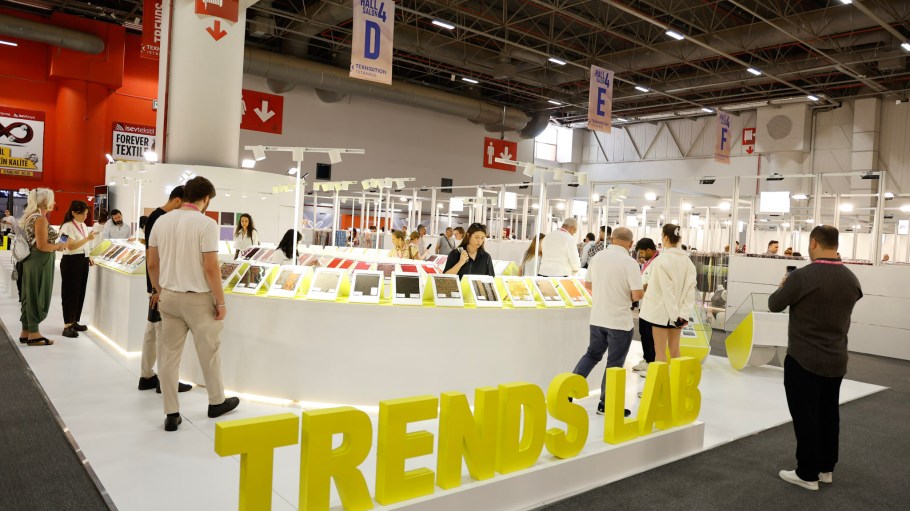
The eighth Texhibition in Istanbul, held from Sept. 10 to 12, may have been its most important edition yet. Bringing together more than 500 exhibitors and 25,000 industry professionals, the event pulsed with an unexpected energy and optimism, despite the tough years that have weighed heavily on Turkey’s economy.
The timing of the fair was significant. The country’s textile and apparel industry has faced a slowdown in exports, but expectations are shifting as Turkey positions itself to benefit from a favorable 15 percent U.S. tariff rate—considerably lower than that of most rival sourcing countries. Industry players were alert and expectant, even as costs at home remain high. The minimum wage in Turkey has risen by more than 150 percent in the past two years, and inflation, while easing, is still officially running in the mid-30s. Workers at the fair were quick to point out that the real rate often feels much higher. Still, there was a strong sense of resilience and cautious hope across the show floor at the region’s largest textile exhibition.
Related Stories
Launched in 2023, the biannual event has quickly taken on a steady rhythm. This year’s edition felt settled, with many familiar companies returning to compare notes with past shows. For larger players such as Kipaş Tekstil, attending was as much a statement of industry solidarity as it was about securing orders. For others from more distant regions, including Denizli and other provincial hubs, the focus was on expanding business. Many exhibitors said they were pleased with the number of inquiries and the high footfall.
Turkey holds a strong position in the global textile trade. It is the world’s fifth-largest textile exporter, the second-largest exporter of textiles to the European Union, and the third-largest apparel supplier to the bloc.
“We are offering more innovative and sustainable solutions that make production in Türkiye unique,” said Ahmet Öksüz, chairman of İTHİB, the Turkish Textile and Apparel Exporters’ Association. He noted that despite global headwinds—including supply chain disruptions, rising costs, and intensifying competition—Turkey’s textile and raw materials exports reached $7.6 billion in the first eight months of 2025. That was a 1.2 percent increase year-on-year, accounting for 4.3 percent of total national exports. Among growth markets, exports to Africa climbed 19.1 percent, while shipments to Asia jumped 26 percent.

“Our textile and apparel sector is expected to close this year with a production volume of over $80 billion. Sustainability is an important pillar for our exports, and one where targeted investments are being made,” Öksüz said.
Manufacturers were quick to underline the sector’s strengths: strategic location between Europe, Asia, and the Middle East; strong vertical integration that allows complete manufacturing solutions; shorter lead times; and high productivity. But there was also an undercurrent of unease. Many privately acknowledged the competitive threat posed by Egypt, where significantly lower wages and costs, combined with a free trade agreement with the U.S., make it hard to ignore. For now, however, Europe remains Turkey’s dominant market, and industry conversations are increasingly shaped by sustainability and innovation rather than by claims of any price advantage.
The displays of innovative materials at Texhibition reflected that shift.
Stalls showcasing new fibers, sustainable blends, and performance fabrics were crowded throughout the three days.
“Our focus has been on structural reforms, sustainability initiatives, and branding investments,” said Dr. Osman Gürsoy, secretary general of İTKİB. “The industry is poised for change, with a larger emphasis on new markets.”
Spread over 42,850 square meters and eight halls at the Istanbul Expo Centre, the exhibition exceeded expectations in terms of attendance. More than 25,000 visitors passed through, an increase of 6.7 percent over the March edition. Domestic visitors numbered 17,127, while international visitors rose nearly 17 percent from earlier in the year. Attendees from Europe made up the largest share at 34.9 percent, followed by the Middle East at 29.2 percent and Asia at 19.6 percent. Just 2.5 percent of visitors came from the U.S., underlining the still-limited presence of Turkish textiles in that market.
One of the busiest spaces was the Innovation Hub Area, curated by designers Arzu Kaprol and Filiz Tunca. Blending technology and fashion, it showcased garments that could emit fragrance or regulate body temperature. Kaprol’s red dress, designed for the Museum of Modern Art in New York for AmfAR’s 25th anniversary, stood at the center.
The fair also featured the Blue Black Denim Area, which debuted last season and returned with greater scale. Twenty-one leading Turkish denim manufacturers, including Bossa, İSKO, and Kipaş, presented their collections. The open, stylishly designed space buzzed with conversations on eco-friendly production and sustainable denim design. Another highlight was the ReValue Stock Hub, a platform for companies to market surplus materials while promoting sustainable solutions for excess stock through both physical and digital channels.
Sustainability was a recurring theme in conversations across the exhibition. “It is one of Türkiye’s strengths that we can design within 10 days and complete production within two weeks,” said Süleyman İpek, marketing manager at Palmiye Tekstil, which produces for Zara, Mango, and Bestseller. “We do this while investing in social change—reverse osmosis plants, solar panels, and textile-to-textile recycling. Sustainability is what differentiates us, even under the pressures of fast fashion timelines.” He acknowledged that rising costs continue to squeeze margins, but said most manufacturers were determined to remain rooted in Turkey. “In Türkiye we are used to solving problems,” he added with a smile.
Others agreed. “Everyone is asking for more sustainable products and that is the larger focus,” said Engin Emanet, Kıvanç. He pointed out that exports to the U.S. are often understated in official figures, since many shipments are routed through third countries. “Sometimes the documentation doesn’t tell the whole story. And textiles just cannot be dismissed as one huge category—it spans countless variations and formats.” He added that 2025 had been stronger for business than the previous year, though cost pressures remained.
Even niche segments reflected innovation. Erdem Kahveci, sales manager at Görenler in Denizli, said label and print technologies were being transformed by sustainability demands. “Everyone thinks labels are basic, but with new technology we can weave images directly into them with high washing resistance. Most label makers don’t yet have this capability. We’re excited about the change,” he said.
While industry discussions centered on sustainability and costs, trends still had their place. “For 2026, light mint and purple will be important, no shimmer, and double-face interlock is the most popular weave,” said Neylan Acar of Kasar, a third-generation company employing more than 1,400 people.
She admitted the past two years had been difficult, but remained optimistic. “We believe 2026 will be good for us. The U.S. market is very new for us, but we are in discussions. She captured the mood of many in the industry who were still hesitant to voice, adding: “Right now, our eyes are open.”