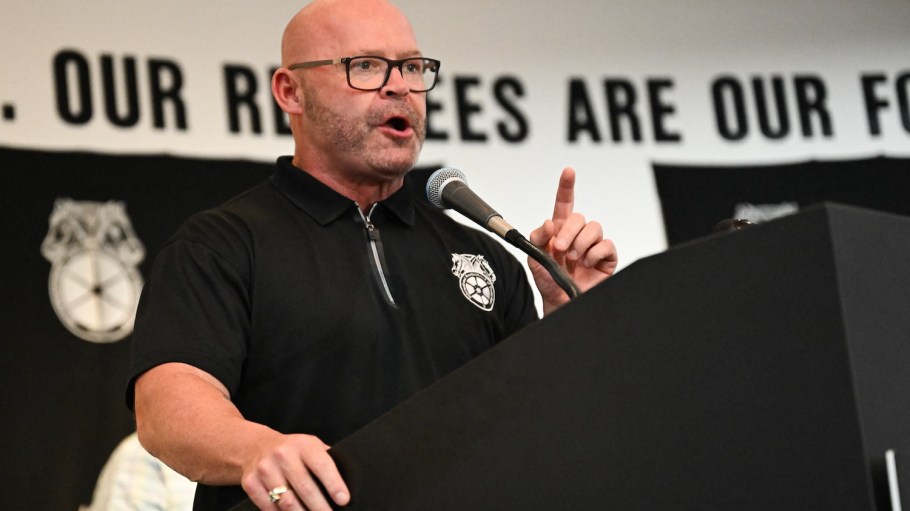
Sean O’Brien, general president for the International Brotherhood of the Teamsters, isn’t so sure that all the provisions outlined in President Donald Trump’s “one, big, beautiful bill” are quite so beautiful.
The Teamsters boss wrote to senators asking that they strike a moratorium on state artificial intelligence laws from the bill, which is currently under the Senate’s consideration.
O’Brien called the proposal “a disaster for communities and working people” and “an attempt to give special Congressionally-sanctioned treatment to a select few to the detriment of the American workers and the public.”
Related Stories
The provision O’Brien refers to in his letter, if passed, would place a 10-year moratorium on state and local AI legislation; that is to say, non-federal governments in the U.S. would be barred from enacting and enforcing laws related to AI, its risks or its further development.
Most U.S. states have, at the very least, seen some form of AI-related regulation proposed in their legislatures, but some, including New York, California, Colorado, Texas and others, have already enacted legislation related to the burgeoning technology.
To date, federal legislators have not approved sweeping AI-focused legislation, which marks a break from other global leaders’ policies. The European Union has enacted the EU AI Act, which regulates systems by risk. That in mind, if such a moratorium went into place, there would be a general lack of governance around AI systems in the United States. O’Brien addressed that hole in his letter.
“To date, Congress has not passed substantial legislation to govern the implementation of artificial intelligence,” he wrote. “In response, unions, community organizations, faith-based groups and others across the nation are working with state legislatures and localities in a bipartisan manner to address the dangers of unfettered AI deployment without oversight.”
The Teamsters have been vocal about their commitment to keeping a human in the loop with emerging technologies in the workforce. The union has already been active in supporting laws that center human labor, including a California bill that would prohibit autonomous vehicles (AVs) from delivering commercial goods without a human operator. This week, the Teamsters hosted a rally outside a hearing for the Massachusetts General Court Join Committee on Transportation, specifically demanding that lawmakers pass a bill that would require humans in AVs and requesting that they axe a Waymo-backed bill related to autonomous driving.
If state legislation goes by the wayside because of the moratorium in Republicans’ “big, beautiful bill,” it could kill momentum behind pro-worker legislation unfolding in many states. According to a social media post accompanying the full text of O’Brien’s letter, Teamsters harbor specific concerns about driverless trucks, AI-based surveillance and automation that revokes existing jobs.
O’Brien said that, if Republicans choose to throw their heft behind the bill without adaptations to the AI moratorium provision, it would show that their allegiance to Big Tech supersedes their commitment to the average American worker.
“If adopted, this provision extinguishes local control in favor of giving tech companies free reign to act without regard to the cost and impact on local communities,” O’Brien wrote. “Pure and simple, it is a give-away to Big Tech companies who reap economic value by continuing to operate in an unregulated void where their decisions and behavior are accountable to no one.”
The Teamsters aren’t the only union occupied with emerging technologies’ impact on the future of work. The International Longshoremen’s Association (ILA) found itself in a back-and-forth battle with the United States Maritime Alliance (USMX) over automation in its last contract negotiation. The ILA ceased talks with the USMX over concerns over technologies like rail-mounted gantry cranes, but the two entities ultimately rectified their disparities, agreeing upon a six-year contract that saw ILA boss Harold Daggett touting the contract as one that boasts “full protections against automation” for workers. That automation was a strong sticking point in the negotiations is likely representative of the fact that, nationally, unions are paying strong attention to the possibility for emerging technologies, including AI, to disrupt their standard work patterns.
Proponents of the moratorium have argued that the moratorium would ensure AI innovation is not stifled as the U.S. works to compete against other countries, like China, over development of the technology. Senator Ted Cruz (R-Texas) said that “having a patchwork of 50 different standards” would detract from the proliferation of AI in the U.S.
But not all Republicans are on board; some senators have actively spoken about their resistance to the moratorium. Senator Josh Hawley (R-Mo.) said he would propose an amendment to strike the moratorium from the current version of the bill if needed. That kind of action is exactly what O’Brien and the Teamsters seem to be hoping for. In his letter, the head Teamster urged legislators to act against the moratorium.
“On behalf of 1.3 million Teamsters, I strongly urge you to oppose this provision of the reconciliation bill. If the language is included in legislation on the [Senate] floor, I ask you to support an amendment to remove it,” he wrote to Senators.