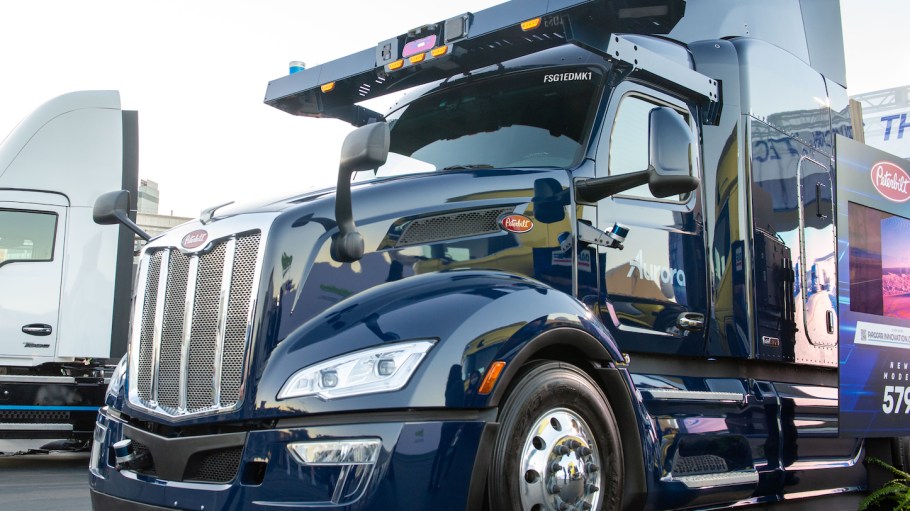
California Teamsters on Tuesday celebrated California Assembly Bill 33 (AB 33) clearing the state assembly’s Committee on Transportation; the proposed legislation would prohibit autonomous vehicles (AVs) without human operators “from delivering commercial goods directly to a residence or business for its use or retail sale.”
The union has backed the bill, noting that it believes it will safeguard working people’s jobs and urging lawmakers to support its passage. Peter Finn, Teamsters Western Region international vice president and president of Joint Council 7, said AB 33 clearing committee is an important start toward that goal.
Related Stories
“It’s obvious what’s driving the investment in AV technology—the desire to increase profits at the expense of public safety and middle-class careers,” Finn said in a statement. “Lawmakers have a duty to protect Californians from the chaotic instability that Big Tech unleashes on society, and the commonsense guardrails that AB 33 implements will go a long way toward fulfilling that obligation.”
But not every organization shares the Teamsters’ view on AVs; Chamber of Progress, a technology trade group, wrote last month to the Committee on Transportation in opposition of the bill, arguing that it would be likely to stymie innovation without good reason.
“By imposing restrictions like AB 33, California would be stifling progress and innovation at a time when we should be encouraging it. Instead of fostering an environment where emerging technologies can grow and evolve, the bill prematurely shuts down AV opportunities,” Robert Singleton, senior director of policy and public affairs, California and U.S. West, wrote in the letter.
Singleton further noted that many of the current use cases for AVs involve transporting goods between large fulfillment centers, warehouses or distribution centers, which, he contends, renders the bill “unnecessary,” given that many of the functions carried out by AVs today are not aimed at last-mile delivery to individual stores and consumers.
“The bill fails to address the industry’s current landscape, imposing unnecessary restrictions on technology that isn’t yet a significant part of the delivery process in California,” he wrote in March. “In short, by focusing on a technology not yet in widespread use, AB 33 attempts to address a problem that does not exist.”
Assemblywoman Cecilia Aguiar-Curry (D) introduced AB 33, which is not California’s first go-around on tightening legislation on AVs.
In 2023, California Governor Gavin Newsom vetoed California Assembly Bill 316, which would have required a human safety operator to ride in any autonomous vehicle exceeding 10,000 pounds on public roads. The state had already required safety drivers, but the bill would have made those operators permanent fixtures in the trucks, effectively banning massive autonomous trucks in the state.
Upon vetoing the bill, Newsom called the regulation “unnecessary for the regulation and oversight of heavy-duty autonomous vehicle (AV) technology in California,” noting that “existing law provides sufficient authority to create the appropriate regulatory framework.”
At the time, Aguiar-Curry, who co-introduced AB 316, said she was “deeply disappointed” by the governor’s decision and noted, “I respectfully disagree with [Newsom’s] decision, but hope that we will have a truly meaningful process to protect the public and working people going forward.”
Since then, issues over artificial intelligence and automation have become more popular topics of conversation among workers and unions.
Automation was a key sticking point in negotiations to avert a strike between the International Longshoremen’s Association (ILA) and the U.S. Maritime Alliance (USMX). The two eventually came to an agreement that saw Harold Daggett, ILA president, saying the contract offers “full protections against automation.”
The Teamsters’ support of the bill appears to be another indication that AI and automation remain important issues unions are prepared to act and speak on—whether in contracts or with regard to emerging legislation slated to protect workers’ tenure.
And though the bill’s fate remains to be seen, January data from Tulchin Research, cited by the Teamsters, showed that more than half of Californians indicated that they are “very concerned” about job replacement because of AI and automation.
The same data showed that nearly eight in 10 Californians support legislation requiring human drivers in delivery AVs. Chris Griswold, Teamsters International vice president at-large and president of Joint Council 42, said legislators should concern themselves with constituents’ interests.
“Silicon Valley might not be concerned with the fate of millions of people who could lose jobs to automation, but everyone else is,” Griswold said in a statement. “AV regulation is popular because people understand the risks. This is essential to protecting jobs and preventing billionaires from steamrolling an entire workforce in its reckless push for profit.”