Artificial intelligence in the retail industry remains a moving target—and many retailers and brands have started inking partnerships with technology companies to keep up. Target‘s newly announced, AI-based shopping experience inside the ChatGPT platform is no exception to that trend.
The retailer revealed Wednesday that it has partnered with OpenAI to give users a new kind of shopping experience inside the technology company’s publicly facing large-language model, ChatGPT.
Related Stories
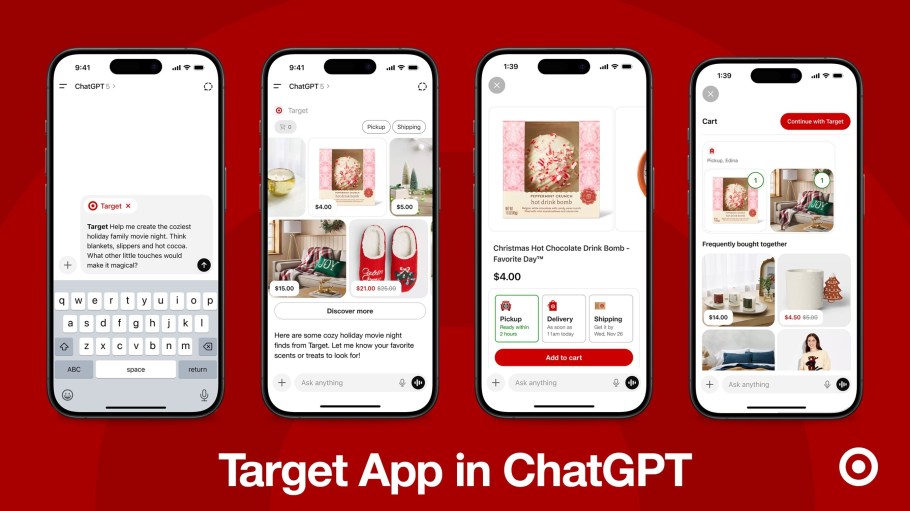
Target will integrate its new app into OpenAI’s platform, allowing users not just to discover or purchase single items, but to go through the entire shopping experience, just as they might on Target’s own site or app.
Target said consumers will be able to “tag” Target on ChatGPT, then ask it to carry out tasks, like, “help me find cute matching holiday pajamas for my family.” From there, the Target app, embedded into ChatGPT, will return product options that suit the user’s initial query. The consumer can flick through those options, refine their request and ultimately, add multiple items to their cart and purchase them. Target said several of its fulfillment options, including same-day pickup or shipping, will be available when consumers make a purchase.
That consumers can purchase multiple items at once could be a turning point for consumers using LLMs to shop. Up until now, consumers purchasing goods from retail partners that have signed on for ChatGPT’s Instant Checkout function have only been able to buy one item at a time. Those brands and retailers include superstore giant Walmart, online marketplace Etsy and a variety of Shopify merchants. Notably, e-tail giant Amazon has opted not to partner with OpenAI or a competitor on LLM-based yet, and is actively engaged in a lawsuit against Perplexity over agentic commerce.
Target and OpenAI working together to facilitate a multi-item basket could be somewhat of a turning point for shoppers to solve more complex problems with ease. For example, rather than asking ChatGPT to, “help me find a festive top to wear for a party,” users could ask it to, “help me find a top to wear for a holiday party I’m hosting, and show me decorations I can buy.”
The companies plan to launch the experience in beta next week, though they did not disclose a particular date for the rollout, nor did they state whether it would be available to all ChatGPT users simultaneously.
Still, the launch’s timing—right around the Black Friday Cyber Monday (BFCM) weekend rush—could bode well for the retailer, which announced in its earnings this week that it saw a profit decline for Q3 year on year and cut its guidance.
Target announced last week that it has also added AI-enabled gifting features to its own app, including a tool it calls Target Gift Finder and a tool that imports and helps check off a handwritten shopping list.
Salesforce has projected that more than one-third of retailers will bolster their holiday shopping experiences with agentic AI, and noted that it expects 21 percent of all site traffic to come from agent-based shopping this holiday season.
Prat Vemana, executive vice president and chief information and product officer at Target, said the technology upgrade is meant to bring a personalized touch to the digital-first experience for consumers.
“At Target, everything starts with the guest, and that means meeting them wherever they are, including emerging spaces like ChatGPT, where millions of consumers visit,” Vemana said in a statement.”We’re proud to be one of the first retailers bringing shopping into this new channel, partnering with OpenAI to make discovery through the Target app in ChatGPT as easy and joyful as browsing our aisles. Our goal is simple: make every interaction feel as natural, helpful and inspiring as chatting with a friend.”
Target already had an existing relationship with OpenAI. Internal teams have been leveraging ChatGPT enterprise, equipped with organizational data and proprietary information to “increase speed, simplify workflows and create more space for creativity.”
Fidji Simo, CEO of applications at OpenAI, said the company looks forward to supporting Target as it leverages both internal use cases for AI and consumer-facing upgrades to its technology.
“A big part of the AI transformation is happening inside enterprises, and Target is a great example of what that shift looks like when it’s done with ambition and speed,” Simo said in a statement. “We’re excited to work with Target as they weave intelligence throughout their business to create useful and joyful experiences for their customers and their employees.”