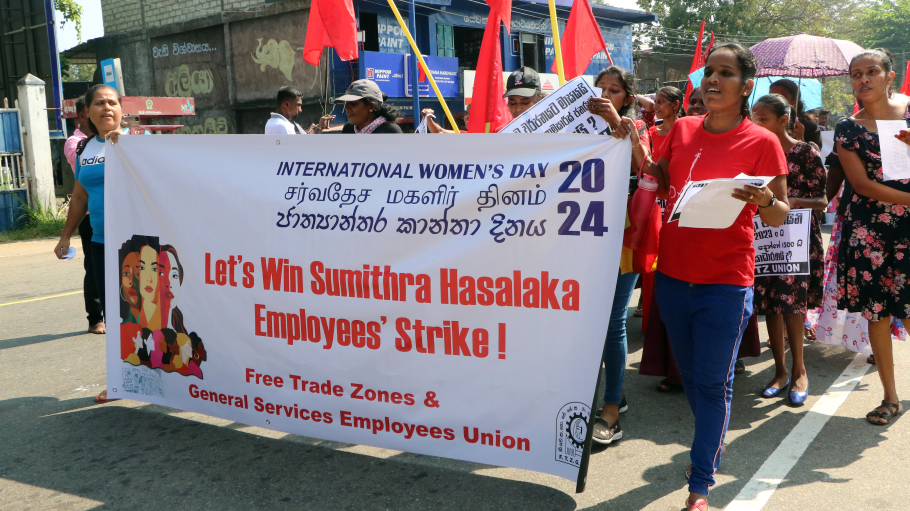
One month after workers started to protest outside a the Sumithra Group factory at Hasalaka, their calls for support were amplified as more than 200 workers from different areas raised their voices in a belated women’s day meeting of unity.
The factory at Hasalaka is an approximate 125 miles from the capital city of Colombo.
“It was fierce and passionate,” Anton Marcus, joint secretary Free Trade Zone and General Services Employees Union (FTZ&GSEU) told Sourcing Journal, talking how the workers shouted slogans and expressed their outrage.
Related Stories
The Sumithra Group, which has four factories in Sri Lanka, manufactures for brands like Asda, Superdry and Dillards.
Anton said that union members were physically assaulted on Feb. 9 and forcefully prevented from attending a union meeting scheduled that day. “Management physically assaulted some of them, including the branch union office bearers, severely injuring one woman worker, while forcefully taking them inside the factory to make them sign resignation letters. Union members were forced to file a police complaint,” he said.
The matter was taken up by the global arm of the union.
“It is completely unacceptable to use violence against workers who are merely exercising their fundamental rights. IndustriALL Global Union is calling on Sumithra Group to immediately address the acts of violence and negotiate with the union in good faith,” said Atle Høie, general secretary IndustriALL.
Not all the workers at the factory joined the strike. More than 132 stopped work during the first day according to the factory management, with 388 workers still continuing to work. Mostly machine operators and technicians were on strike, but production continued.
The factory management denied the charge of a physical assault on workers.
In a letter in response to these allegations to IndustriALL, the company noted: “It is stressed that the acts of intimidation, aggression, incitement and violence were initiated by a handful of union employees who physically obstructed the staff buses from entering the company gate. Though they were requested to do so, they did not step aside and instead engaged in an altercation with one executive,” the company stated, stressing the “zero tolerance policy for violence of any kind.”
The company told Sourcing Journal that the workers meeting was called during a production deadline, at 3.30 on a working day, and that the unionized workers tried to prevent non striking workers from entering the factory the next day.
Although the strike began because of a disagreement over an increase in salary, issues are adding up on both sides.
“In January 2024 we announced an increase of 1,500 Sri Lankan rupees ($4.90) a month, and an attendance bonus of 1,000 Sri Lankan rupees ($3.27)—so a gross increase of 2,500 rupees ($8.17),” Maithri Bandaranaike, head of human resources at Sumithra Group said. “The situation has been dire for the company, and for many months of 2023 with the shortage of orders we manufactured for the local market, it was hardly enough to cover costs. Many factories were unable to give any increases at all,” he said, adding that that despite the inflationary pressures and skyrocketing power and electricity prices faced by the company, workers were given an economic enhancement package of bonus of 6,250 Sri Lankan rupees ($20.44) to be made in three stages, with the final one of 3,000 rupees ($9.81) starting from October 2022.
Marcus explained that apparel industry employees have become among the most vulnerable in the wake of the economic crisis.
“The industries were hit hard—but the ultimate burden was on the shoulders of the employees at the ground level. Also, the new value-added tax impacts the ground-level employees the most, not the business class which is around 20 percent of the population. Also, even when the industry was doing well there was nothing shared with the employees. Even when the dollar depreciated, there were gains from the companies that were not shared with the employees who had to work hard for a low income while paying 400 percent because of inflation with the lowest wages in the South Asian region,” he said.
Many of the issues need attention, Marcus observed.
“While the company is offering an attendance bonus, a worker who is absent even one or two days loses that attendance bonus. Even if workers are sick, they lose the bonus, so they show up for work. There are other production incentives for additional income, but the company fixes the targets. Sometimes workers only get 30 minutes for their lunch, but they eat within 10 minutes to get back to work. One female worker complained they don’t drink water so they don’t have to go to the toilet. All these things result in health problems,” he said.
“We are not going to give in to that pressure, it’s a bad precedent. Every time they feel like going on strike they get pay; it’s unfair for those working who have been harassed verbally and mentally, so we are clear and certain that our company is not going to pay the strikers,” Bandaranaike added.
The salary scale of the workers at the factory is well above the minimum wage of 16,500 rupees, approximately $52, he said.
“There are many issues in our part of the world,” he said. “I’m not saying Sumithra is perfect, but there is a mechanism in place.”
Both sides claim to have videos, which they are open to share. The factory management said that they welcome an independent investigation.
After several efforts at negotiation, one at the area district level labor office and another in Colombo, the matter appears to be moving toward arbitration. “Arbitration is not our first option—our first option is settlement, but if the management is reluctant to settle this matter through negotiation we will continue the strike,” said Marcus.