As U.S. trade policy shifts reshape sourcing strategies, apparel companies are facing a new kind of visibility challenge, one that goes far beyond tracking shipments.
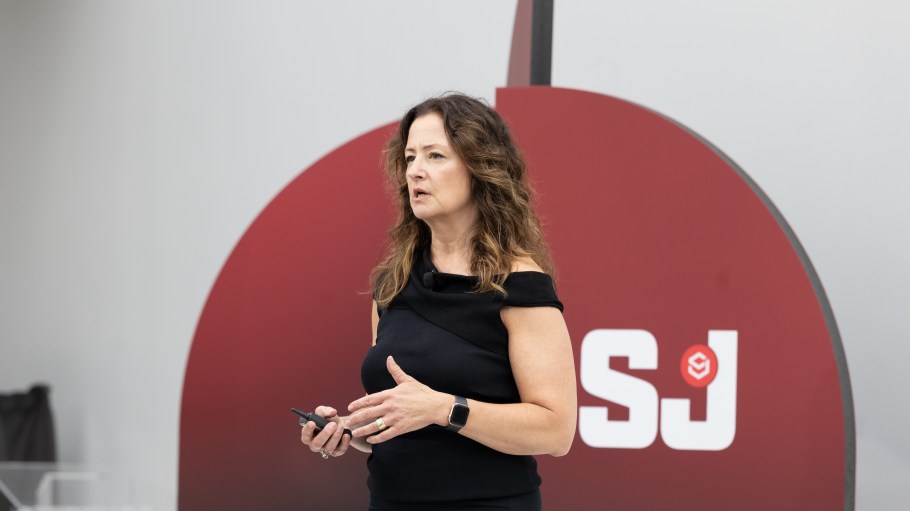
Speaking at Sourcing Journal’s annual Fall Summit, Heidi Benko, vice president of product management and strategy at Infor, said that global supply chains are now at an “unprecedented inflection point,” driven by overlapping pressures: geopolitical volatility, evolving ESG regulations and the accelerating role of artificial intelligence.
Related Stories
“We can no longer do everything the way we’ve always been doing it—we have to change,” Benko said. “It’s no longer just about knowing where my shipment is and when it will arrive. Now it’s about where and how something was made, proving that, and having a full audit trail.”
From tracking to orchestrating
Benko argued that traditional supply chain management models—often built around linear, point-to-point connections—are quickly becoming obsolete. New laws such as the Uyghur Forced Labor Prevention Act (UFLPA), along with the European Union’s introduction of digital product passports, are pushing brands to map and validate multiple tiers of their supplier base, she said.
“You need multi-tier visibility in order to achieve compliance,” she said, adding that the same data is increasingly demanded by consumers who want to know the provenance of their products. That need for deeper traceability has added enormous complexity to global networks.
“About 80 percent of all the data and processes you have in managing supply chains sit outside your own systems,” Benko noted. “In some of our more complex networks we monitor, the rate of change can be 50 times per second. Human coordination alone just can’t work anymore.”
For decades, supply chain decisions were driven by a simple tradeoff: cost versus service. Today, Benko said, sustainability is the third factor reshaping that equation. “Now it’s cost versus service versus sustainability, and that changes everything,” she said.
Many apparel companies, however, still rely on disconnected systems to manage different compliance, logistics and supplier engagement functions.
“Point-to-point connections can’t scale,” Benko warned. “We’re always breaking down silos. We see companies that use one system fo managing supplier ESG surveys and traceability, another for shipment visibility and yet another for trade compliance…That’s room for inefficiencies, that creates errors and then delays in supply chains.”

Benko called for a shift toward unified network platforms that connect all trading partners—from raw material providers to finished goods manufacturers—on a single system. By entering and validating data once, companies can achieve end-to-end visibility while enabling real-time collaboration across tiers.
These platforms could integrate supplier management, transportation, compliance and even payments, Benko said, incentivizing more stakeholders to participate—a critical factor in achieving visibility beyond Tier 1.
“When all the parties are connected on one network, it makes achieving transparency and traceability tremendously easier,” Benko said.
To illustrate what multi-tier traceability looks like in practice, Benko walked through the Infor platform showcasing how product information is tied to one “digital product identity.” With the scan of a QR code, the platform brings up a full traceability record showing the material’s journey and verification details across all tiers of the supply chain.
For example, for a T-shirt made from raw cotton, the digital product identity will include data captured throughout the ginning, spinning, weaving and manufacturing processes. This includes the origin materials down to the yarn, as well as the facilities the product has passed through.
“Regulations are requiring this data now,” Benko said. “Now you have a full picture of your supply chain to make better decisions.”
The same data, she added, allows companies to make better sourcing decisions, identify potential risks and demonstrate compliance in a rapidly changing trade environment.
“This isn’t theoretical. This is where supply chains are going,” Benko said.