Artificial intelligence has the capacity to transform the way the fashion industry operates, but brands should be aware of the technology’s wide-ranging capabilities—as well as its liabilities—before they integrate it into their business practices.
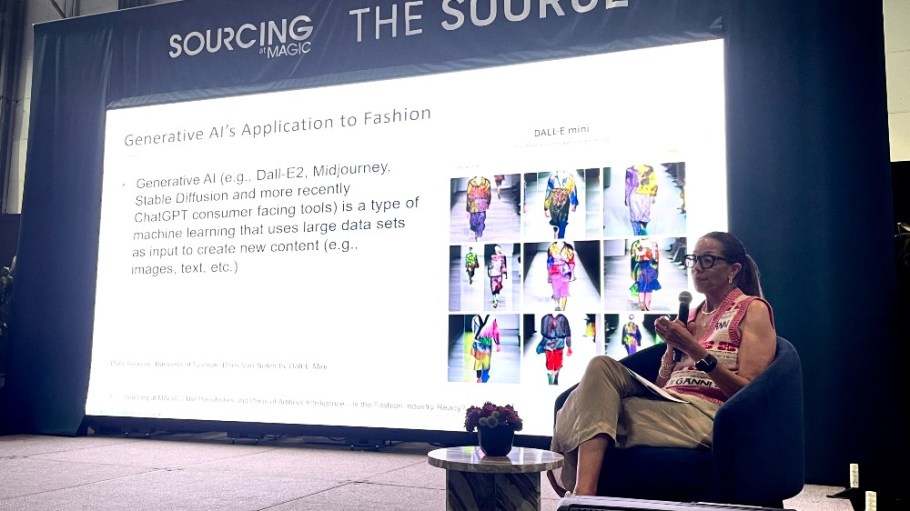
That’s according to Gina Biddy, global head of fashion technology for Withersworldwide, LLP. The intellectual property attorney spoke to an audience at the Sourcing at Magic trade show on Tuesday about how the industry is leveraging AI and machine learning to automate processes from copywriting to virtual try-on and personal shopping.
Related Stories
The fashion sector is increasingly exploring use cases for generative AI—a type of artificial intelligence “that takes very large data sets as input to create new content,” Biddy said. “You can create text, you can create images, you can create videos.” Levi’s recently unveiled AI-generated apparel models on its e-commerce site, noting that they will supplement, not replace, their human counterparts. Similar digital renderings could also be used for 3D product design and fashion show production, the attorney added.
Marc Jacobs utilized OpenAI’s ChatGPT to produce a script for its fall 2024 runway show, and Valentino implemented AI tech to fuel its on-site chatbot. Luxury firm Kering has deployed AI-based personal shoppers, and plenty of brands and retailers are using AI tools to help consumers find their perfect fit when shopping online.
The technology is able to perform the way it does because of its capacity to take in vast amounts of web-based information, synthesizing it to develop new content. The possibilities for AI are limitless, Biddy said, but brands should exercise caution before letting it run amok. “If you’re training your AI algorithm on someone else’s designs or someone else’s photographs, and that input is copyright protected, you’re running the risk of being sued for whatever comes out of the back end of your AI algorithm,” she said. Meanwhile, content of any kind generated using AI can’t be copyrighted, according to a recent ruling from the U.S. Copyright Office.
“The thing about technology is that it moves much more quickly than the law moves,” she added. “So we as lawyers and Congress and similar legislative bodies who enact laws are trying to play catch up.”
Copyright infringement and data privacy infringement should be top concerns for brands and retailers who plan to leverage AI now or in the future. “If you’re training your AI algorithms based on your customer data, and there’s personal information in that data, you have to be very careful about what you’re using,” Biddy said. Enterprises must also exercise prudence when it comes to sharing that data with third parties for processing, and storing consumer insights for future use.
All of these actions could touch upon consumer privacy landmines. In the U.S., these laws vary by state, meaning that an e-commerce brand leveraging data from shoppers across the country could easily find itself in violation if it treats its data set as a monolith. If a company is found to have infringed upon consumers’ privacy in a state like California, which has expanded its data privacy laws, it risks incurring hefty fines. “Nobody wants to deal with attorneys because we’re expensive, but I will tell you that it is a lot less expensive and a lot easier if you consult an attorney from the very beginning,” she said. “When we have to pull you out of a ditch, it’s really going to be expensive and painful.”
Companies have also entered an era where they need to actively fend off infringement upon their own IP. Biddy pointed to Hermes’ now viral case against Mason Rothschild, the creator of the MetaBirkin NFT collection of Birkin handbag-inspired digital artworks, which sold for tens of thousands of dollars each. “That case was about NFT’s, but there are some lessons to be learned,” she said. Ultimately, Rothschild was found to have infringed upon the French fashion house’s trade dress agreement for recreating the Birkin in 2D for his own commercial gain.
“The court held that the artist had violated Hermes’ trademark and trade dress rights, and what the case really turned on was the fact that it wasn’t so much an artistic endeavor as it was a commercial endeavor,” Biddy said. The decision handed down was that “you cannot exploit the intellectual property rights of a another without their permission for a mostly commercial endeavor.” Similar situations could occur when companies use generative AI to create images, video and text for marketing campaigns or develop product designs based on content available online which could be subject to copyright.
“If you’re pulling photographic images or other imagery from the web like clothing designs, and you’re feeding that information into an AI algorithm, based on what we know today, you’re not going to be able to protect it,” the attorney added. “And on top of that, you might get yourself in the crosshairs of that intellectual property infringement suit.”
Legislation surrounding AI-generated content could change, and perhaps in the near future. “I think that’s going to evolve over time, I think as lawmakers and the lawyers who interpret these laws catch up to the technology,” Biddy said.