Danish fashion group Bestseller’s sustainable innovation and investment platform Invest FWD is putting financial support behind automated garment manufacturing.
Bestseller led a $20 million Series B1 funding round for autonomous sewing technology firm SoftWear Automation, joining existing investors including CTW Venture Partners, SRI Capital and MacDonald Ventures. With this investment, Bestseller has taken a minority share in SoftWear Automation and the group’s chief financial officer Thomas Borglum Jensen will join the Atlanta-based company’s board.
Related Stories
“This partnership with Bestseller and the support from Invest FWD are not just a vote of confidence in our technology—they are a powerful catalyst for the future of on-demand, localized and more sustainable apparel manufacturing,” said Palaniswamy “Raj” Rajan, chairman and CEO of SoftWear Automation.
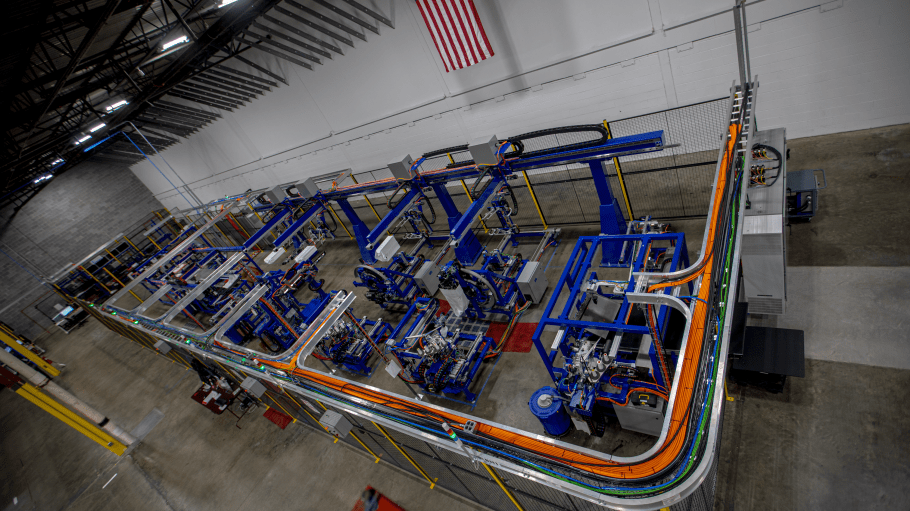
Founded in 2012, SoftWear Automation wants to “revolutionize sewn goods manufacturing” with its automated sewing machines, which it calls Sewbots. The patented technology arms robots with cameras and sensors, allowing them to adjust material as it moves through the sewing head, similarly to how a human tailor would manipulate textiles. SoftWear Automation has been able to fully automate T-shirt construction.
By swapping human sewers for robots, SoftWear Automation sees the potential for more on-demand, nearby manufacturing that would shorten production times, reduce waste and trim costs.
The company is wrapping up research and development on the third generation of its T-shirt Sewbot worklines, which it expects to be commercially available in the first half of 2026. “As we get close to commercializing our Sewbot technology for making apparel, having a partner like Bestseller is not just validation for our technology, but also tees up for rapid scale up, because this opens up the door for multiple partnerships with folks like Bestseller,” Rajan told Sourcing Journal.
In addition to reaching commercialization on its T-shirt lines, SoftWear Automation plans to use this latest investment round to fund further research and development. Among the product categories it is working toward in the “next few years” are polos, trousers, cargo pants and jeans. The capital will also support geographic expansion. Currently, the company is focused on North and Central America, and it is eyeing Europe next.
“We started this journey to transform the industry, and it’s a huge challenge, and we’ve been persistent and dogged at getting this work done,” said Rajan. “We…expect to continue making the difference as we expand into additional product categories and regions.”

As Invest FWD is considering investments, it aims to support solutions that will benefit the entire industry. “At Bestseller, we look for innovations that can support progress within the fashion industry, where change is needed,” said Bestseller’s Jensen. “SoftWear Automation is helping address some of the key challenges we face across the industry—from speed and flexibility to lowering environmental impact. We’re pleased to support their development and explore how this technology can help us move forward.”
Invest FWD has previously put financial support toward innovations including Ambercycle’s Cycora regenerated polyester and circular cellulose carbamate producer Infinited Fiber. The investment arm of the group—which includes brands like Jack & Jones and Vero Moda—focuses on financing solutions around pillars such as lower impact materials, supply chain technologies, new business models, women’s empowerment and renewable energy. To date, Invest FWD has invested more than 200 million Danish krones, equivalent to roughly $31 million at current exchange.
“When it comes to transforming the fashion industry, it is necessary with a diversified focus,” said Dorte Rye Olsen, head of sustainability at Bestseller. “The fashion industry is still linear, so it is crucial for us to also invest in innovative recycling technologies that can transform the clothes we wear today into new garments for the next generation. We have been doing this for several years, and we will intensify these efforts going forward.”